
Most new owners end up buying the same kit twice. The best daily essentials for puppy care aren't the cute ones on the end-cap display. They're the boring, hard-wearing bits you'll touch every morning for the next twelve to fifteen years.
Bowls, a crate, a lead, a brush, and a bottle of enzymatic cleaner.
Our research into first-year ownership costs puts a realistic set-up between £1,200 and £3,000 (roughly $1,500 to $4,000). A big slice of that is gear replaced within three months because it was sized for an eight-week-old instead of a full-grown dog. One crate with a divider panel fixes that in a single purchase.
Here's exactly where the money leaks, and what to buy instead.
Quick Answer
The best daily essentials for puppy care are simple and few. Buy an adult-size crate with a divider panel. Choose stainless steel bowls and an AAFCO growth-formula puppy food.
Add a Y-front harness, a 6 ft lead, and rubber chews. Keep a slicker brush and enzymatic cleaner in daily reach.
The £2,000 Puppy Kit Most People Buy Twice

Walk into any pet shop with a new puppy on the way and you'll be sold a bundle. Small crate, plastic bowls, a fleece bed, a squeaky plush, a starter bag of food. Within eight weeks, most of that is destroyed, outgrown, or quietly binned.
The problem isn't carelessness. Puppies change size faster than almost any other pet you'll own. A Labrador puppy weighing 4 kg at eight weeks can hit 20 kg by six months.
Where the money actually leaks in year one
Aggregate reviews and returns data point to the same handful of repeat purchases every time.
| Item | Why it gets replaced | Cost of the mistake |
|---|---|---|
| Crate (puppy-sized) | Outgrown by 4 to 6 months | £40 to £80 wasted |
| Harness (non-adjustable) | Girth outgrown in 6 to 10 weeks | £15 to £40 per replacement |
| Plastic bowls | Chewed, scratched, harbouring bacteria | £10 plus a vet visit for chin acne |
| Soft plush bed | Destroyed during teething | £25 to £60 |
| Rope toys | Fibres shed, ingestion risk | £8 plus potential surgery |
| Retractable lead | Rehomed once pulling starts | £20 to £35 |
Note the pattern. Nearly every one is a sizing or durability mistake, not a taste mistake.
The buy-once test worth applying to every item
Before anything goes in the basket, run it through four questions. If it fails two or more, put it back.
- Will it still fit a fully grown dog? Crates, harnesses, collars and gates should all be bought at or adjustable to adult size.
- Can it survive a teething mouth? Between roughly 12 and 24 weeks, everything within reach gets chewed. Rubber, stainless steel and tough-weave fabric survive. Foam, thin plastic and plush usually don't.
- Does it go in the washing machine or dishwasher? Puppy gear gets covered in mud, wee and drool weekly. If you can't wash it at 60°C or run it through a dishwasher, it becomes a smell problem fast.
- Is it used every single day? Poo bags, chews and bowls earn their place. A raincoat and a car booster seat can wait until you know the dog.
The one honest exception is the bed. Skip a proper orthopaedic bed for the first few months and use a cheap washable vet bed fleece instead. It drains fluid, dries quickly, and you won't grieve when it gets shredded.
Crates, Pens and Gates: Wire vs Plastic vs Fabric
Containment is the first thing you'll set up and the last thing you'll stop using. A crate isn't a cage if it's introduced properly. It's a den, a toilet-training tool, and later on it's how you keep a dog on cage rest after surgery without losing your mind.
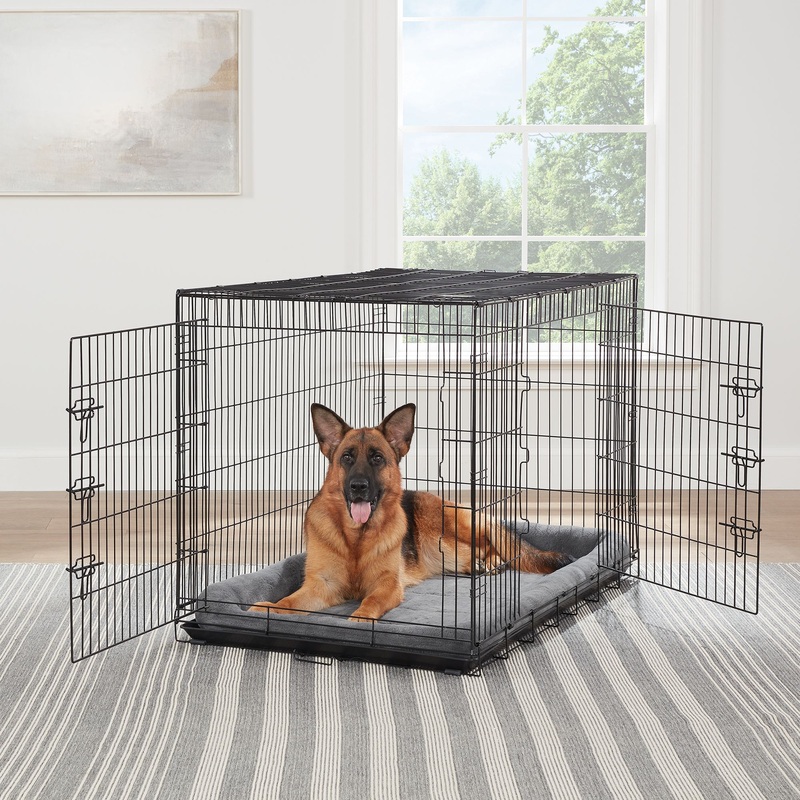
Why you buy the adult-size crate with a divider
Here's the logic that saves most people £60. Puppies won't usually soil where they sleep, so a crate that's too big lets them wee in one corner and nap in the other. That's why everyone tells you to buy small.
A divider panel does the same job. It's a wire or plastic partition that slots in and shrinks the usable space. You slide it back every few weeks as the puppy grows, and you've bought one crate instead of three.
Look for these features on a wire crate:
- Double door (front and side), so the crate works in more room layouts
- Slide-bolt latches rather than flimsy clip catches
- Removable plastic tray for easy cleaning, or a metal pan if your puppy chews plastic
- Included divider panel, not sold separately
- Foldable frame with a carry handle for car travel and holidays
Manufacturer specifications from the main crate brands are consistent on sizing. Measure your dog's expected adult length from nose to base of tail, then add 5 to 10 cm. Height should be standing head height plus about 5 cm.
Crate sizing by adult weight
| Crate size | Adult weight | Typical breeds |
|---|---|---|
| 24 in | Under 11 kg | Chihuahua, Yorkie, Dachshund, Pomeranian |
| 30 in | 11 to 18 kg | Cocker Spaniel, Beagle, Mini Poodle |
| 36 in | 18 to 29 kg | Border Collie, Springer, Staffie |
| 42 in | 29 to 41 kg | Labrador, Golden Retriever, GSD |
| 48 in | 41 kg and over | Great Dane, Bernese, Rottweiler, Mastiff |
If your puppy is a crossbreed and you're guessing, size up. An oversized crate with a divider is recoverable. An undersized one isn't.
Wire vs plastic vs fabric: who each one suits
Wire crate. Best all-rounder for home use. Great airflow, folds flat, easy to cover with a blanket for a den feel. Downside is weight and the clanging noise a restless puppy makes at 3am.
Plastic (airline-style) crate. Best for enclosed, den-like security and for dogs who settle better with solid walls. Also the go-to for air travel. Poorer ventilation and harder to clean around the seams.
Fabric crate. Not suitable for a puppy. Zips and mesh last about one determined chewing session. Save it for a trained adult dog at a show or campsite.
When a playpen beats a crate, and when you need both
If you're out for more than a couple of hours, a crate alone is too restrictive. A puppy exercise pen (often called an X-pen) gives a safe zone with room for a bed, water, toys and a pad area.
The practical set-up is this. Crate for sleeping and short settles. Pen for longer unsupervised stretches.
Baby gates to shut off stairs, kitchens and hallways.
- Pen panel height: 24 in for toy breeds, 30 to 36 in for medium, 42 in for anything that jumps
- Pressure-mounted gates suit doorways and rentals, but they aren't safe at the top of stairs
- Hardware-mounted gates screw into the frame and are the only sensible choice for stairs
- Walk-through gates save you stepping over twenty times a day
Put the crate in a family room, not an isolated utility room. Puppies separated from all human contact overnight cry more, settle slower, and crate training takes weeks longer.
Bowls and Feeding Gear: Stainless Steel vs Ceramic vs Plastic
This is the cheapest decision in the whole kit and one of the easiest to get wrong. Two bowls cost under £20 done properly. Done badly, they cause a vet visit.
The plastic bowl problem
Plastic bowls scratch. Puppies chew the rims and drag them around, and every scratch becomes a groove that holds bacteria and food residue through normal washing.
That bacterial load sitting against the chin is a known trigger for canine chin acne and contact dermatitis. Vets see it most often in short-coated breeds. The fix is usually as simple as swapping the bowl.
Plastic also gets destroyed. A bored puppy will happily chew a plastic bowl into swallowable shards.
What to choose instead
| Bowl type | Hygiene | Durability | Best for |
|---|---|---|---|
| Stainless steel (304 / 18-8) | Excellent, non-porous | Effectively indestructible | Almost every puppy |
| Ceramic (lead-free glaze) | Excellent while unchipped | Chips and cracks if dropped | Heavy bowl for tippers |
| Silicone (travel) | Good | Moderate, chewable | Car and walks only |
| Plastic | Poor once scratched | Low | Avoid for daily feeding |
Go for stainless steel with a non-slip rubber base ring. Look for 304 or 18-8 grade, which is food-grade and dishwasher safe. A pair sized around 700 ml suits most medium breeds, with 350 ml for toys and 1.4 L for giants.
If you use ceramic, check the glaze is certified lead-free and cadmium-free. Retire the bowl the moment it chips, because a chipped glaze exposes porous clay underneath.
Standard bowl vs slow feeder vs snuffle mat vs puzzle feeder
A plain bowl is fine for a puppy who eats at a sensible pace. Plenty don't.
- Slow feeder bowl. Moulded ridges force the dog to work food out. Best for gulpers and deep-chested breeds. Check the ridge depth suits your puppy's muzzle length, since flat-faced breeds struggle with deep, narrow patterns.
- Snuffle mat. Fabric strips hide kibble and turn a meal into a sniffing job. Burns mental energy without loading growing joints. Machine washable ones are worth the extra few pounds.
- Lick mat. Textured silicone smeared with wet food or plain yoghurt, then frozen. Brilliant for settling a puppy during nail trims or a first grooming session.
- Puzzle feeder. Sliding and lifting compartments. Save these for 12 weeks and up, once the puppy has the coordination to succeed rather than get frustrated.
Aggregate owner feedback is consistent on one point. Scatter feeding and snuffle mats do more to settle an overtired puppy than another walk does.
Do puppies need an elevated feeder?
Most don't. Raised bowls are usually recommended for older dogs with mobility or oesophageal issues, and the evidence around bloat prevention in large breeds is mixed. A standard floor bowl is fine for a healthy puppy.
The exception is a giant-breed puppy who has to splay awkwardly to reach the floor, or a dog with a diagnosed condition where a vet has specifically advised it.
Food storage that actually works
Kibble goes stale and rancid once the fat oxidises. Don't decant it into a bare plastic bin.
Keep the food in its original bag, then put the whole bag inside an airtight container. The bag has a fat barrier layer, and it carries the batch number and best-before date you'll need if there's ever a recall.
Puppy Food: Reading the Label Instead of the Marketing
Food is the biggest recurring cost and the one with the most real consequence. A growing puppy's skeleton is built out of what's in that bowl, and the window to get it right is short.
AAFCO growth statement and FEDIAF complete-for-growth explained
Ignore the front of the bag. All of it. Claims about ancestral diets and premium recipes are marketing copy with no legal definition behind them.
Turn the bag over and find the nutritional adequacy statement. In the US, you want a line saying the food is formulated to meet the nutrient profiles established by AAFCO for growth, or for all life stages. In the UK and Europe, the equivalent is a FEDIAF-aligned statement that the food is complete for growth.
Two details matter more than most people realise:
- "Complete" vs "complementary." Complete means it can be fed as the only food. Complementary means it can't, and it's often on the tins people use as a main meal.
- Feeding trial vs formulation. A statement saying the food passed AAFCO feeding trials carries more weight than one saying it was formulated to meet the profile on paper.
Large-breed formula vs standard puppy food
If your puppy will weigh over about 25 kg as an adult, this isn't optional. It's the most important nutritional decision you'll make in year one.
Large and giant-breed puppies are vulnerable to developmental orthopaedic disease. Excess calcium and rapid growth are both implicated in hip dysplasia and osteochondrosis. Small breeds regulate calcium absorption reasonably well.
Large-breed puppies under six months don't.
Large-breed growth formulas control this deliberately:
| Nutrient | Standard growth | Large-breed growth |
|---|---|---|
| Calcium (dry matter) | 1.2% to 1.8% | Capped near 1.8%, typically 1.0% to 1.5% |
| Calcium per 1,000 kcal | Wider range | Around 4.5 g maximum |
| Calcium to phosphorus ratio | 1:1 to 2:1 | Tightly held near 1.1 to 1.4:1 |
| Calorie density | Higher | Moderated to slow growth rate |
Two warnings that come up constantly:
- Never add a calcium supplement to a complete puppy food. You aren't helping the bones. You're overriding a balanced formula and raising the risk of skeletal disease.
- Don't feed adult food to a large-breed puppy to slow them down. Adult maintenance food lacks the protein, DHA and mineral balance a growing dog needs.
AAFCO growth profiles set a minimum crude protein of 22.5% and crude fat of 8.5% on a dry matter basis, plus a DHA minimum of 0.05% for brain and retinal development. Most decent puppy foods sit comfortably above the protein and fat floors.
Kibble vs wet vs fresh vs raw for a growing puppy
There's no single right answer, but there are honest trade-offs.
| Diet type | Strengths | Watch-outs |
|---|---|---|
| Dry kibble | Cheapest per calorie, easy to measure, useful for training | Lower moisture, quality varies enormously |
| Wet / canned | High palatability and moisture, good for fussy eaters | Higher cost, softer stools, more dental plaque |
| Fresh cooked | Highly digestible, portion-controlled subscriptions | Expensive, fridge and freezer space needed |
| Raw | Some owners report coat and stool improvements | Pathogen handling risk, homemade recipes often unbalanced for growth |
If you go raw or home-cooked, get the recipe formulated by a board-certified veterinary nutritionist. Analyses of homemade puppy diets repeatedly find calcium and phosphorus levels well outside the safe growth range. That's a skeletal problem you can't undo later.
The 7-day transition and why you don't switch on day one
Whatever the breeder or rescue was feeding, buy a bag of it before pickup. Changing home, family, routine and food in the same 24 hours is how you end up mopping diarrhoea off a hallway floor at midnight.
Give it a week to settle, then transition gradually:
- Days 1 and 2: 75% old food, 25% new
- Days 3 and 4: 50/50
- Days 5 and 6: 25% old, 75% new
- Day 7: 100% new food
Slow it down further if stools go soft. Some puppies need ten to fourteen days.
Meal frequency and portioning
Feed by weight, not by scoop. Kibble density varies wildly between brands, and a cup is a guess.
- 8 to 12 weeks: four meals a day
- 3 to 6 months: three meals a day
- 6 months onwards: two meals a day, for life
Weigh the puppy weekly and recalculate portions against the manufacturer's chart, which is based on current weight and expected adult weight. Then check the body condition score. You want to feel ribs easily under a thin fat layer, with a visible waist from above.
Around 4 to 5 out of 9 is the target.
Skip free-feeding entirely. Leaving a full bowl down drives rapid growth, makes toilet training unpredictable, and removes the best training currency you have.
Collars, Harnesses and Leads: What Protects a Growing Neck
Walking gear is where the most damage gets done, and it's almost always with good intentions.
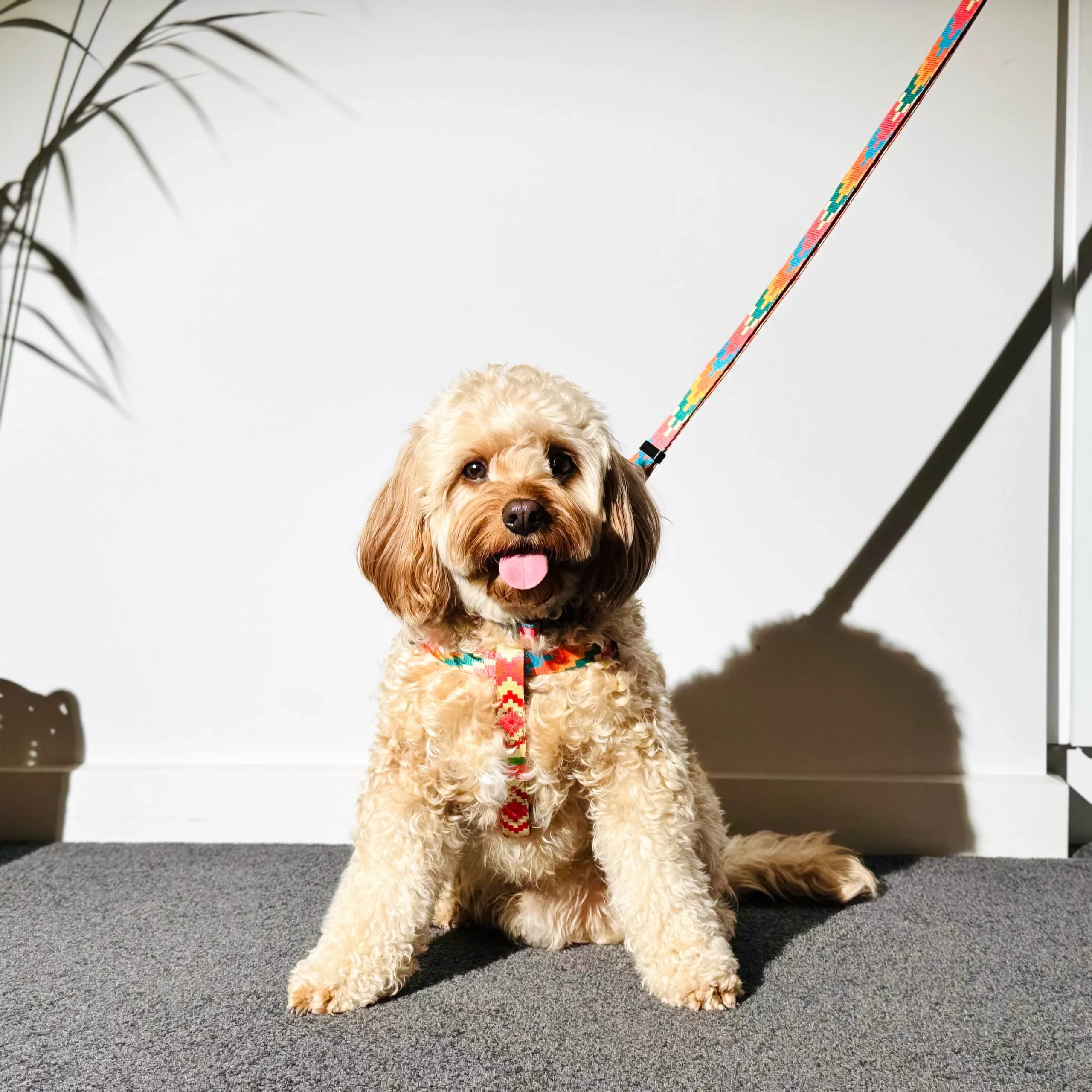
Y-front harness vs step-in vs back-clip
A puppy learning to walk on a lead pulls. That's not misbehaviour, it's a dog with no idea what a lead is. The question is what that pulling force lands on.
On a flat collar, it lands on the trachea, thyroid and cervical spine. On a badly designed harness, it lands across the point of the shoulder and restricts the gait. On a properly fitted Y-front harness, it spreads across the sternum and ribcage.
Look at the front of the harness. The strap should form a Y shape sitting on the breastbone, leaving the shoulder joints free to rotate. If it's a straight horizontal bar across the chest, it's sitting directly on the shoulders.
Step-in harnesses are usually the worst offenders.
What to look for:
- Four points of adjustment, so it grows with the puppy for months rather than weeks
- Padded chest plate and girth strap
- Two attachment points (chest and back) for flexibility as training progresses
- Reflective stitching for dark mornings
- Quick-release buckles you can undo one-handed with a wriggling puppy
Fit check: slide two fingers flat under every strap. Recheck it fortnightly. Puppies outgrow harnesses fast, and a harness that's grown tight rubs the armpits raw.
Flat lead vs retractable vs long line
Three tools, three jobs. Only one belongs on a daily walk.
| Lead type | Length | Best use | Main problem |
|---|---|---|---|
| Flat lead | 1.2 m to 1.8 m | Everyday walking and training | None worth mentioning |
| Long line | 5 m to 10 m | Safe freedom before recall is solid | Tangles, needs open space |
| Retractable | Up to 8 m | Very little | Teaches pulling, burn and injury risk |
| Slip lead | Variable | Vet and kennel handling only | No stopper means real choking risk |
For material, biothane is waterproof, wipes clean and doesn't hold mud or smell. Nylon is cheapest. Leather softens beautifully with age but hates being soaked.
Choose the lightest trigger clip that's still secure, because a heavy metal clip bouncing off a small puppy's chest is unpleasant.
Why the retractable lead teaches pulling
The mechanism is the problem. A retractable lead only extends when the dog pulls against the spring, which means constant, low-level tension every step of the walk.
That's a training loop. Pull, gain ground, repeat. You're rewarding the exact behaviour you're trying to eliminate, hundreds of times a walk.
There's a safety side too. The thin cord causes friction burns and lacerations to hands and legs. A dog hitting the end of 8 m of line at speed generates enough force to cause neck injuries and yank the handle from your grip.
If you want distance, use a proper long line attached to a harness.
Collars, ID tags and the legal bit
A puppy still needs a flat collar, even if you walk on a harness. That's where the ID tag lives.
In the UK, microchipping is a legal requirement for dogs from eight weeks old. The Control of Dogs Order 1992 requires a dog in a public place to wear a collar with the owner's name and address on it or on an attached tag. Add a phone number too.
In the US, licensing and rabies-tag rules vary state by state and often town by town, so check your local ordinance.
- Flat buckle collar with two fingers of room, checked weekly for growth
- Martingale collar for narrow-headed breeds like Whippets and Greyhounds who back out of flat collars
- Never a choke chain, prong or slip collar on a growing puppy
- Microchip registered in your name, not the breeder's, on an ISO 11784/11785 compliant chip
- Remove collars and harnesses before crating unsupervised, as they catch on wire bars
The American Veterinary Medical Association and veterinary behaviour bodies are consistent here. Aversive neck equipment carries physical risk and doesn't outperform reward-based training.
Chews and Enrichment: Rubber vs Nylon vs Natural vs Rawhide
Teething runs from roughly 12 to 24 weeks, with all 42 adult teeth usually through by six or seven months. During that window a puppy will chew. Your only real choice is what.
The thumbnail test for chew hardness
Press your thumbnail into the chew. If it doesn't leave a slight indentation, it's too hard for a dog's teeth.
Anything harder than tooth enamel risks a slab fracture, most commonly on the upper carnassial. That's the big shearing tooth at the back, and the repair is usually extraction or root canal under general anaesthetic. It's a four-figure problem.
Fails the thumbnail test in most cases:
- Antlers and split antlers
- Hooves
- Weight-bearing bones, raw or cooked
- Hard nylon bones marked for powerful chewers
- Ice cubes and stones, which owners often overlook
What to give instead
Natural rubber stuffable chews. The workhorse of the whole kit. Buy the puppy-grade compound, which is deliberately softer than the adult version. Stuff with wet food, soaked kibble or plain yoghurt, then freeze.
A frozen stuffed chew soothes inflamed gums and reliably buys you thirty quiet minutes.
Softer puppy-specific nylon chews. Fine as long as they flex slightly under a thumbnail. Bin them once the ends chew into sharp nubs.
Edible natural chews. Yak milk chews, bully sticks and fish skins are digestible and popular. Always supervise, and take them away once they're small enough to swallow whole. A bully stick holder solves the end-of-chew gulping problem.
Lick mats and snuffle mats. Not chews exactly, but they scratch the same itch and calm an over-aroused puppy fast.
Rawhide, rope toys and tennis balls
Three of the most commonly gifted puppy items, all with genuine problems.
- Rawhide softens, swells and gets swallowed in strips. It's a well-documented choking and obstruction risk, and processing varies enormously by supplier. Skip it.
- Rope toys shed cotton fibres that a puppy swallows. Ingested string acts as a linear foreign body, which can bunch the intestine and requires surgery. Use rope for supervised tug only, never as a leave-alone chew.
- Tennis balls have an abrasive fuzz that wears down enamel over years of fetch. The bigger risk is a standard ball wedging in the throat of a large dog. Buy a dog-specific rubber ball sized bigger than your dog's throat.
Sizing a toy so it can't be swallowed
The rule is simple. Any toy or chew must be larger than your puppy's fully open mouth, and it must stay that way as the dog grows.
Check the toy stack every fortnight:
- Squeeze the toy. Any splits, exposed stuffing or loose squeakers means it goes in the bin.
- Compare the smallest current piece against your puppy's gape.
- Rotate four or five toys in and out weekly, so nothing gets boring and everything gets inspected.
- Never leave a puppy crated alone with a chew, a rope, or a soft toy.
Rotation matters more than volume. Owners consistently report that five toys rotated weekly hold attention better than twenty left in a heap.
Grooming Kit Matched to Your Puppy's Coat Type
The most common grooming mistake isn't brushing too little. It's owning the wrong brush and assuming the coat is fine because it looks fine on the surface.
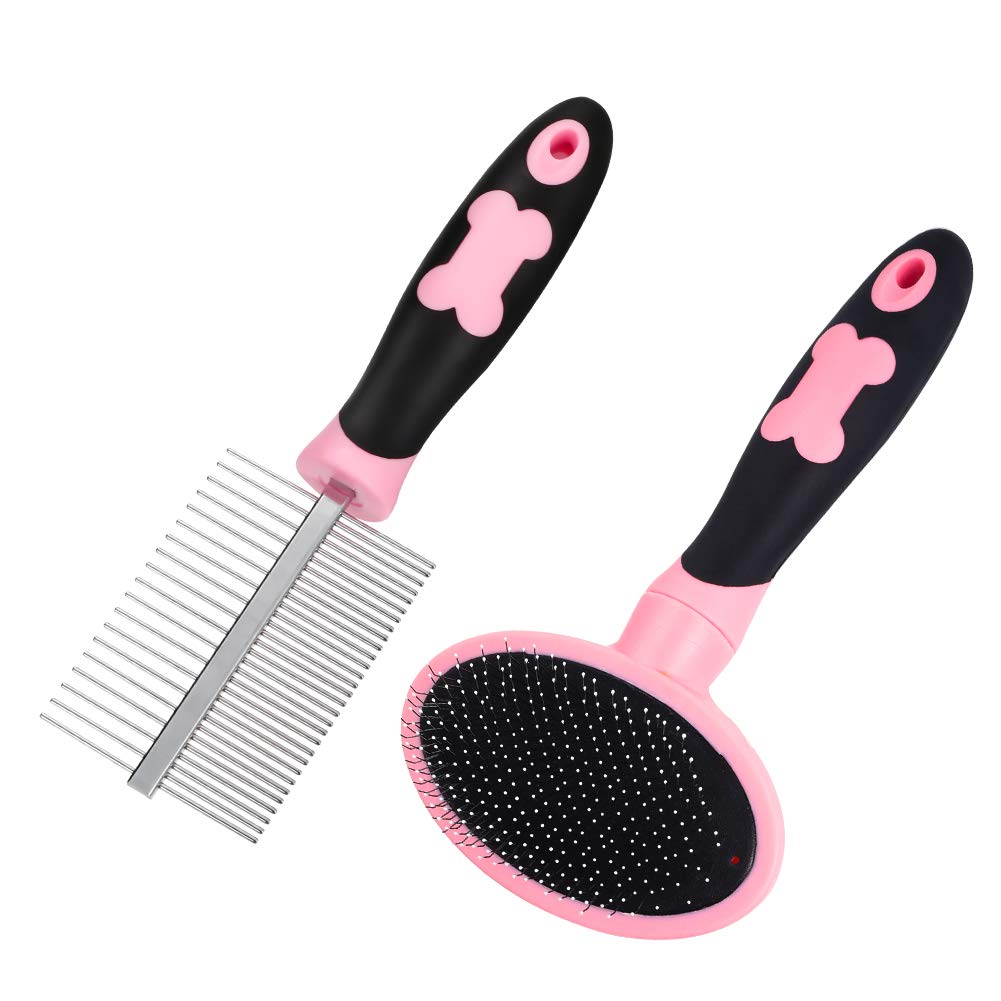
Slicker vs pin brush vs rubber curry vs undercoat rake
Each tool does a different job, and the picture above shows why they're not interchangeable. Fine angled wire pins pull mats apart. Widely spaced steel teeth pull dead undercoat out.
A rubber mitt does neither, it just lifts loose surface hair.
| Tool | What it does | Suits |
|---|---|---|
| Slicker brush | Fine bent wire pins, removes tangles and loose coat | Doodles, Poodles, Spaniels, feathering |
| Pin brush | Rounded-tip pins, gentle daily maintenance | Silky and long coats, Yorkies, Shih Tzus |
| Rubber curry / mitt | Lifts loose hair, stimulates skin | Smooth coats, Labs, Boxers, Staffies |
| Undercoat rake | Pulls dead undercoat from the layer beneath | Double coats, Huskies, Collies, Corgis, GSDs |
| Steel greyhound comb | Finds mats a brush skims over | Every coat, as the final check |
The greyhound comb is the tool most owners don't own and should. Brush the coat, then run the comb through. If the comb snags, the brush didn't do the job.
Doodles and curly coats: why daily brushing isn't optional
Curly and wavy coats don't shed. The dead hair stays in the coat, wraps around the live hair, and knits itself into felt.
The trouble spots are always the same. Behind the ears, in the armpits, on the inner thighs, around the collar line, and on the tail. Mats there tighten against the skin, trap moisture and cause sores.
A badly matted dog often can't be brushed out at all and has to be shaved down.
Fifteen minutes a day with a slicker and a comb prevents it. Line brush in sections, working from the skin outwards, not just skimming the surface. Start on day one, before the puppy coat changes at around eight to twelve months, because that transition is when most matting emergencies happen.
Nail clippers vs grinder
Both work. The choice comes down to your puppy's tolerance and your nerve.
- Scissor-style clippers give clean, fast cuts and suit most sizes. Sharp blades matter more than brand.
- Guillotine clippers suit small dogs but crush thicker nails.
- Nail grinders file the nail down gradually and make it much harder to hit the quick. The trade-off is noise and vibration, which needs desensitising over a week or two.
Keep styptic powder in the kit. You will nick a quick eventually, and it stops the bleeding in seconds. Trim every two to three weeks, taking small amounts often rather than a big cut occasionally, because frequent trimming encourages the quick to recede.
Dark nails hide the quick. Take slivers off the tip and stop when you see a small grey or pink oval appear in the cut face.
Shampoo, bathing frequency and what human products do to skin
Don't bath a puppy weekly. Every four to eight weeks is plenty, or when they're genuinely dirty.
Over-bathing strips the sebum layer that keeps the skin barrier working. That leads to dry, flaky, itchy skin and, ironically, a stronger doggy smell as the skin overcompensates.
Human shampoo is the bigger error. Human skin is more acidic than canine skin, so shampoo formulated for us disrupts a dog's barrier function. Use a soap-free, sulphate-free dog shampoo, and a tearless formula around the face.
The 60-second daily handling routine
This is the highest-value habit in the entire grooming section, and it costs nothing.
Every day, for about a minute:
- Handle each paw, spread the toes, touch each nail with the clippers or a switched-off grinder.
- Lift each ear flap and look inside.
- Lift the lips, touch the teeth and gums.
- Run a hand down the tail and pick up the tail base.
- Brush for thirty seconds even if the coat doesn't need it.
Pair each one with a treat. A puppy handled like this from eight weeks becomes a dog your vet and groomer can actually work with. Skip it, and by six months you have a dog who has to be muzzled or sedated for a nail trim.
Cleanup Gear: Enzymatic Cleaner vs Everything Else
You will clean up wee. A lot of it. Get the cleaner right and toilet training moves faster, because half of house training is stopping the puppy returning to the same spot.
Why ammonia and vinegar make toilet training worse
Dog urine contains uric acid crystals. Those crystals bind to carpet fibres, grout and floorboards, and they don't dissolve in water or standard detergent. You clean the visible mess, the smell fades to your nose, and the puppy still smells a toilet.
Enzymatic cleaners work differently. They contain bacteria and enzymes that break the uric acid down into carbon dioxide and ammonia gas, which evaporates. That removes the marker instead of masking it.
| Cleaner | What it does | Verdict for puppy accidents |
|---|---|---|
| Enzymatic cleaner | Digests uric acid at the source | The only reliable option |
| Ammonia-based cleaner | Smells like a component of urine | Actively encourages re-marking |
| White vinegar | Neutralises surface odour temporarily | Masks, doesn't remove crystals |
| Bleach | Disinfects, doesn't break down uric acid | Odour returns, fumes harsh on puppy airways |
| Carpet shampoo | Cleans the visible stain | Leaves the crystals behind |
Never mix bleach and ammonia products. The reaction produces chloramine gas, which is genuinely dangerous in a closed room.
How to use enzymatic cleaner properly
Most people under-apply it and wonder why it failed. The enzymes need contact time and moisture to work.
- Blot up as much liquid as you can with kitchen roll. Press, don't rub.
- Soak the area generously. The cleaner needs to reach as deep as the urine went, including the underlay.
- Leave it wet for 10 to 15 minutes, or as long as the label says.
- Blot again and let it air dry fully. Don't heat-dry it.
- Keep the puppy off the area until dry.
Don't steam clean before using enzymes, because heat sets the protein into the fibres permanently. And ignore any cleaner promising instant results, because enzymes need time by definition.
A UV torch is a cheap add-on that pays for itself. Dried urine fluoresces under blacklight, so you can find the spots you missed and the ones behind the sofa you didn't know about.
Puppy pads vs straight outdoor training
If you have safe outdoor access and you're home during the day, skip pads entirely. They teach a puppy that going indoors on a soft absorbent surface is fine, and rugs, bathmats and duvets all feel like pads underfoot.
Pads make sense in specific situations:
- High-rise flats where the puppy can't get outside within the ninety seconds you have
- Pre-vaccination weeks if your building has heavy dog traffic in shared areas
- Overnight for very young puppies with a small bladder
- Toy breeds in hard winters, where a real-grass patch or indoor litter tray is often the better version
If you do use them, put them in one fixed spot near the door you'll eventually use. Then shrink the pad area weekly and move it closer to the exit. Washable pads with a waterproof backing work out cheaper and hold more than disposables.
The toilet-training maths nobody tells you
Bladder control follows a rough formula. Age in months plus one, in hours, is the maximum a puppy can hold it. An eight-week-old is looking at around two hours, and that's when asleep and calm.
Awake and active, plan for a trip outside:
- Immediately on waking, every single time
- Within 10 to 20 minutes of eating
- After play or excitement
- Every 45 to 60 minutes otherwise
- Last thing at night, and once during the night for the first few weeks
Regression around four to six months is normal, not a failure. Growth spurts, hormones and increased confidence all play a part. Go back to a tighter schedule for a fortnight rather than telling yourself off.
Dental and Health Basics You'll Actually Use Daily
The health kit is small. Four or five items, most under a tenner, and skipping them creates problems that are expensive to fix later.
Toothbrush, enzymatic paste and the xylitol warning
Dental disease is one of the most common conditions vets diagnose in adult dogs. A scale and polish under general anaesthetic runs several hundred pounds, and extractions push it higher. Two minutes a day prevents most of it.
Never use human toothpaste. Many contain xylitol, also labelled as birch sugar, which is severely toxic to dogs. It triggers a rapid insulin release and can cause fatal hypoglycaemia and liver failure at small doses.
Human toothpaste also contains fluoride at levels dogs shouldn't swallow, and they swallow everything.
What you need:
- Dog-specific enzymatic toothpaste, usually poultry or malt flavoured
- A finger brush to start with, moving to a long-handled dog toothbrush
- Optionally, a product carrying the Veterinary Oral Health Council (VOHC) seal, which means it met a plaque or tartar reduction standard in testing
Build it up over a week. Day one, let the puppy lick paste off your finger. Day two, rub a finger along the gum line.
By day five you're using the brush on the outer surfaces only, at a 45 degree angle to the gum line. You don't need to do the inner surfaces. The tongue handles most of that.
Daily is ideal. Three times a week is the realistic minimum for any meaningful benefit. Dental chews and water additives help around the edges, but nothing replaces mechanical brushing.
Ear cleaner, eye wipes and what to check daily
Ears are the second most common trouble spot, especially in drop-eared breeds. Cockers, Basset Hounds, Labradors and doodles all have poor airflow to the ear canal.
Use a vet-approved ear cleaning solution, not cotton buds. Fill the canal, massage the base of the ear for about twenty seconds, let the puppy shake, then wipe the visible part with cotton wool. Never push anything down the canal.
Clean ears only when they need it, roughly every two to four weeks, or after swimming. Over-cleaning irritates the lining. Signs that need a vet, not a wipe:
- Head shaking or scratching at one ear
- A yeasty or sour smell
- Brown, black or yellow discharge
- Redness, heat or pain when touched
- Head tilt
Eyes need less. A damp cotton pad, one per eye, wiped from the inner corner outwards. Persistent green or yellow discharge, squinting or a cloudy eye is a same-day vet call.
Parasite prevention and vaccination timing
Puppies come with worms. Roundworm is transmitted from the mother, which is why worming starts at two weeks and repeats fortnightly to twelve weeks, then monthly to six months.
Flea, tick and worm products must be dosed by current weight. Puppies outgrow doses fast, so weigh before every treatment. Get products from your vet rather than a marketplace listing, because counterfeit spot-ons are a real problem and under-dosed product is wasted money.
One serious warning for multi-pet homes. Permethrin-based flea treatments sold for dogs are highly toxic to cats. Cats poisoned by permethrin often get it from grooming or sleeping against a recently treated dog, not from direct application.
If you have both species, ask your vet for a permethrin-free option.
Typical vaccination timing:
| Stage | Age | Notes |
|---|---|---|
| First vaccination | 6 to 8 weeks | Usually given by the breeder |
| Second vaccination | 10 to 12 weeks | Often the first one you attend |
| Third (region dependent) | 14 to 16 weeks | Some protocols and some leptospirosis strains |
| Full immunity | 1 to 2 weeks after final dose | Free outdoor walking from here |
| Rabies | Varies by country and state | Legally required across most of the US |
| First booster | 12 months | Then per your vet's schedule |
Vaccination timing collides with the socialisation window, which closes around 16 weeks. Don't lock the puppy indoors until the course finishes. Carry them out, sit on a bench near traffic, let them meet vaccinated adult dogs in private gardens, and go to a properly run puppy class that requires proof of vaccination.
Missed socialisation causes more dogs to be rehomed than infectious disease does.
The puppy first-aid kit worth keeping
Small box, kept where you can reach it in the dark. These are the items owners reach for most in the first year.
- Styptic powder for nail bleeds
- Sterile saline pods for flushing eyes and grazes
- Non-stick wound pads and self-adhesive cohesive bandage
- Blunt-ended scissors and tweezers
- A tick removal hook, twist type rather than pointed
- Digital thermometer (normal canine range is roughly 38.3 to 39.2°C, or 101 to 102.5°F)
- Your vet's number and the nearest 24-hour emergency practice, written down
Add your national poison line to your phone contacts. In the US that's the ASPCA Animal Poison Control Center or the Pet Poison Helpline. Both charge a consultation fee, and both are worth it at 2am.
Side-by-Side: Budget vs Mid vs Premium Across Every Category
Not every category rewards spending more. Some do, some absolutely don't, and knowing which is where the real savings sit.
What the three tiers actually get you
| Category | Budget | Mid | Premium | Worth upgrading? |
|---|---|---|---|---|
| Crate with divider | £30 / $40 | £60 / $80 | £120 / $160 | Mid. Thicker wire, better latches |
| Playpen | £35 / $45 | £60 / $80 | £110 / $140 | Budget is fine for small breeds |
| Stainless bowls (pair) | £8 / $10 | £18 / $22 | £35 / $45 | No. Steel is steel |
| Puppy food (monthly) | £20 / $28 | £40 / $55 | £75 / $100 | Yes, to mid at minimum |
| Y-front harness | £12 / $15 | £28 / $35 | £50 / $65 | Yes. Fit and adjustment points |
| Lead plus long line | £12 / $15 | £30 / $38 | £55 / $70 | Mid. Biothane earns it |
| Chew and enrichment set | £15 / $20 | £35 / $45 | £70 / $90 | Yes. Cheap rubber splits |
| Grooming kit | £15 / $20 | £40 / $50 | £90 / $120 | Depends entirely on coat type |
| Enzymatic cleaner | £6 / $8 | £12 / $16 | £20 / $25 | No. Check the enzyme claim, buy big |
| Bed and bedding | £15 / $20 | £40 / $50 | £90 / $120 | No, not in year one |
Where spending more genuinely pays off
Food. The clearest case. Budget kibble is usually lower in digestible protein and higher in filler, which means bigger, softer stools and more of them. Mid-tier growth formulas from established manufacturers carry feeding-trial data and consistent batch quality.
Harness. A £12 harness typically has two adjustment points and thin webbing. It'll be outgrown in six weeks and it rubs. A mid-tier harness with four points of adjustment often lasts from twelve weeks to six months.
Chews. Cheap rubber is a false economy and a safety issue. Thin, low-grade rubber splits into swallowable chunks. Named-brand natural rubber survives a teething Labrador and gets replaced maybe twice a year.
Grooming tools, but only if you have a coat that needs them. A cheap slicker with rigid, unrounded pins scratches skin and makes the puppy hate brushing. For a doodle or a double coat, spend the money. For a smooth-coated Staffie, a £5 rubber mitt does the whole job.
Where premium is mostly marketing
Bowls. A 304 stainless bowl is a 304 stainless bowl. The £35 version has a nicer rim.
Enzymatic cleaner. Buy the 4 or 5 litre refill of a mid-priced brand rather than a small designer bottle. Check the label actually says enzymatic or bacterial, because plenty of pet stain removers are just scented detergent.
Beds. Buy a £15 washable vet bed fleece for the first six months. Orthopaedic memory foam at £120 is for a dog who has stopped chewing and stopped growing.
Designer collars and leads. No performance difference. Spend it on the harness instead.
The two places you should never buy budget
Car restraint and preventative medication. Both are safety items with a real failure mode.
An untested travel harness or crate is decorative in a crash. Look for gear that has passed independent crash testing, such as products certified by the Center for Pet Safety, rather than one marked "crash tested" with no test body named.
For flea, tick and worm products, buy through your vet. Counterfeit spot-ons are widespread online, and the consequences range from wasted money to genuine toxicity.
Best Pick for Your Situation
The right kit shifts depending on the dog and the household. Here's how the choices change.
Large and giant breeds
Everything scales up, and one thing becomes non-negotiable.
- Food: large-breed growth formula, controlled calcium, until 18 to 24 months. Not adult food, not standard puppy food.
- Crate: 42 in or 48 in with a divider from day one. Check the wire gauge, as thin wire bends under a Great Dane leaning on it.
- Harness: buy for adjustability and expect to replace it two or three times regardless.
- Joints: no forced running, no repetitive fetch on hard ground, and limit stairs. Growth plates in giant breeds may not close until 18 months or later.
- Bowls: heavy stainless with a rubber ring, 1.4 L capacity.
Toy and small breeds
Different risks entirely. Fragility and dental disease, rather than joint loading.
- Bowls: shallow, 350 ml. Deep bowls press on whiskers and put fussy small dogs off eating.
- Collar: a lightweight harness is safer than a collar. Toy breeds are prone to tracheal collapse, and neck pressure makes it worse.
- Dental: brush daily without exception. Small breeds are far more prone to periodontal disease and crowded teeth.
- Food: small-breed kibble, because tiny mouths struggle with large pieces. Watch for hypoglycaemia in very small puppies, which means frequent meals.
- Crate: 24 in with a divider. A 30 in crate for a Chihuahua is a bedroom and a toilet.
Flat and apartment living
The main constraint is time to get outside.
- Toilet setup: a real-grass patch or a washable pad station near the door, with a plan to phase it out
- Enrichment: more of it, since the garden isn't doing any of the work. Snuffle mat, lick mat and scatter feeding daily
- Noise: a covered crate helps with corridor traffic and lift noise
- Stairs: carry a small puppy up and down for the first few months rather than letting them bump down
- Neighbours: start alone-time training in week one, in two-minute increments, before separation anxiety sets in
Working owners and long-day routines
If nobody's home for six hours, a crate alone won't do. Build a pen zone instead.
The workable setup is a pen containing a crate with the door open, a water bowl, a toilet area at the far end, and two or three safe chews. Add a midday visit from a walker, a neighbour or a daycare pickup. A puppy under six months shouldn't be alone longer than about four hours.
Frozen stuffed chews make departures manageable. Give one as you leave, every single time, so leaving predicts something good.
Brachycephalic breeds
Pugs, French Bulldogs, English Bulldogs and Boston Terriers need a modified kit.
- Harness only. Never a collar for walking. Their airways are already compromised.
- Heat management. Walk early morning and late evening. Keep a cooling mat available. Heatstroke risk is substantially higher, and it develops fast.
- Bowls. Shallow and wide. Deep bowls make breathing while eating harder.
- Slow feeders. Choose shallow ridge patterns. Deep, narrow mazes are unusable for a flat face.
- Skin folds. Wipe facial and tail folds daily with a dry or barely damp pad, then dry thoroughly. Trapped moisture causes fold dermatitis.
Rescue puppies with unknown history
You're working without a manual, so build in more room.
- Ask what food they're currently on and keep it for at least a week, longer than usual
- Assume no handling desensitisation and start the 60-second routine from scratch, slowly
- Introduce the crate with the door removed or tied open for several days before ever closing it
- Expect toilet training to take longer if they were kennel-reared on a hard floor
- Book a vet check within 48 hours for a weight, worming and vaccination status review
- Add a long line early, because recall may need building from zero
What to Skip: Gear You'll Outgrow or Never Touch
Every pet shop bundle contains a few items that are genuinely wasted money. Here's what keeps showing up in the still-boxed pile.
The things that get outgrown
- Puppy-sized crates. The single biggest one.
- Fixed-size harnesses and collars. Anything with fewer than four adjustment points is a six-week purchase.
- Newborn-style plush beds. Cute at eight weeks. Confetti by fourteen.
- Puppy-only feeding bowls. Novelty sizes with paw prints. Buy adult stainless immediately.
- Tiny toys. A toy sized for a nine-week-old Labrador is a choking hazard for a four-month-old one.
The things that rarely get used
- Dog strollers and carriers for anything other than very small breeds or medical need.
- Automatic ball launchers for a puppy. Repetitive high-speed fetch is exactly the joint loading you're trying to avoid.
- Cologne and scented sprays. They irritate skin and mask smells you should be investigating.
- Grooming clipper kits bought before you know the coat. Most owners use a groomer, and a bad home clip on a doodle takes months to grow out.
- Raincoats and boots for most breeds in year one. A microfibre drying coat or an old towel by the door does more.
- Water fountains for a single puppy. More parts to clean, no real benefit over a refreshed bowl.
- Elaborate puzzle feeders bought at eight weeks. Coordination isn't there yet, and frustration teaches quitting.
The things to actively avoid
These aren't just wasted money. They carry risk.
| Item | The problem |
|---|---|
| Retractable lead | Rewards pulling, burn and injury risk |
| Choke chain, prong, slip collar | Tracheal and cervical injury on a growing dog |
| Rawhide | Swells, obstructs, choking risk |
| Antlers, hooves, weight-bearing bones | Slab fractures of the carnassial tooth |
| Rope toys left unsupervised | Linear foreign body, surgical risk |
| Human shampoo or toothpaste | Wrong pH, xylitol and fluoride toxicity |
| Calcium supplements on a complete diet | Developmental orthopaedic disease |
| Untested "crash tested" car harnesses | No verifiable protection in an impact |
| Non-prescription spot-ons from marketplaces | Counterfeits, wrong dosing, permethrin risk to cats |
The best buy nobody puts on the list
A second enzymatic cleaner bottle and a stack of cheap microfibre cloths.
Running out of cleaner at 11pm on night three, with wee soaking into a rug, is the moment most people reach for whatever's under the sink. That's how ammonia ends up on the carpet and the puppy learns the hallway is a toilet.
Buy the 4 litre refill up front. As of 2026 it's still one of the cheapest lines on the whole set-up sheet, and it does more for toilet training than any gadget in the shop.
Buying Mistakes That Cost Money or Cause Harm
The gear list is only half the job. Most of the expensive errors come from how the kit gets used.
Buying everything before the puppy arrives
Tempting, and mostly a mistake. You don't know the adult size of a crossbreed, the coat type until it changes, or how hard your puppy chews.
Buy the non-negotiables before pickup. Everything else waits two weeks.
Buy first:
- Crate with divider, sized to expected adult weight
- Stainless bowls and the breeder's current food
- Flat collar, ID tag, 1.8 m lead, adjustable Y-front harness
- Two rubber stuffable chews
- Enzymatic cleaner, poo bags, vet bed fleece
- Baby gates for stairs
Buy after two weeks:
- Grooming tools, once you've seen how the coat behaves
- Long line, once the puppy is walking outdoors
- Slow feeder, only if they gulp
- Puzzle feeders, from about 12 weeks
- Proper bed, once teething eases
Using the crate as punishment
This one costs nothing and ruins everything. Shut a puppy in the crate as a telling-off and you've turned the safe den into a threat.
The crate should predict good things. Feed meals in it. Throw treats in and let the puppy walk back out.
Give the frozen chew in there. Never slam the door on a puppy who's already stressed.
Same rule applies to opening it. Wait for calm, then open. Otherwise you teach them that barking opens the door.
Buying gear that doesn't get measured first
A depressing number of returns come down to guessing. Measure before you buy.
- Collar: neck circumference, then add room for two fingers flat
- Harness: girth just behind the front legs, plus chest width
- Crate: expected adult nose-to-tail-base length plus 5 to 10 cm
- Gates: the actual doorway width at its narrowest point, including skirting
Then remeasure the collar and harness every two weeks until about six months. Puppies outgrow a collar without anyone noticing until it's rubbing.
Over-walking a growing puppy
More walking is not better. Growth plates are soft areas of cartilage at the ends of long bones, and they don't close until roughly 9 to 11 months in small breeds and 14 to 18 months or more in giants.
Repetitive high-impact exercise on open growth plates is linked to joint problems later. The commonly used guideline is about five minutes of formal lead walking per month of age, up to twice a day. A four-month-old gets around 20 minutes, twice.
That doesn't mean a bored puppy. Free play on grass, sniffing walks at the dog's pace, and enrichment feeding all burn energy without the loading. Avoid running alongside a bike, long hikes, repeated ball throwing and stair sprints until the vet says the plates have closed.
Creating a resource guarder by accident
Taking food and chews off a puppy to prove you can is the fastest way to build guarding. The dog learns that a hand near the bowl means loss.
Do the opposite. Walk past the bowl and drop something better in. Approach a chew, drop a treat, walk away.
Trade up rather than take.
If you see stiffening, freezing, a hard stare or a low growl, stop and get help from a qualified behaviourist. A growl is information, not defiance. Punishing it removes the warning and leaves you with a dog who bites without one.
Buying food on the front of the bag
Grain-free, ancestral and premium have no legal definition. The nutritional adequacy statement does.
One related point. The US Food and Drug Administration opened an investigation into a possible link between certain grain-free diets and dilated cardiomyopathy in dogs, and the picture is still unresolved. Unless your vet has diagnosed a genuine grain allergy, there's no health reason for a growing puppy to be on a grain-free diet.
Skipping the microchip paperwork
The chip is only useful if it's registered to you. A shocking number of found dogs are chipped to a breeder who moved house four years ago.
Do three things in week one:
- Confirm the chip number with your vet at the first appointment.
- Transfer the registration into your name on the correct database.
- Add a second contact number, ideally someone at a different address.
What a Real Day Looks Like With This Kit
Gear only works inside a routine. Here's how the same kit gets used differently as the puppy grows.
8 to 12 weeks
Everything is short. Short naps, short training, short outdoor trips, and a bladder that holds about two hours.
Sleep is the thing most owners underestimate. A puppy this age needs 16 to 20 hours in 24. An overtired puppy bites harder and listens less, and looks like a behavioural problem when it's just knackered.
| Time | What happens | Kit in use |
|---|---|---|
| 6:30am | Straight outside, then meal 1 | Lead, poo bags, bowl |
| 7:15am | Toilet, short play, crate nap | Crate, chew |
| 9:00am | Toilet, 2 minute training, meal 2 | Treat pouch, clicker |
| 9:45am | Enforced nap | Crate, cover |
| 11:30am | Toilet, handling routine, snuffle mat | Brush, snuffle mat |
| 1:00pm | Meal 3, toilet, nap | Bowl, crate |
| 3:00pm | Carried outing for socialisation | Harness, lead |
| 5:00pm | Meal 4, toilet, calm play | Bowl, rubber chew |
| 7:00pm | Witching hour, frozen chew, settle | Frozen stuffed chew, pen |
| 10:30pm | Last toilet, into crate | Crate, vet bed |
| 2:00am | One night toilet trip | Lead, torch |
The evening zoomies and biting spell around 6 to 8pm is normal. It's overtiredness, not aggression. Frozen chew, dim the lights, and let them crash.
12 to 16 weeks
The socialisation window is closing, so this fortnight matters more than any other. Vaccinations usually finish here too.
What changes:
- Drop to three meals a day around 12 to 14 weeks
- Teething is in full swing, so frozen chews come out daily
- First proper lead walks once immunity is complete, roughly 15 minutes twice a day
- Long line comes into use in a safe field for early recall
- Night waking usually stops, and most puppies sleep through by 14 to 16 weeks
Socialisation isn't about meeting dogs. It's calm exposure to the world. Aim for variety rather than volume: hard floors, stairs, umbrellas, wheelie bins, hi-vis jackets, hats, children's voices, traffic, hoovers, the vet's waiting room for a treat and a walk back out.
Puppy class should start now. Look for one that caps numbers, requires vaccination proof, and spends more time on settling and handling than on free-for-all play.
4 to 6 months
The dog gets bigger and cockier, and the routine loosens. This is where owners hit the wobble.
Expect three things:
- Toilet regression. Usually a fortnight. Tighten the schedule, don't panic.
- Selective hearing. Recall stops working around 5 months as confidence grows. This is exactly when the long line goes back on.
- Adult teeth. All 42 through by six or seven months. Swap the softest puppy chews for adult-strength versions, but keep applying the thumbnail test.
By six months, two meals a day. Walks around 25 to 30 minutes twice daily, still on the five-minute rule. Grooming becomes properly important for curly and double coats, since the puppy coat starts giving way to the adult one.
Alone-time training should be well established. If your puppy still can't settle for 20 minutes without you, work on it now rather than at nine months.
Safety Rules, Legal Requirements and Recall Checks
Some of this is legal, some is common sense learned the hard way. All of it is cheaper to know than to discover.
Legal requirements by region
In the UK, microchipping is compulsory for dogs from eight weeks old across England, Scotland, Wales and Northern Ireland. The Control of Dogs Order 1992 also requires a collar with the owner's name and address in a public place. The Animal Welfare Act 2006 sets out five welfare needs you're legally responsible for meeting.
Lucy's Law in England and Wales means puppies must be sold by the breeder, seen with their mother, and not through a third-party dealer. If a seller won't show you the mum with the litter, walk away.
In the US, rules are set at state and municipal level. Rabies vaccination is legally required in most states, timing varies, and local licensing and leash ordinances differ by town. Check your county's animal services page rather than assuming.
For car travel, UK Highway Code Rule 57 requires dogs to be suitably restrained. A loose dog is a projectile in a crash and a distraction before one.
Household hazards to sort in week one
Puppy-proofing takes an afternoon and prevents most emergency calls.
- Cables: cover or reroute anything within reach. Chewed live cable causes mouth burns and pulmonary oedema.
- Bins: lock or move. Cooked bones, corn cobs and greasy wrappers are all obstruction risks.
- Medication: every packet off surfaces. Ibuprofen and paracetamol are toxic to dogs at low doses.
- Antifreeze: ethylene glycol tastes sweet and causes fatal kidney failure. Wipe up driveway spills immediately.
- Rodent bait and slug pellets: remove entirely if you have a puppy.
Toxic foods and plants worth memorising
| Category | Items |
|---|---|
| Foods | Chocolate, grapes and raisins, onion, garlic, leeks, macadamia nuts, alcohol, caffeine, xylitol/birch sugar |
| Plants | Lilies, sago palm, daffodil and tulip bulbs, azalea, oleander, foxglove, yew |
| Seasonal | Conkers, acorns, blue-green algae in summer, grass seeds in long grass, adders on heathland |
Grass seeds deserve a specific mention. Between roughly May and September they burrow into paws, ears and eyes, and they often need removal under sedation. Check between the toes after every walk in long grass.
Pet food recalls: how to actually check
Keep the original bag. The batch number and best-before date printed on it are the only way to know whether your specific lot is affected.
If a recall is announced, stop feeding immediately, photograph the batch details, and contact the manufacturer for a refund. Then speak to your vet before switching, especially if the puppy has been unwell.
The FDA maintains a public recall and withdrawal list for animal food in the US. In the UK, the Food Standards Agency publishes pet food alerts. Both are worth a bookmark.
Crate and toy safety rules that get broken
Five rules, all learned the expensive way by somebody else.
- No collar or harness on a crated puppy. Tags and buckles catch on wire.
- No long chews, bully sticks or rawhide in a crate alone.
- No soft plush toys unsupervised once stuffing is exposed.
- Nothing hanging into a crate that can be pulled in and shredded.
- Water available in a pen for long stays, but a spill-proof or clip-on bowl rather than a tipping dish.
Heat, cold and paw safety
Hot pavement burns pads fast. Press the back of your hand to the ground for seven seconds. If you can't hold it, neither can the dog.
Heatstroke risk is highest in brachycephalic breeds, but no puppy regulates heat well. Signs are heavy panting, bright red gums, drooling, wobbliness and vomiting. Cool with tepid water, move to shade, and get to a vet immediately.
Don't use ice water.
In winter, rinse paws after walks on gritted roads. Road salt irritates pads and gets licked off.
When to Upgrade, Refit or Retire Each Item
Most of this kit isn't permanent. Knowing when things change stops you replacing gear too early or, worse, too late.
The refit and replacement schedule
| Item | Check how often | Typical change point |
|---|---|---|
| Collar fit | Weekly to 6 months | Two-finger rule fails |
| Harness fit | Fortnightly to 6 months | Replaced 2 to 3 times in year one |
| Crate divider | Every 3 to 4 weeks | Slide back as the puppy grows |
| Crate itself | Once, if sized right | Never, if you bought adult size |
| Toys and chews | Fortnightly inspection | Splits, exposed squeaker, swallowable size |
| Food portions | Weekly weigh-in | Recalculate against current weight |
| Food formula | Once | 12 months small/medium, 18 to 24 months large/giant |
| Nail trim | Every 2 to 3 weeks | Ongoing for life |
| Bedding wash | Weekly at 60°C | Replace when chewed or thin |
| Parasite treatment | Per product schedule | Redose by current weight |
When to switch from puppy food to adult food
Timing depends on adult size, not age alone. Switching too early on a large breed cuts the nutrition their skeleton still needs.
- Toy and small breeds (under 10 kg): around 10 to 12 months
- Medium breeds (10 to 25 kg): around 12 months
- Large breeds (25 to 40 kg): around 15 to 18 months
- Giant breeds (over 40 kg): 18 to 24 months
Use the same seven-day transition. Portion sizes drop noticeably on adult food, so recalculate rather than filling the bowl to the same level.
When the divider comes out and the pen goes away
Retire the divider when the puppy can stand up, turn around and lie fully stretched out with a few centimetres to spare. Slide it back gradually rather than removing it in one go.
The pen usually goes at around 6 to 9 months, once the dog is reliably house trained and no longer chewing furniture. Don't rush it. Plenty of owners take the pen down at four months and put it back up at five.
The crate door can start staying open overnight from about 6 to 12 months, depending on the dog. Most keep using the crate voluntarily for years, which is exactly what you want when they need cage rest after a spay or an injury.
When to upgrade the bed
Once teething is done and destruction has stopped, usually between 8 and 12 months. That's the point where a proper orthopaedic or bolster bed is worth the money.
Buy it in adult size, machine washable at 60°C, with a removable waterproof inner cover. Keep the old vet bed fleece for the car and the crate.
When to stop the five-minute rule
Ask your vet, and expect the answer to depend on breed size. Small breeds are usually cleared for longer, faster exercise from around 9 to 12 months. Giant breeds may need to wait until 18 months or later.
Signs you're pushing too hard include limping after exercise, stiffness th
[trimmed for storage]