
You love your Saint Bernard, but let's be honest: the grooming is a full-time job. Between the shedding, the drool, and those glorious folds, keeping this breed looking and feeling great takes serious effort. If you've been searching for how to groom a Saint Bernard without turning your home into a fur-filled disaster zone, you're in the right place.
Here's the reality: a Saint Bernard has a dense double coat that sheds heavily year-round and "blows" completely twice a year. As of 2026, the breed standard from the American Kennel Club calls for a thick, medium-length coat that's neither shaggy nor curly. Understanding that structure is the difference between a happy, healthy dog and one dealing with skin infections, painful mats, and constant scratching.
Quick Answer
Groom a Saint Bernard with an undercoat rake and slicker brush three to four times weekly. Bathe every six to eight weeks with dog-safe shampoo. Dry completely with a high-velocity dryer.
Clean facial folds weekly. Trim nails monthly. Never shave the double coat.
Check ears and paws during every session.
The Real Deal on Saint Bernard Grooming
Here's what nobody tells you before you bring one of these gentle giants home: grooming is not optional. It's not a "when we get around to it" task. It's a core part of responsible ownership, right up there with feeding and vet visits.
The math is simple. A Saint Bernard can weigh anywhere from 120 to 180 pounds. That's a lot of dog, which means a lot of hair.
In our research, owners consistently report that a well-maintained coat sheds noticeably less than a neglected one. That's because loose undercoat that gets brushed out ends up in your trash can, not on your couch.
Skipping grooming sessions doesn't just create a mess. It creates health problems. Matting pulls on the skin, causing pain and restricting movement.
Trapped moisture in those deep folds leads to bacterial and yeast infections. Floppy ears that never get dried properly become breeding grounds for ear infections. The list goes on.
The good news? Once you have the right tools and a solid routine, grooming a Saint Bernard becomes manageable. It's not quick, but it's straightforward.
And the payoff is a happier, healthier dog and a home that doesn't look like a yeti exploded in it.
Let's break down exactly what you need, what to do, and what to absolutely avoid.
What You Need Before You Start
Before you begin, gather the right tools. Using the wrong brush on a Saint Bernard is like using a toothbrush to scrub a bathtub. It technically does something, but not nearly enough.
Here's your essential kit, built from what the breed actually requires:
| Tool | Purpose | Recommended Frequency |
|---|---|---|
| Undercoat rake | Removes loose undercoat from the dense inner layer | Every brushing session |
| Slicker brush | Tackles tangles and surface debris | Every brushing session |
| Pin brush | Finishes the coat and removes loose guard hairs | As needed |
| Metal greyhound comb | Checks for mats in sensitive areas | Every session |
| High-velocity dryer | Forces water and loose fur out of the coat after bathing | Every bath |
| Dematting spray | Loosens stubborn tangles safely | When needed |
| Dog-safe shampoo | Cleans without stripping natural oils | Every 6-8 weeks |
| Ear cleaning solution | Prevents infection in floppy ears | Weekly |
| Grooming wipes | Cleans facial folds and drool areas | Daily |
| Nail grinder or clippers | Maintains paw health | Every 3-4 weeks |
| Styptic powder | Stops bleeding if you clip the quick | Keep on hand |
| Paw balm | Protects pads from salt, heat, and cracking | Seasonal |
You'll notice we didn't include a FURminator on this list. That's deliberate. While it's a popular de-shedding tool, many groomers and veterinarians warn against using it on double-coated breeds.
The blade edges can cut through the guard hairs, damaging the coat's natural protection over time. Stick with an undercoat rake designed for thick, double coats instead.
The Saint Bernard Coat: What You're Actually Brushing
To groom effectively, you need to understand what you're working with. A Saint Bernard's coat isn't just one layer. It's a sophisticated two-layer system with specific jobs.
The outer coat consists of harsh, medium-length guard hairs. These are water-resistant and protect your dog from the elements. They're the first line of defense against rain, snow, and brush.
Beneath that sits the undercoat. This is a soft, dense, woolly layer that provides insulation. It keeps your dog warm in winter and, counterintuitively, helps regulate temperature in summer.
When the undercoat sheds, it comes out in clumps that can pack down into tight mats if not brushed regularly.

Image source: Omlet US
Here's where most owners go wrong. They brush the top layer, the guard hairs, and call it done. They never penetrate down to the undercoat where all the loose fur is hiding.
That's like sweeping your kitchen floor but ignoring the dust bunnies under the cabinets.
Why Shaving Is Never the Answer
Some owners think shaving a Saint Bernard for summer is a kindness. It's not. It's one of the worst things you can do to this breed.
The double coat insulates against heat as well as cold. The guard hairs block UV rays and reflect heat away from the skin. Shave them off, and you actually make your dog hotter, not cooler.
Shaving also destroys the coat's texture. Many owners report that after a full shave, the coat grows back patchy, wiry, or a completely different color. In severe cases, the undercoat grows back first, leaving a cotton-like layer that mats almost instantly.
Some coats never fully recover.
Yes, we know a shaved Saint Bernard looks "neater." But it's shortsighted. Keep the coat intact and manage the shedding with regular brushing instead.
The Blowout: Twice-a-Year Shedding Overload
Twice a year, usually as seasons shift, your Saint Bernard will blow their coat. This isn't normal shedding. It's a full-on fur explosion that lasts two to four weeks.
During this period, you'll need to brush more often. Daily sessions are recommended. You'll pull out what feels like a whole second dog's worth of fur.
This is normal. It's natural. And it will pass.
A good undercoat rake is your best friend here. It can remove significantly more loose fur than a slicker brush alone. Some owners also find a high-velocity dryer useful between baths to blast out loose undercoat on dry days.

Image source: Amazon (product image)
Your Weekly Brushing Routine (Step-by-Step)
Consistency beats intensity. Brushing for 15 minutes every other day is far more effective than a two-hour marathon once a month. Your Saint Bernard will also tolerate shorter, more frequent sessions much better.
Here's the routine that works, based on input from breeders and professional groomers who handle giant breeds daily.
Step 1: Prepare Your Space and Dog
Start with a calm dog. A post-walk Saint Bernard is usually more relaxed and willing to stand still. Use a grooming table if you have one, or a non-slip mat on the floor.
For a dog this size, you want them comfortable and stable.
Keep treats handy. Positive reinforcement makes grooming sessions something your dog looks forward to instead of dreads.
Step 2: Start with the Undercoat Rake
Begin at the back of the neck, just behind the ears. Work in sections, moving toward the tail. Use long, smooth strokes that penetrate down through the topcoat and into the undercoat.
Focus on the heavy-duty zones:
- The hindquarters and upper thighs
- The chest and neck area
- The base of the tail (especially prone to matting)
Don't press too hard. The rake should glide through the coat, pulling loose fur. If you hit resistance, there's likely a mat.
Stop and address it before continuing.
Step 3: Switch to the Slicker Brush
Once you've loosened the undercoat, use the slicker brush to pull it away from the skin. Work in short, gentle strokes. Follow the direction of hair growth to avoid scratching the skin.
The slicker brush is also excellent for the tail. Saint Bernards have a bushy tail that mats easily at the base. Give it extra attention.
Step 4: Hit the Sensitive Areas
This is where many owners rush, and it's a mistake. The high-friction zones, where mats form fastest, need special attention.
| Sensitive Area | Why It Mats | Best Tool |
|---|---|---|
| Behind ears | Hair rubs against collar and neck | Slicker brush and greyhound comb |
| Armpits | Friction from leg movement | Dematting spray and fingers |
| Rear thighs | Dense undercoat collections | Undercoat rake |
| Tail base | Thick hair grows in all directions | Slicker brush |
| Between paw pads | Hair collects debris and moisture | Grooming scissors or trimmer |
For mats that won't brush out, apply a dematting spray and work gently with your fingers. For severe mats, use a mat splitter or carefully cut vertically through the mat, then brush it out. Save shaving mats as the absolute last resort.
A Saint Bernard's skin is surprisingly delicate under all that fur.
Step 5: Finish with the Greyhound Comb
The comb is your quality check. Run it through the coat section by section. If it snags, you missed a tangle.
Go back and address it.
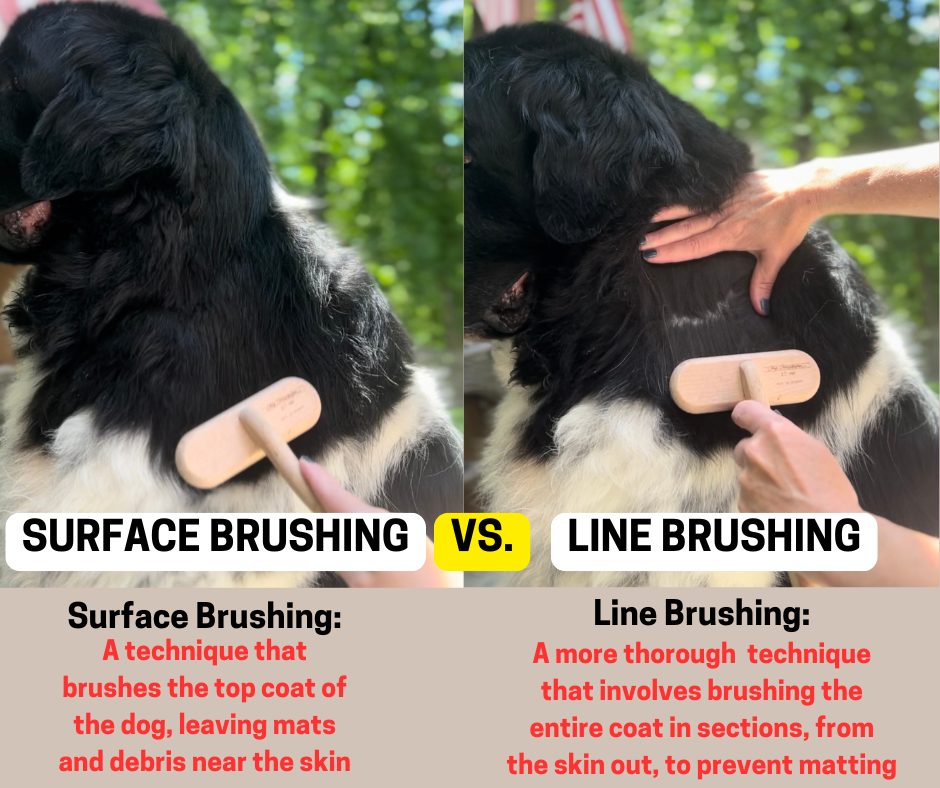
Image source: My Brown Newfies
Step 6: End with a Positive
Finish each session with a treat and some praise. This builds a positive association that makes future grooming easier. Your dog should associate the brush with good things, not just being held still.
The Skin Fold and Drool Zone: Face, Wrinkles, and Ears
The Saint Bernard has droopy lips, heavy jowls, and deep facial wrinkles. They're adorable, but they create real hygiene challenges. Food particles and moisture collect in the folds, creating the perfect environment for bacterial and yeast infections.
This is the "fold pyoderma" zone, and it's one of the most common skin problems in the breed. Veterinary dermatology literature indicates that deep facial folds retain moisture longer than flat skin, significantly increasing infection risk.
The Daily Fold Wipe
Make a habit of wiping your Saint Bernard's facial folds daily. Use a soft, damp cloth or canine grooming wipes. Avoid human baby wipes, as many contain ingredients that can irritate dog skin.
Gently lift each wrinkle and wipe the skin beneath. Ensure the area is completely dry afterward. Moisture in these folds is the enemy.
Many owners keep a dry cloth nearby specifically to dry the folds after meals and drinks.
The lips also need attention. The loose, droopy lips trap food and drool. Wipe them clean daily.
Check for redness, swelling, or an unpleasant odor. These are early signs of an infection that needs veterinary attention.
Ear Care That Prevents Problems
Saint Bernards have floppy ears that cover the ear canals. This creates a warm, dark, humid environment where infections thrive. If you've ever noticed your dog shaking their head or scratching at their ears, infection is the likely culprit.
Here's the weekly ear routine:
- Lift the ear flap and inspect the interior for redness, swelling, or waxy buildup.
- Squeeze a canine ear cleaning solution into the ear canal.
- Massage the base of the ear for 15-30 seconds to work the solution in.
- Let your dog shake their head.
- Wipe away loosened debris with a cotton ball or pad.
Never insert cotton swabs into the ear canal. You'll push debris deeper and risk damaging the eardrum.
A healthy ear is light pink and has minimal odor. Any dark, smelly discharge or persistent scratching warrants a trip to the vet. Chronic ear infections can quickly damage the eardrum in this breed.
Eye Care and Tear Staining
Saint Bernard eyes are deep-set, which makes them prone to irritation from long hairs and debris. Check the eyes during every grooming session. Look for redness, discharge, or cloudiness.
Tear staining, those reddish-brown streaks below the eyes, is common. It comes from porphyrin, a natural pigment in tears. When tears overflow onto the fur and sit there, the pigment oxidizes and stains the coat.
Regular wiping with a damp cloth helps minimize staining. You can also apply a small amount of cornstarch to keep the area dry.
Long hairs around the eyes can poke and irritate. Trim them carefully with blunt-nosed safety scissors. If your dog squints or rubs at their eyes, seek veterinary advice.
Eye problems can escalate quickly in this breed.
Bath Time for a 120-Pound Dog
Bathing a Saint Bernard is an event. It's not a quick task you squeeze in before dinner. It's a full operation that requires planning, space, and patience.
Most owners we've consulted agree: the process takes anywhere from 60 to 90 minutes from start to finish, not including drying.
Let's be clear about one thing upfront. You do not need to bathe your Saint Bernard often. Every six to eight weeks is the sweet spot for most dogs.
Bathing more frequently strips the natural oils that keep the double coat healthy and water-resistant.
How Often Should You Bathe?
| Scenario | Bathing Frequency |
|---|---|
| Normal indoor dog | Every 6-8 weeks |
| Heavy shed season | Same, but more brushing |
| Dog with skin issues | Per vet recommendation |
| Muddy or smelly incidents | As needed |
If your Saint Bernard rolls in something foul, you can spot-clean with water or grooming wipes. Reserve full baths for when they're genuinely needed.
Choosing the Right Shampoo
Your choice of shampoo matters more than you might think. Human shampoo is off-limits. Our skin has a different pH balance than a dog's, and human products can strip the protective acid mantle from their skin.
That leads to dryness, itching, and a higher risk of infection.
Look for:
- Dog-specific formulas with a pH balanced for canines
- Oatmeal-based shampoos for sensitive skin
- Hypoallergenic options for dogs with allergies
- Formulas specifically labeled "de-shedding" or "for double coats"
Avoid anything with artificial dyes, heavy fragrances, or harsh sulfates. These can irritate sensitive skin, especially in a breed already prone to skin fold issues.
The Pre-Bath Brush
This step is non-negotiable. You must brush your Saint Bernard thoroughly before getting them wet. Water makes mats worse.
A small tangle can turn into a tight, painful mat once it's soaked and allowed to dry.
Spend at least 15-20 minutes on pre-bath brushing. Use your undercoat rake first, then the slicker brush. Pay extra attention to the rear thighs, tail base, and behind the ears.
Remove as much loose fur as possible. This also makes the bath faster and keeps your drain from clogging.
Setting Up Your Bath Station
You have two main options: an indoor bathtub or an outdoor setup. Each has its pros and cons.
Indoor bathtub:
- Pros: Climate-controlled, easy access to warm water, no weather concerns
- Cons: Space is tight, clean-up is extensive, risk of fur clogging drains
Outdoor setup:
- Pros: More space, easy to rinse, no bathroom clean-up
- Cons: Weather-dependent, cold water risk, dog may resist
Whichever you choose, gather everything you need before bringing the dog in. Shampoo, conditioner, towels, brush, washcloth, and a cup for rinsing. You won't be able to step away once the dog is wet and slippery.
The Washing Process Step-by-Step
Get the coat thoroughly wet with lukewarm water. Not hot, not cold. Test it on your inner wrist first.
Saint Bernard skin is sensitive, and water that's too hot will cause discomfort and can worsen skin conditions.
Work the shampoo into the coat in sections. Start at the neck and work your way back. Massage it down to the skin, not just through the top layer.
Use your fingers to work through the dense undercoat. You'll feel when the fur is clean and soapy.
The face gets special treatment. Use a washcloth instead of pouring water directly over the head. Keep the ears protected.
Use one hand to gently hold each ear flap closed while rinsing the head. Water in the ear canal leads to infections, and this breed is already prone to them.
Rinse thoroughly. Shampoo residue left in the coat causes irritation and dulls the fur. You should rinse until the water runs completely clear.
This takes longer than you think. A good rule: rinse twice as long as you think you need to.
Why You Should Consider a Conditioner
A good conditioner designed for double-coated breeds does more than make the fur soft. It helps detangle, reduces static, and replaces moisture lost during washing. It also helps maintain the natural water resistance of the outer coat.
Apply conditioner after you've rinsed out the shampoo. Work it through the coat, avoiding the face. Let it sit for the recommended time on the label, usually two to three minutes.
Rinse thoroughly.
The Drying Protocol: The Most Overlooked Step
If there's one step where Saint Bernard owners go wrong, it's drying. This is the difference between a healthy coat and a skin disaster. In our research, vets consistently identify incomplete drying as a leading cause of hot spots, fungal infections, and itchiness in double-coated breeds.
Here's the problem: a Saint Bernard's undercoat is like a sponge. It traps moisture close to the skin. If you towel-dry and let the rest air-dry, the undercoat can stay damp for hours or even a full day.
That warmth and moisture create the perfect environment for Malassezia yeast and bacteria to flourish.
Why Towel Drying Is Not Enough
Towel drying removes surface moisture only. The water trapped deep in the undercoat stays put. You can go through five or six towels and still have a damp undercoat.
Air drying is worse. The outer coat dries first, trapping dampness beneath. Meanwhile, your dog is walking around with wet skin for hours.
Any folds, wrinkles, or areas of friction become prime candidates for irritation.
The solution is mechanical drying. You need forced air to blow through the coat and lift water away from the skin.

Image source: Amazon (product image)
The High-Velocity Dryer Method
A high-velocity dryer is the single most valuable grooming investment for a Saint Bernard owner. These tools force air at high speed through the coat, pushing water out and separating the hair shafts. They are the standard in professional grooming for good reason.
Here's how to use one properly:
- Set the dryer to low or medium speed for the first pass. High speed on wet, matted fur can cause tangling.
- Work in sections. Start at the rear and move forward.
- Hold the nozzle a few inches from the coat at an angle, not perpendicular.
- Use one hand to lift and separate the fur as you dry.
- Follow the direction of hair growth.
- Pay extra attention to the undercoat, rear thighs, and tail base.
Drying time runs 45 to 75 minutes for a full Saint Bernard. You'll see water vapor coming off the coat as the undercoat dries. When you run your hands through the fur and feel no moisture, you're done.
The Fluff Drying Technique
If you want professional results, combine the high-velocity dryer with a slicker brush. This is called "fluff drying." You brush the coat while drying it simultaneously.
This technique serves two purposes. It blows water out of the coat while separating hair shafts. A properly fluff-dried Saint Bernard has a noticeably fuller, softer coat.
It also prevents the fur from drying in clumps, which can turn into tangles.
Work in small sections. Brush a section of fur, then dry it. Move to the next section.
It's slower than just drying, but the results are worth it.
A Quick Word on Drying in Warm Weather
You might be tempted to let a wet Saint Bernard air-dry in the sun on a hot day. Don't. The outer coat can trap heat against the skin.
Combined with a wet undercoat, this creates a dangerously hot, humid environment that's perfect for skin infections and heat stress.
Always mechanically dry, even in summer. Your dog will be more comfortable and much healthier for it.
Nails, Paws, and the Stuff People Forget
Nail trimming is the part of grooming that most owners dread, and for good reason. A Saint Bernard's nails are thick, and many dogs of this breed have black nails, making the quick invisible. But this is non-negotiable.
Long nails don't just look bad. They can change your dog's gait, cause joint pain, and lead to long-term orthopedic issues.
How Often to Trim
Every three to four weeks is a good baseline. You'll know they're too long when you hear clicking on hard floors. If you're less certain, look at your dog's feet from the side.
The nails should be close to the ground but not touching it when standing.
| Nail Length Issue | Sign | Risk |
|---|---|---|
| Too long | Clicking on floors | Altered gait, joint strain |
| Touching ground | Visible contact when standing | Pressure on quick, pain |
| Curling | Tip curls toward paw pad | Pad punctures, infections |
Handling Black Nails Safely
Black nails are tricky because you can't see the quick. The quick is the bundle of nerves and blood vessels inside the nail. Clip into it and you get bleeding, pain, and a dog that's nervous about future trims.
The safest approach is gradual removal. Take small slices off the tip, not big chunks. After each cut, look at the cross-section of the nail.
If you see a light gray or pink oval in the middle, you're getting close to the quick. Stop.
If you do clip the quick, don't panic. Apply styptic powder to the nail tip and apply gentle pressure for a minute or two. The bleeding should stop.
Keep a jar handy during every session.
Grinder vs. Clippers
You have two main tool options for nail care. Each has advocates and critics.
Nail Grinders:
- Pros: No risk of cutting the quick, smooth edges, less pressure
- Cons: Slower, loud, some dogs dislike the sensation
- Best for: Nervous owners, dogs with black nails
Clippers:
- Pros: Fast, quiet, precise with practice
- Cons: Risk of quicking, leaves sharp edges, can crush brittle nails
- Best for: Experienced owners, cooperative dogs, clear nails
In our research, many Saint Bernard owners prefer grinders. The breed is usually calm, which pairs well with the slower, gentler process. Grinders also smooth the nail edge, which prevents snagging and scratching.
Paw Pad Care
Your Saint Bernard's paws take a beating. The large, thick-padded feet are designed for snow and rough terrain. But heat, ice, salt, and pavement can all cause problems.
| Season | Paw Threat | Prevention |
|---|---|---|
| Summer | Hot pavement burns | Walk early or late, use paw balm |
| Winter | Ice salt and chemical deicers | Wipe paws after walks, use booties |
| Year-round | Cracks and dryness | Apply paw balm weekly |
Check the paw pads during each grooming session. Look for cracks, cuts, redness, or foreign objects stuck between the toes. You should also check the space between the pads for matting.
Hair here collects debris and can cause painful snowball-like formations in winter.
Trim excess hair between the pads with blunt-nosed scissors. This keeps the area clean and reduces the risk of matting and debris accumulation.
Dewclaw Checks
Dewclaws are the small, high-up toes on the inside of the legs. Some Saint Bernards have them on the front only, some in the rear too, and some are born without them.
These nails don't touch the ground, so they don't wear down naturally. They can curl back around into the paw pad if left untrimmed. That's painful and can cause serious infection.
Include dewclaws in your regular nail trim every single time. They're easy to forget, but the consequences of forgetting are severe.
Dental Health as Part of Grooming
You might not think of dental care as grooming, but it belongs in the same routine. Saint Bernards are prone to dental disease, and regular cleaning prevents bad breath, tooth loss, and systemic infections.
Use a dog-specific toothbrush and toothpaste. Human toothpaste contains xylitol, which is toxic to dogs. Start slow, especially with a puppy.
The goal is to brush the outer surfaces of the teeth and the gum line.
Brushing twice a week is a good target. If you're not comfortable with a brush, use dental wipes or dental chews designed for large breeds. These aren't as effective as brushing, but they're far better than nothing.
If you notice persistent bad breath despite regular brushing, that's often the first sign of dental disease. Tartar buildup, red gums, or bleeding during brushing means it's time for a veterinary dental check. Professional cleanings under anesthesia are sometimes the only way to address established dental issues in this breed.
The mouth also ties into the drool problem. Food particles trapped in the lip folds and between the teeth contribute to the sour smell that many Saint Bernard owners complain about. Regular dental care plus daily lip wipes dramatically reduces that odor.
Eyes and Tear Stains
We touched on eyes earlier, but they deserve a deeper look. Saint Bernards have deep-set eyes that are prone to irritation from long hairs, debris, and their own facial folds. During every grooming session, take 30 seconds to examine both eyes.
Look for:
- Redness or bloodshot whites
- Cloudiness or a bluish tint
- Excessive discharge or crusting
- Squinting or pawing at the face
- Changes in tear stain color
Tear stains appear as reddish-brown streaks below the eyes. They come from porphyrin, an iron-rich pigment in tears. When tears overflow onto the fur and sit there, the pigment oxidizes and stains the coat.
Regular wiping with a damp cloth keeps this under control. You can also apply a small amount of cornstarch to keep the area dry.
Some owners try whitening products or hydrogen peroxide to remove stains. Don't. These can irritate the eye and surrounding skin.
Gentle, consistent wiping is safer and just as effective over time.
Long hairs growing near the eyes should be trimmed with blunt-nosed scissors. If your dog suddenly develops excessive tearing, squinting, or visible discomfort, see a vet immediately. Eye issues in this breed can progress quickly.
Common Mistakes That Hurt Your Saint Bernard
We've covered the proper techniques in detail. Now let's talk about what goes wrong. These are the mistakes that send owners to the vet, damage the coat, and create behavioral issues around grooming.
Mistake 1: Brushing Only the Top Layer
This is the most common error by far. Owners brush the guard hairs, see a smooth coat, and assume the job is done. The undercoat remains packed with loose fur that mats against the skin.
By the time you feel those mats, they're already pulling and restricting movement.
The fix: always use the undercoat rake first, every single session. Penetrate down to the skin. If you can't feel the rake's tines through the coat, you're not brushing deep enough.
Mistake 2: Shaving or Clipping the Coat
We covered this earlier, but it deserves emphasis. Shaving a Saint Bernard damages the coat permanently in most cases. The guard hairs may grow back different in texture, color, or thickness.
In severe cases, they don't grow back at all, leaving permanent bare patches.
Shaving also increases heat stroke risk. The double coat insulates against heat, not just cold. Remove it and you expose the skin to direct sun and heat absorption.
Mistake 3: Bathing Too Frequently
We get it, a 120-pound dog with drool and dirt can get smelly fast. But bathing more often than every six weeks strips the skin of its natural protective oils. Dry skin leads to itching, scratching, and secondary infections.
Instead of more baths, increase brushing frequency and use grooming wipes for spot cleaning. These address odor and dirt without damaging the coat's natural defenses.
Mistake 4: Incomplete Drying
We've already detailed why this matters. Let's make it crystal clear: a damp undercoat is a breeding ground for bacteria and yeast. Hot spots, itchy skin, and a musty odor all trace back to incomplete drying.
The fix: always use a high-velocity dryer after baths. If you don't have one, keep your dog inside and brush them frequently until fully dry. Never let a freshly bathed Saint Bernard air-dry outside or in a drafty area.
Mistake 5: Ignoring the Skin Folds
The facial folds and lip wrinkles are silent trouble zones. They trap moisture, food, and drool. Owners who skip fold cleaning notice a sour smell, redness, and eventually infections that require topical or oral antibiotics.
The fix: wipe the folds daily. Dry them completely after every wipe. This takes 30 seconds and prevents a world of pain for both you and your dog.
Mistake 6: Using the Wrong Brush
A human brush or a pin brush alone won't penetrate the Saint Bernard coat. Likewise, a FURminator can damage the guard hairs over time. You need a proper undercoat rake and a slicker brush designed for thick, double coats.
Mistake 7: Turning Grooming Into a Struggle
If your dog fights every brush, you're doing it wrong. Grooming should be calm and positive. Forcing a struggling giant breed only creates fear and resistance.
The fix: start slow, use treats, keep sessions short and end on a positive note. Build trust before you build routine.
When to Call a Professional Groomer
There's no shame in admitting when a Saint Bernard is beyond your grooming comfort zone. These are large, powerful animals with thick coats and sensitive skin. Professional groomers with giant breed experience bring skill, specialized equipment, and the physical strength to handle a wiggly 150-pound dog.
Signs You Need a Professional
Some situations genuinely require professional intervention:
- Severe matting that you can't safely brush out at home
- A dog that becomes aggressive or defensive during grooming
- Nails that are overgrown to the point of curling
- A double coat that's already been damaged and needs repair
- You simply don't have the time or physical ability for regular maintenance
If you find yourself dreading grooming sessions, that's also a sign to delegate. A professional can handle the deep grooming while you maintain with light brushing between appointments.
What a Professional Grooming Session Includes
A proper professional session for a Saint Bernard includes more than just a bath and brush. Expect the following:
- Full de-shedding treatment with professional-grade undercoat rakes
- Thorough bath with high-quality shampoo and conditioner
- Complete drying with high-velocity dryers and fluff drying
- Nail trimming and grinding
- Ear cleaning
- Paw pad trimming and care
- Facial fold cleaning
- Sanitary trim for hygiene
How Much Does It Cost?
Giant breed grooming costs more than standard sizes. This is due to the time, equipment, and physical effort involved.
| Service | Typical Cost Range |
|---|---|
| Full groom (bath, dry, brush, nails) | $85 – $150 |
| De-shedding treatment alone | $50 – $90 |
| Nail trim | $15 – $25 |
| Bath only | $40 – $70 |
Prices vary by region and facility. Large metropolitan areas run higher. Rural areas tend to be more affordable.
Always ask about giant breed pricing before booking.
How to Find a Groomer Who Knows the Breed
Not every groomer is equipped for a Saint Bernard. Some work exclusively with small dogs. Others lack the sturdy tables and heavy-duty dryers needed for giant breeds.
Ask potential groomers these questions:
- Have you worked with Saint Bernards or similar giant breeds?
- What techniques do you use for drying a double coat?
- Do you use a high-velocity dryer?
- Are you comfortable with dogs that weigh over 120 pounds?
- Can I watch the first session?
If a groomer hesitates or says they've never handled a giant breed, keep looking. You want someone confident and experienced, not someone learning on your dog.
Quick Reference: The 10-Minute Grooming Checklist
Life gets busy. Some weeks, you won't have time for a full grooming session, and that's okay. What matters is consistency.
A 10-minute daily or every-other-day routine prevents the problems that turn into hours of work later.
Here's your streamlined checklist for those hectic days. Print it. Stick it on the fridge.
Make it a habit.
Daily (2-3 minutes):
- Wipe facial folds and lip wrinkles with a damp cloth
- Dry the folds completely
- Check for redness, odor, or discharge in folds
Every Other Day (10 minutes):
- Run the undercoat rake over the rear thighs, neck, and tail base
- Follow with a slicker brush over the whole body
- Check ears for redness or odor
- Offer a dental chew if brushing isn't happening today
Weekly (15-20 minutes):
- Full pass with undercoat rake
- Full pass with slicker brush
- Greyhound comb check on sensitive areas
- Clean ears with canine solution
- Spot-check nails for length
- Inspect paw pads for cracks or debris
Monthly (30-45 minutes):
- Trim or grind nails
- Check and trim dewclaws
- Thorough paw pad inspection with hair trimming
- Full body check for lumps, bumps, ticks, or wounds
- Deep clean of facial folds and skin wrinkles
Seasonally (every 6-8 weeks):
- Full bath with dog-safe shampoo and conditioner
- High-velocity dryer dry with fluff drying
- De-shedding deep session during blowout season
- Dental check and possible professional cleaning
Here's the honest math. If you spend 10 minutes every other day plus one 20-minute weekly session, you're looking at roughly 60 to 80 minutes per week on grooming. That's less time than most people spend watching one TV episode per night.
The payoff is a healthier dog, cleaner home, and far fewer emergency vet visits for skin or ear infections.
The alternative is devastating. Skipped grooming for two weeks can mean mats that require sedation to remove. A single overlooked ear infection can progress to require months of treatment.
The 10-minute routine is genuinely cheap insurance.
FAQs Owners Actually Ask
How much grooming does a Saint Bernard need?
Plan on brushing three to four times per week for 15 to 20 minutes each session. Daily brushing is better during the seasonal blowouts. Full baths happen every six to eight weeks, plus daily fold wiping and weekly ear cleaning.
Total weekly grooming time lands around 60 to 90 minutes.
Can I use a FURminator on my Saint Bernard?
Most professional groomers recommend against it. FURminator blades are designed to cut through the undercoat, which means they can also cut and damage the guard hairs of a double coat. Over time, this damages the coat's water resistance and appearance.
A proper undercoat rake achieves the same de-shedding results without the damage.
How often should I bathe my Saint Bernard?
Every six to eight weeks is the standard recommendation. Bathing more frequently strips natural skin oils and causes dryness and irritation. If your dog gets smelly between baths, use grooming wipes or a waterless dog shampoo for spot cleaning.
Reserve full baths for genuinely dirty situations.
Why does my Saint Bernard smell even after a bath?
The most common cause is incomplete drying, which leaves moisture trapped in the undercoat and skin folds. Bacterial or yeast infections, particularly in the facial folds and ears, also cause persistent odors. If your dog smells sour or musty despite proper grooming, check the folds and ears.
If you find redness, discharge, or unusual odor, a vet visit is in order.
Should I shave my Saint Bernard in summer?
Never. The double coat insulates against heat as well as cold. Shaving increases heat stroke risk and permanently damages the coat.
Instead, increase brushing frequency during summer to remove loose undercoat and improve airflow through the fur.
How do I stop my Saint Bernard from shedding so much?
You can't stop a double coat from shedding. It's a natural process tied to daylight and temperature changes. What you can do is manage it.
Regular undercoat raking removes loose fur before it lands on your floors. During blowout season, daily brushing keeps the fur out of your home; a high-velocity dryer on dry days also works well to blast out loose undercoat.
What's the safest way to trim black nails?
Take small slices off the tip and inspect the cross-section after each cut. If you see a gray or pink oval, you're approaching the quick and should stop. A nail grinder offers a safer alternative since it allows gradual removal without the risk of cutting the quick.
Always keep styptic powder on hand in case of bleeding.
The Bottom Line on Keeping Your Saint Bernard Looking and Feeling Great
Grooming a Saint Bernard is not optional. It's a core responsibility that directly impacts your dog's health, comfort, and quality of life. The dense double coat, deep skin folds, floppy ears, and giant paws all require consistent attention.
Here's what it boils down to:
Brushing three to four times weekly prevents mats, removes loose fur, and keeps the skin healthy. The undercoat rake is your primary tool. The slicker brush handles the topcoat. The greyhound comb checks your work.
Bathing every six to eight weeks keeps the coat clean without stripping natural oils. Always brush before the bath. Always dry completely with a high-velocity dryer. Never air-dry a double coat.
Daily fold wiping and weekly ear cleaning prevent the most common Saint Bernard health issues. These small tasks take minutes but save hours of vet visits and thousands of dollars in treatments.
Never shave a double coat. It's not a kindness. It's harmful.
Professional grooming support is available when you need it. Don't hesitate to book a session if you're out of your depth, short on time, or dealing with an uncooperative dog.
The most important principle is consistency over intensity. Ten minutes every other day beats a two-hour marathon once a month. Your dog will thank you, your home will stay cleaner, and you'll catch health issues before they become emergencies.
Start today. Even five minutes of brushing makes a difference. Build the habit, gather the right tools, and you'll find that grooming your Saint Bernard becomes a bonding ritual rather than a dreaded chore.
Your gentle giant deserves nothing less.