
Your Sphynx cat's skin feels like warm suede, but it leaves an oily film on everything it touches. That's not a flaw. It's biology.
Without fur to absorb the sebum your cat produces naturally, the oil builds up quickly, mixing with dead skin cells, dust, and litter debris. Left alone, that mixture turns into a brown, waxy residue that smells, stains your furniture, and clogs your cat's pores.
Learning how to bathe a Sphynx cat correctly is the most important grooming skill you'll develop as an owner. Get it right, and your cat's skin stays healthy and comfortable. Get it wrong, and you'll trigger the exact problems you're trying to prevent: dry patches, acne, infections, and a cat that dreads bath time.
As of 2026, veterinary dermatologists still recommend a simple, consistent bathing routine over any expensive skincare line. Your goal isn't to strip every drop of oil. It's to manage the buildup before it becomes a problem.
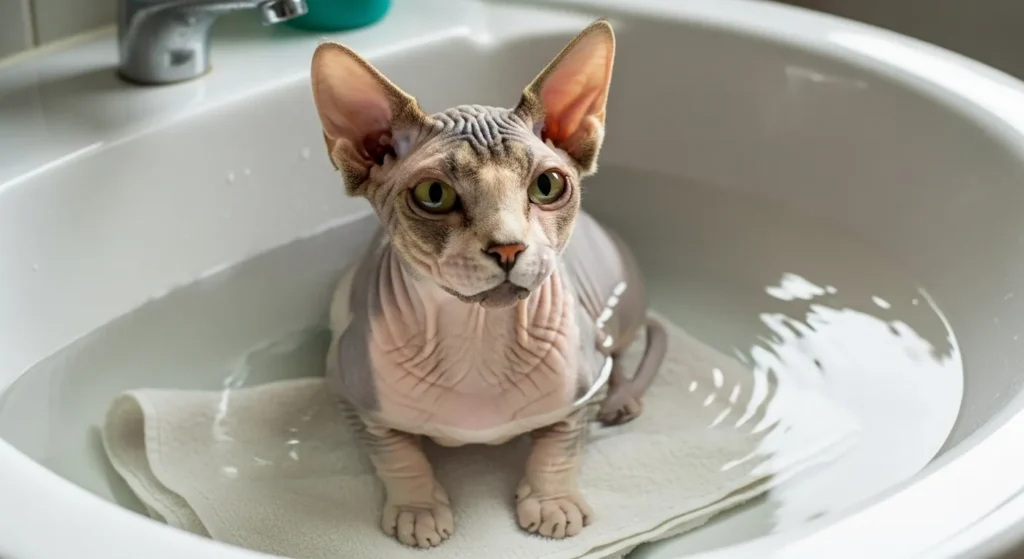
Image source: Bing (Web (fair-use with source credit))
Quick Answer
Bathe your Sphynx every 1 to 2 weeks using warm water at 98 to 100°F and a veterinarian-formulated cat shampoo. Wet the body, lather gently, rinse thoroughly, and dry completely with warm towels. Never use human shampoo.
Trim nails first. Clean ears after. Watch for skin irritation.
Why Bathing a Sphynx Is Different (and Why It Matters)

Image source: Web (Bing) / 12thblog.com (Web image (fair-use with source credit))
Most cats never need a bath. Their coats handle oil distribution naturally. A Sphynx doesn't have that luxury.
With no fur to wick sebum away from the skin, the oil sits right on the surface, where it collects everything. This isn't a hygiene failure on your part. It's a genetic reality of the breed.
The skin of a Sphynx is also more delicate than it looks. You're working with a surface that's exposed to the world 24/7 without any protective layer. The skin barrier, the outermost layer that locks in moisture and blocks irritants, is doing double duty.
When you bathe too aggressively or use the wrong products, you damage that barrier.
What Is Sebum and Why Does It Matter?
Sebum is the natural oil your cat's skin produces. In a furred cat, it travels down the hair shaft and keeps the coat conditioned. In a Sphynx, there's nowhere for it to go.
The result is exactly what you see on your cat's skin: a slick, sometimes sticky film that picks up dust and dander. This buildup is called a sebaceous film, and it's completely normal. However, the rate at which it accumulates varies wildly between individual cats.
Some Sphynxes need a bath every 5 days. Others go 3 weeks without looking greasy.
Sphynx breeders consistently report that diet plays a major role in oil production. Cats on high-protein, low-carbohydrate diets tend to produce less sebum than cats eating kibble with heavy grain fillers. That's not a universal rule, but it's worth noting if your cat gets greasy unusually fast.
What Happens When You Don't Bathe
Skipping baths entirely leads to a predictable set of problems. The oil film thickens. Dead skin cells pile up.
Blackheads form, especially on the chin, tail, and back. You may also notice a yeasty, musty smell, which signals that bacteria or yeast are multiplying in the trapped moisture.
This isn't just cosmetic. The buildup can clog hair follicles, causing folliculitis, an inflammation that looks like small red bumps. In severe cases, the skin becomes so irritated that your cat starts scratching, which breaks the skin and opens the door to secondary infections.
Research from the Cornell Feline Health Center emphasizes that feline skin health depends heavily on maintaining a balanced microbiome. Over-washing disrupts that balance just as much as under-washing does. The goal is moderation, not sterilization.
The Sphynx Skin Barrier and pH
Here's where things get technical, but it matters. A cat's skin pH hovers between 6.0 and 7.5. Human skin sits at a more acidic 4.5 to 5.5.
Human shampoo is formulated for that acidic environment. When you use it on a cat, it strips the skin barrier far too aggressively. The result is dry, flaky skin that itches, plus a rebound effect where the skin overproduces oil to compensate.
That's why your Sphynx can end up greasier after a human shampoo wash than before it.
Always choose a shampoo explicitly labeled for cats, ideally one designed for sensitive or hairless breeds.
How Often Should You Bathe a Sphynx? (The Short Answer)
There's no single schedule that works for every Sphynx, and anyone who tells you otherwise is simplifying too much. The truth is that bathing frequency depends on your individual cat's oil production, diet, environment, and skin condition.
Start with a baseline of once every 1 to 2 weeks. Then adjust based on what you observe. If your cat's skin looks slick and feels oily at day 6, you're in the every-week camp.
If your cat stays relatively clean for 2 weeks or more, stretch the interval.
Reading Your Cat's Skin Signals
Your Sphynx's skin tells you exactly when it needs a bath. You just have to know what to look for.
- The touch test. Run your hand across your cat's back. If your palm comes away with a visible shine or a sticky residue, it's bath time.
- The smell test. A clean Sphynx has a neutral, almost warm smell. A musty or sour odor means the sebum is starting to break down and harbor bacteria.
- The appearance test. Look for a brownish film on the skin, especially around the ears, chin, armpits, and groin. That's oxidized sebum mixed with dead skin cells.
- The transfer test. If your cat leaves an oily mark on dark clothing or your white sheets, the buildup is already significant.
If the skin feels rough and flaky, you're bathing too often or using a harsh product. If the skin feels slick and looks shiny, you're not bathing often enough.
Seasonal Adjustments
Summer heat increases sebum production across most Sphynx cats. Warmer temperatures mean more oil, which means more frequent baths. During humid summer months, you may need to shift to a weekly schedule just to keep up.
Winter brings the opposite challenge. Cold, dry air can make skin flaky and irritated. Many owners find their Sphynx needs fewer baths in winter, and those baths should use a conditioner to lock in moisture.
Breeder forums and veterinary dermatology resources consistently report seasonal variation in sebum output. Your cat's skin is not static. It responds to its environment, and your routine should too.
Age and Life Stage
Kittens under 6 months old produce less sebum than adults. Their skin is also more sensitive. Start with baths every 3 to 4 weeks and increase the frequency gradually as your kitten matures.
Senior Sphynx cats often develop drier skin. Bathing every 2 to 3 weeks with a moisturizing shampoo is usually adequate. If you notice persistent flakiness, consult your vet rather than just adding more baths.
Individuals with skin conditions like dermatitis or fungal infections need a veterinary-prescribed schedule. That schedule may involve medicated shampoos and a completely different frequency than what works for a healthy cat.
What You'll Need: The Sphynx Bathing Checklist

Image source: Bing (Web (fair-use with source credit))
The right tools make bath time manageable for both of you. Gather everything before you start. There's nothing worse than wrestling a wet, slippery cat while you scramble for a forgotten towel.
Essential Supplies
Here's your complete checklist, broken down by category.
| Category | Item | Why It Matters |
|---|---|---|
| Cleanser | Cat-safe shampoo (veterinary formula or oat-based) | Matches feline skin pH, gentle on sensitive skin |
| Cleanser | Cat-safe conditioner (optional) | Adds moisture back for dry or flaky skin |
| Tub setup | Non-slip rubber mat | Prevents slipping, reduces panic and injury risk |
| Tub setup | Cup or handheld sprayer | Controls water flow, keeps water out of the face |
| Drying | 2 to 3 microfiber towels | Absorbs much more water than cotton, speeds drying |
| Prep | Nail clippers | Prevents scratches during handling |
| Prep | Cotton balls | Blocks ear canals, absorbs excess moisture |
| Aftercare | Cat-safe ear cleaner | Removes wax, prevents infection |
| Comfort | Treats or squeeze tube of wet food | Rewards calm behavior, builds positive association |
Choosing the Right Shampoo
The safest choice is a shampoo specifically formulated for sensitive feline skin. Look for labels that say oatmeal-based, hypoallergenic, or specifically for hairless breeds.
What you want to see in the ingredients:
- Oatmeal (colloidal oatmeal calms irritation)
- Aloe vera (soothes and moisturizes)
- Glycerin (humectant that pulls moisture into the skin)
What you must avoid at all costs:
- Any human shampoo, including baby shampoo
- Tea tree oil (toxic to cats even in small amounts)
- Essential oils, including lavender, eucalyptus, and citrus
- Flea and tick shampoos unless a vet has prescribed them
- Products with artificial dyes or strong fragrances
Manufacturer specifications for many cat shampoos indicate a dilution ratio. "Concentrated" formulas often need a 1:1 mixture with warm water before application. Check the label.
Applying undiluted concentrate can be too harsh.
Water Temperature and Depth
Fill the tub or sink with about 3 to 4 inches of warm water. The temperature should sit between 98 and 100°F (36 to 38°C). That's body temperature for a cat.
Test the water with your wrist or elbow, the same way you would for a baby. If it feels neutral, not hot and not cold, it's right. Water that's too hot risks scalding your cat's sensitive skin.
Water that's too cold triggers stress and shivering.
Your cat's comfort during the bath is as important as the cleaning itself. A cat that associates bath time with discomfort will fight harder next time. A calm, warm experience builds tolerance and trust.
Step-by-Step: How to Bathe Your Sphynx Without the Drama
Now we get to the actual process. Every step matters, and skipping preparation is the fastest way to turn bath time into a wrestling match. Follow this sequence every time so your cat knows what to expect.
Pre-Bath Preparation
Trim your cat's nails before the bath, not after. A wet Sphynx is slippery and understandably unsteady. If your cat decides to protest, those claws are your primary injury risk.
Clean the ears before the bath using cotton balls and a cat-safe ear cleaner. You should not be trying to clean ears while your cat is wet and stressed.
Brush the skin gently with a soft mitt or your hands. This dislodges loose dead skin cells and gets the sebum moving so the shampoo can work more effectively.
Step 1: Set Up the Bathing Area
Close the bathroom door and window. You want a draft-free environment. Fill the tub or sink with your 3 to 4 inches of warm water and place the non-slip mat on the bottom.
Have everything within arm's reach. Shampoo, conditioner, cup, towels, cotton balls, all of it. You should never have to step away from your cat once the bath starts.
Step 2: Wet the Body Gently
Place your cat in the water and use your cup or handheld sprayer to slowly wet the body from the neck down. Pour water over the back, sides, and legs.
Do not pour water directly over the head. The face gets cleaned separately with a damp cloth. Aim to thoroughly wet the body while keeping the head dry.
Step 3: Apply Shampoo and Lather
Squeeze a small amount of shampoo, about a nickel-sized drop, into your palm. Dilute it with a little water if the label calls for it.
Work the lather into your cat's skin starting at the neck and moving down the back. Use gentle, circular motions with your fingertips. Pay special attention to the armpits, groin, chin, and the base of the tail.
These are high-sebum zones where buildup happens fastest.
Do not scrub. The skin is sensitive, and aggressive rubbing causes micro-irritation. Keep the massage light and thorough.
Step 4: Wash the Face
Dip a clean washcloth in plain warm water and wring it out until damp. Wipe the face gently, focusing on the chin, around the nose, and the area around the eyes.
You can use a tiny amount of shampoo on the cloth for the chin if acne is present. Rinse the cloth thoroughly and wipe again to remove any soap residue.
Never apply shampoo directly to the face or eyes. The risk of irritation is too high.
Step 5: Rinse Thoroughly
This is the most skipped step, and it's arguably the most important. Shampoo residue left on the skin is a major irritant.
Use your cup or sprayer to rinse the body with clean warm water. Cover every inch you lathered. Keep rinsing until the water running off your cat runs clear with no suds.
Use your fingers to gently squeeze excess water out of the skin folds. This dislodges trapped soap and speeds up the drying process.
Step 6: Squeeze and Towel Dry
Lift your cat out of the tub and wrap it immediately in a dry microfiber towel. The moment your cat is out of the water, heat loss begins, so speed matters.
Press the towel against the skin to absorb water. Don't rub. Rubbing breaks this sensitive skin and tangles any remaining dead skin cells into clumps.
Use a second dry towel to finish the job, especially in the folds. Armpits, groin, chin, and the tail base need special attention. Moisture trapped in these areas creates a perfect environment for fungal and bacterial growth.
If the room is warm and your cat tolerates it, you can finish with a low-heat hairdryer on the cool or warm setting. Hold it at least 12 inches from the skin and keep it moving constantly. Never hold it still over one spot.
Step 7: Post-Bath Care
Once your cat is dry, clean the ears again. The moisture from the bath can push wax deeper into the ear canal. Use a cotton ball with cat-safe ear cleaner and wipe the visible outer ear only.
Reward your cat immediately with treats or a squeeze tube of wet food. This positive reinforcement builds the association that bath time ends with something good.
Keep your cat in a warm, draft-free room for at least 30 minutes after the bath. Wrap a warm towel around your cat if the room is cool.
Common Mistakes That Irritate Sphynx Skin

Image source: Bing (Web (fair-use with source credit))
Even experienced Sphynx owners make mistakes. The good news is that most are easily corrected once you know what to look for. Here are the most common pitfalls, ranked by how often they cause problems.
Over-Bathing and the Rebound Oil Effect
Bathing too frequently is the number one mistake. When you strip the skin of all its natural oil, the sebaceous glands panic and overproduce to compensate.
The result is a cycle that's hard to break. You bathe because your cat is greasy. The bath strips everything.
The skin produces more oil than before. A week later, your cat is greasier than when you started.
Consistent over-bathing also damages the skin barrier. The skin loses moisture faster, becomes dry and flaky, and the flakes mix with the excess oil to create a sticky paste that's harder to clean than normal sebum.
The fix is simple: space out your baths and monitor your cat's natural oil cycle. If your cat is oily by day 5, you're over-bathing or using a shampoo that's too harsh. Try extending the interval by a few days.
Using Human Shampoo
Human shampoo is the second most common mistake. The pH mismatch strips the skin barrier and causes the rebound effect we just discussed.
Baby shampoo isn't the safe alternative it's often made out to be. It's still formulated for human skin and human pH. It may be milder than adult human shampoo, but it's still wrong for a cat.
Stick with veterinary-formulated cat shampoo. The pH is matched to feline skin, and the surfactants are gentle enough for a species that lacks a protective fur coat.
Water in the Ears
Sphynx cats have large, open ears that are prone to wax buildup. It's tempting to clean them aggressively during bath time, but that's a mistake.
Water that gets trapped in the ear canal creates a warm, moist environment where yeast and bacteria thrive. Ear infections in Sphynx cats are common, and many of them start with a bath.
Prevent this by placing a cotton ball gently in each ear before the bath. Just enough to block water entry, not so deep that you can't remove it. Then clean the ears thoroughly after the bath with a drying ear cleaner.
Skipping the Rinse
Shampoo residue is an invisible irritant. It dries on the skin, causes itching, and attracts dirt.
Owners in a hurry often half-rinse their cats. The lather looks gone, but soap is still trapped in the skin folds. The cat starts scratching a few hours later, and the owner assumes the shampoo was too harsh.
The fix is to rinse for twice as long as you think is necessary. Squeeze the skin folds while rinsing to flush out trapped soap.
Inadequate Drying
A damp Sphynx is a cold Sphynx. Without fur, they lose body heat rapidly.
More importantly, a damp Sphynx is a fungal risk. Moisture trapped in skin folds can cause ringworm and other fungal infections within 24 hours. These are miserable to treat and highly contagious to other pets.
Dry your cat with towels until every fold is dry. If your cat tolerates it, finish with a low-heat hairdryer for complete peace of mind.