Tag: home grooming

  • How to Deshed a Dog at Home Safely

    How to Deshed a Dog at Home Safely

    Deshedding a dog at home means removing loose dead hair safely. It is not mat removal, and it should not involve scraping skin, digging with a tool, or trying to pull every last hair. Start with a skin and coat check, choose the gentlest path for the coat, use light pressure, and stop at the first sign of redness, soreness, pain, or stress.

    If your dog has tight mats, irritated skin, hot spots, bald patches, parasites, sudden heavy hair loss, or pain, skip deshedding and use a veterinarian or qualified groomer. For a broader loose-hair routine, see how to remove loose dog hair.

    Check the Coat Before You Start

    A safe deshedding session starts with inspection, not brushing. Part the coat with your fingers in a few dense areas and look for skin changes, tight tangles, packed undercoat, or damp spots.

    Stop before deshedding if you see:

    • Red, sore, hot, flaky, swollen, or broken skin.
    • Bald patches, parasites, odor with irritation, or sudden coat change.
    • Tight mats, skin-level mats, or packed coat that does not separate easily.
    • Pain, yelping, growling, snapping, trembling, or panic.

    Texas A&M Pet Talk notes that abnormal shedding or skin and coat concerns can call for a veterinarian conversation. Treat sudden or patchy hair loss as a health question, not a brushing challenge.

    Deshedding Is Not Dematting

    Deshedding removes loose dead hair that is ready to release. Dematting deals with tangled or compacted hair. Those jobs need different boundaries.

    The ASPCA’s matting guidance warns that mats can hide skin problems and that cutting mats out with scissors can injure pets. If a mat does not brush out easily with gentle work, do not cut, scrape, or force it. Use a groomer or veterinarian.

    Choose the Gentlest Deshedding Path

    The right path depends on coat type, skin condition, mat status, and how well the dog tolerates handling. The ASPCA dog grooming tips recommend matching brushes and combs to the dog’s hair type.

    Coat stateSafer pathStop if
    Short smooth coat, healthy skinRubber curry or soft brush category, short light passesSkin gets pink, warm, flaky, or sore
    Medium double coat, mat-freeDry brush in small zones, then comb-check dense areasTool catches, dog resists, or skin changes
    Heavy double coat, mat-freeShort dry sessions; bath-assisted only if you can dry to skinCoat stays damp near the skin or packed areas remain
    Long, curly, or wavy coatComb-check first; use gentle brushing only where hair separatesTangles pull, tighten, or sit close to skin
    Irritated skin, severe mats, or sudden hair lossNo home desheddingUse a veterinarian or groomer
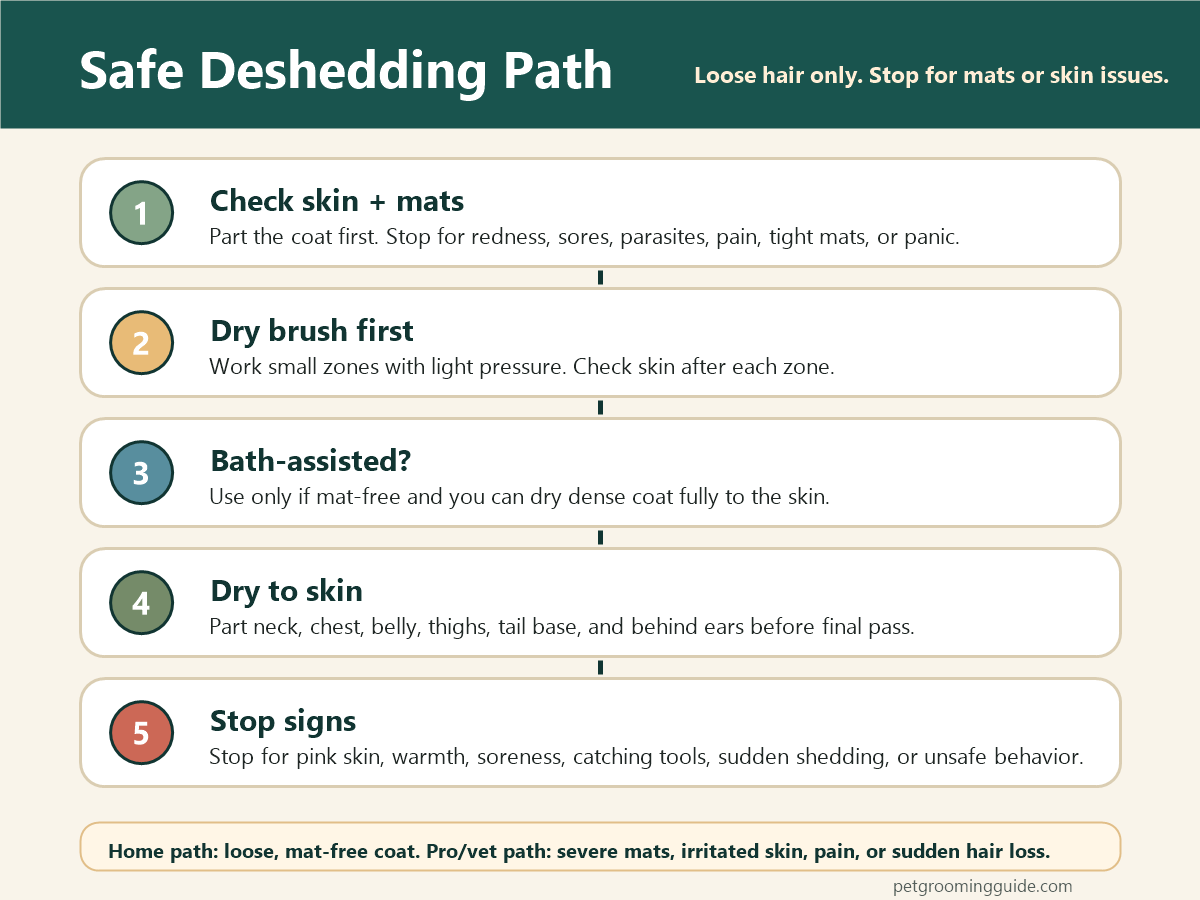
    Deshedding path card showing skin and mat checks, dry brushing, mat-free bath-assisted deshedding, dry-to-skin checks, and stop signs.
    Use this path card as a quick check: loose hair only, dry brush first, use bath-assisted work only when mat-free, and stop for mats or skin issues.

    Dry-Brush Deshedding Routine

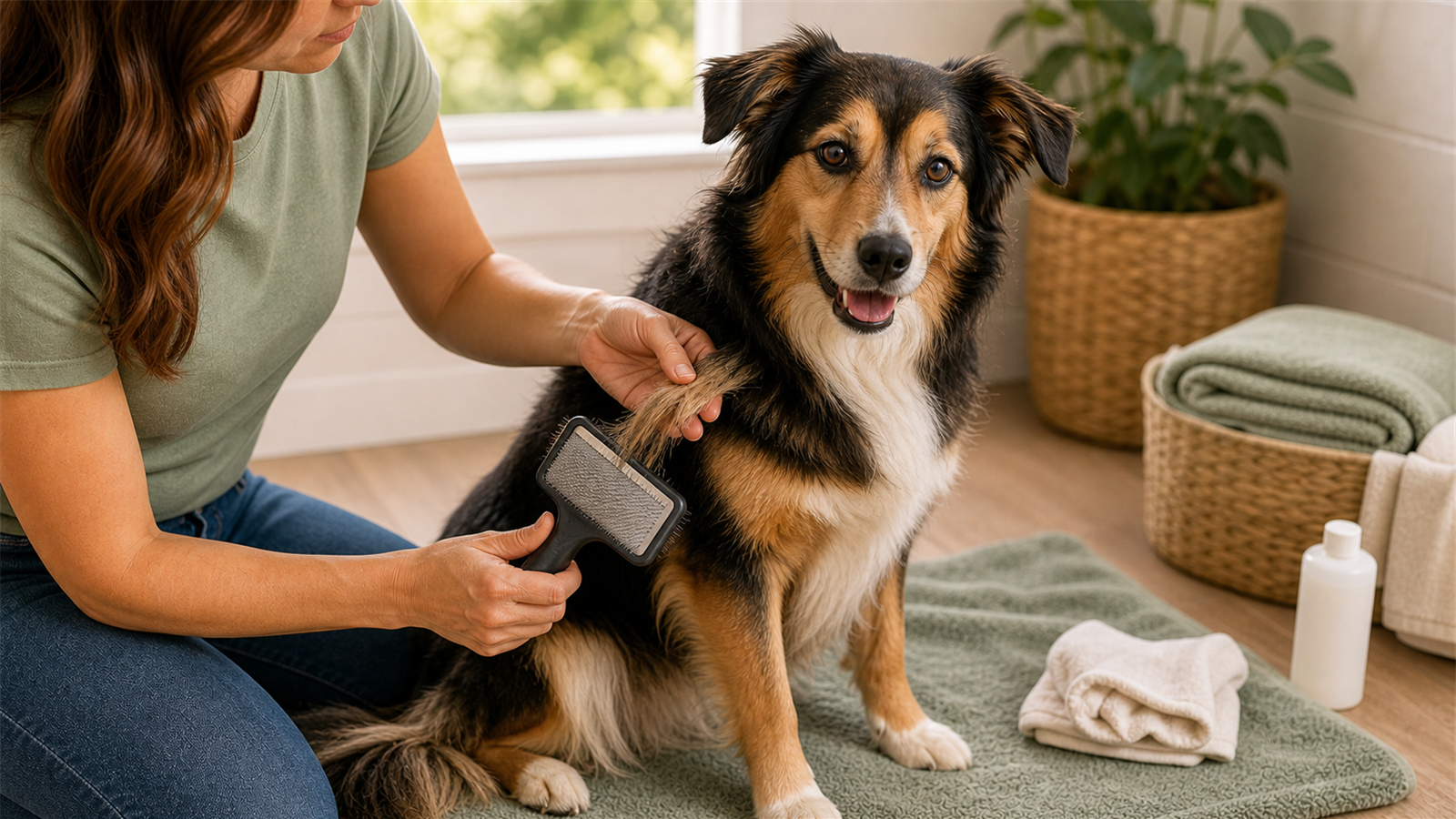
    Use the dry-brush path when the coat is dry, skin looks calm, and there are no severe mats. Keep the session short enough that the dog stays relaxed.

    1. Set the dog on a non-slip surface with good light.
    2. Part the coat and check skin before the first brush pass.
    3. Work one small zone at a time: neck, shoulder, side, chest, thigh, tail base.
    4. Use light pressure and short strokes with a slicker brush, rubber curry, undercoat rake, deshedding tool, or comb only where that category fits the coat.
    5. Pause after each zone and look at the skin.
    6. Finish with a light comb-check or soft brush pass where the coat allows it.

    Merck Veterinary Manual supports regular brushing as part of routine dog care and notes that grooming helps maintain coat health. The home goal is controlled loose-hair removal, not making shedding stop.

    If brushing often turns into tugging, see dog brushing mistakes before repeating the same session pattern.

    Bath-Assisted Deshedding

    Bath-assisted deshedding can help some mat-free coats release loose hair, but water can make existing tangles tighter and can leave dense coats damp near the skin. Brush and inspect first.

    Use the bath-assisted path only if:

    • The coat is mat-free and separates easily.
    • The skin is calm.
    • The dog tolerates bathing and drying.
    • You can dry dense areas all the way to the skin.

    After the bath, rinse well, towel-blot, dry thoroughly, and part the coat in dense areas before doing a final light pass. The Cornell Richard P. Riney Canine Health Center notes that moisture and matted hair can be part of hot-spot risk. For drying help, use how to dry a dog after a bath.

    How Much Deshedding Is Enough?

    Stop while the skin still looks normal and the dog is still comfortable. More loose hair may release later, especially during seasonal coat changes.

    Good stopping points include:

    • The brush is collecting less hair with each gentle pass.
    • The coat feels looser and parts more easily.
    • The dog is becoming tired, restless, or less cooperative.
    • The skin looks even, calm, and unchanged.

    Do not press harder when hair release slows. Repeated passes over one area can irritate the skin. For routine planning by coat type, see the dog grooming schedule by coat type.

    Tool Categories to Know

    Tool names here are category-level only. The aim is to match the tool style to the coat, not to shop for a specific brand.

    Tool categoryWhere it may fitUse carefully
    Rubber curryShort smooth coats and surface loose hairAvoid sore or irritated skin
    Slicker brushLight loose hair and some coat separationUse light pressure; do not scrape
    Undercoat rakeSome dense double coats when mat-freeStop if it catches or pulls
    Deshedding toolSpecific mat-free shedding coatsAvoid repeated passes and wrong-coat use
    CombChecking whether the coat is truly separatedDo not drag through resistance

    If you are choosing between common brush categories, slicker brush vs pin brush explains the difference by coat job and safety limits.

    When to Call a Groomer or Veterinarian

    Call a groomer for severe mats, packed coat, recurring matting, a dense coat you cannot dry fully, or a dog who cannot tolerate handling safely.

    Call a veterinarian for bald patches, sores, hot spots, redness, parasites, sudden heavy shedding, painful skin, swelling, bleeding, odor with irritation, or behavior changes that suggest pain.

    FAQ

    How often should you deshed a dog?

    It depends on coat type, season, skin condition, and tolerance. Many dogs need more loose-hair work during seasonal shedding, but the right frequency is the one that manages loose coat without redness, soreness, or stress.

    Should you bathe before deshedding?

    Usually, check and brush first. Bath-assisted deshedding is safer only when the coat is mat-free and you can dry the coat fully to the skin.

    Can deshedding hurt a dog’s skin?

    Yes. Too much pressure, repeated passes, the wrong tool category, or brushing irritated skin can cause pain or redness. Stop if the skin changes or the dog shows distress.

    What is the difference between deshedding and dematting?

    Deshedding removes loose dead hair. Dematting deals with tangled or compacted hair. Severe, tight, painful, or skin-close mats should be handled by a qualified groomer or veterinarian.

    Will deshedding stop my dog from shedding?

    No. Deshedding can reduce loose hair on the coat and around the home, but normal shedding continues. Be cautious of any promise that one session or tool will stop shedding.

    When is shedding a vet problem?

    Use a veterinarian for bald patches, sores, parasites, hot spots, sudden heavy shedding, painful skin, odor with irritation, swelling, or major coat changes.

    Bottom Line

    Deshedding at home is safest when it stays gentle, short, and limited to loose hair. Check skin and mats first, work in small zones, use light pressure, dry dense coats fully after any bath, and stop before irritation starts. If the coat is matted, painful, abnormal, or unsafe to handle, the right next step is a groomer or veterinarian, not a harder brush pass.
    Sources

  • Dog Brushing Mistakes That Can Hurt Your Dog’s Coat

    Dog Brushing Mistakes That Can Hurt Your Dog’s Coat

    The biggest dog brushing mistakes are brushing only the surface, brushing or bathing over mats, using the wrong brush category, pressing too hard, overbrushing one area, skipping friction zones, and ignoring pain, skin, or behavior stop signs. Safer brushing is slower, lighter, and honest about when a groomer or veterinarian should take over.

    Do not use brushing to solve severe mats. Stop for tight mats, mats close to skin, redness, sores, bleeding, parasites, bald patches, hot spots, pain, yelping, growling, snapping, freezing, or panic.

    Quick Mistake Check

    Mistake 1: Brushing Only the Surface

    Surface brushing can make the outer coat look tidy while tangles keep forming underneath. This is common on long, curly, fleece, woolly, and dense double coats.

    Work in small sections. Part the coat, brush gently through that section, then use a comb to check whether the coat is open near the skin. If the comb catches painfully or repeatedly, stop instead of pulling through it.

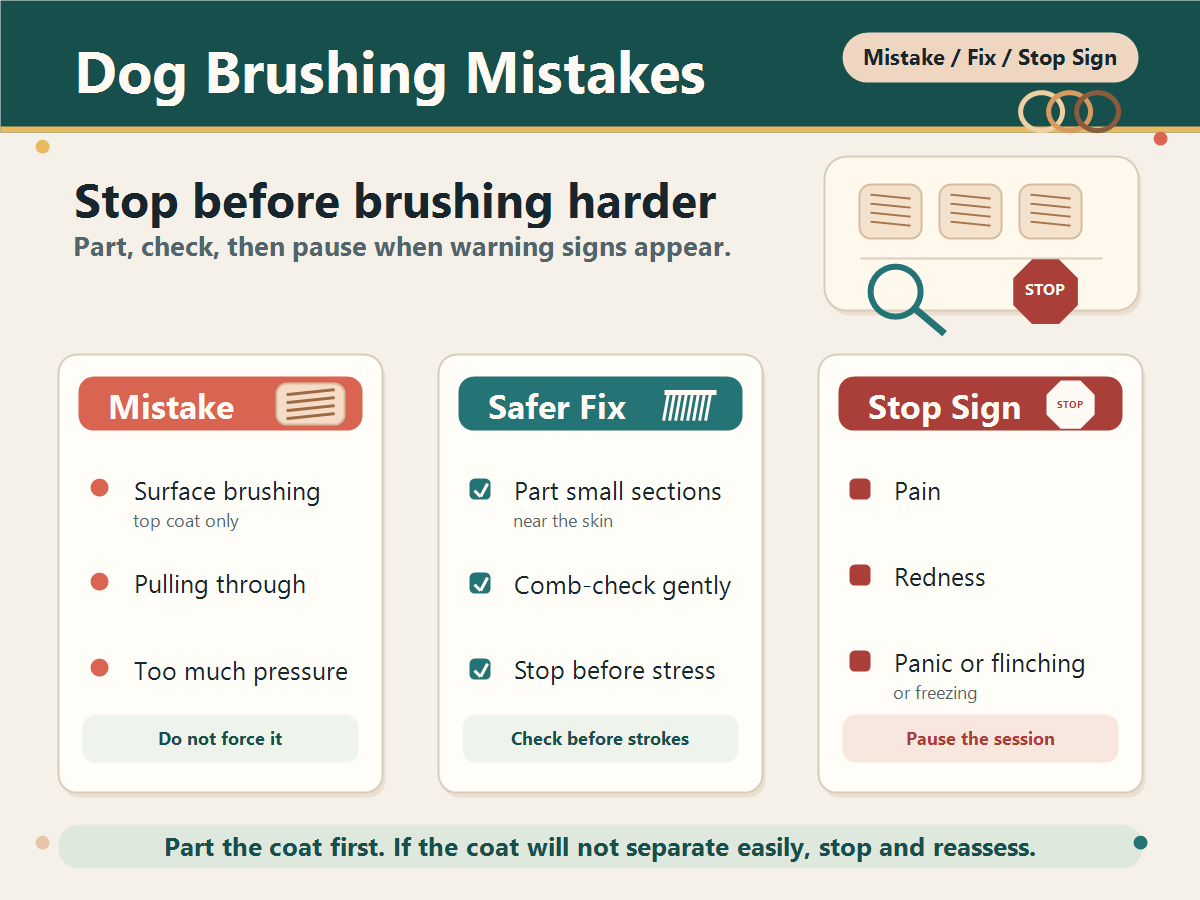
    Dog brushing mistakes card showing safer fixes and stop signs for pain, redness, panic, or flinching.
    Use this quick check when brushing starts to snag, pull, or stress the dog. Stop for pain, redness, panic, repeated flinching, or mats close to the skin.

    The ASPCA says brushing helps prevent tangles and gives owners a chance to check the skin. That only works when the session reaches more than the top layer.

    Mistake 2: Brushing or Bathing Over Mats

    Water can make tangles and mats tighter. Hard brushing over a mat can pull skin and make the dog afraid of grooming.

    Do not bathe over severe mats, force a brush through a tight mat, cut mats with scissors, or keep working because the mat looks small from the outside. Use a groomer or veterinarian for severe, painful, skin-close, widespread, or suspicious mats.

    If you are not sure whether you are dealing with a tangle or a mat, start with dog matting vs tangles. For routine prevention, see how to prevent dog mats. For bath order, use dog grooming before or after bath.

    Mistake 3: Using the Wrong Brush for the Coat

    No single brush category fits every dog. Coat length, density, curl, skin sensitivity, and tolerance all matter.

    MistakeSafer choiceStop sign
    Brushing only the topcoatWork in small sections and comb-check near the skin.The comb catches, pulls, or will not pass gently.
    Brushing or bathing over matsPause and check whether the mat is a groomer or vet task.The mat is tight, painful, skin-close, widespread, or paired with sore skin.
    Using one brush for every coatMatch the tool category to coat type.The tool scrapes, snags, or leaves hidden tangles.
    Pressing harder to get more hairUse light pressure and short sessions.Skin looks red or the dog becomes tense, sore, or evasive.
    Skipping friction zonesCheck behind ears, collar lines, armpits, belly, thighs, tail base, legs, feet, and sanitary areas.The area is sensitive, packed, damp, red, or painful.

    The ASPCA recommends choosing brushes and combs based on the dog’s hair type and asking a veterinarian or groomer when unsure. If you need a broader routine, use the dog grooming schedule by coat type.

    Mistake 4: Pressing Too Hard or Overbrushing One Area

    Brushing should not scrape the skin. Pressing harder does not make a tool safer or more effective. It can create redness, soreness, and handling fear.

    Use lighter pressure than you think you need. Keep sessions short, rotate zones, check skin color and comfort often, and stop before the dog gets sore. Do not chase every last loose hair. Shedding control is maintenance, not a perfect finish.

    For loose-hair work, see how to remove loose dog hair. For double-coated dogs, check double-coat dog grooming mistakes before using heavy undercoat tools.

    Mistake 5: Skipping Friction Zones

    Mats often form where coat rubs, compresses, or holds moisture. These spots are also more sensitive, so check them slowly.

    • Behind ears.
    • Collar and harness line.
    • Armpits.
    • Chest and belly.
    • Inner thighs.
    • Tail base.
    • Legs and feet.
    • Sanitary area.

    If a friction zone is packed, painful, red, damp, or hard to see clearly, stop and use a groomer or veterinarian instead of brushing harder.

    Mistake 6: Ignoring Skin, Pain, or Behavior Stop Signs

    Brushing is also a comfort and skin check. Stop if you see redness, sores, bleeding, parasites, bald patches, hot spots, pain, yelping, growling, snapping, freezing, panic, sudden heavy shedding, or a sudden coat change.

    Do not treat abnormal hair loss, sore skin, or parasites as a brushing problem. Texas A&M Pet Talk notes that abnormal shedding or skin and coat concerns can warrant a veterinarian conversation.

    If the main problem is fear or handling, use how to brush a dog that hates being brushed and keep the session short. A dog that is panicking, painful, or unsafe to handle needs help, not a longer brushing session.

    Brushing Routine by Coat Type

    The routine should change when the coat, skin, season, or dog’s tolerance changes.

    Coat typeCommon starting categoryMain caution
    Short smoothSoft brush, rubber curry, or grooming mittDo not scrape thin or sensitive skin.
    Long silkyPin brush and combWork ends first and check for hidden tangles.
    Curly or doodle-typeSlicker and comb, used gentlyMats may hide close to the skin.
    Dense double coatUndercoat rake, slicker, and comb category with light pressureDo not overwork one area or scrape for loose hair.
    Wire or specialty coatGroomer-guided brush and comb routineAsk for help if the technique is unfamiliar.

    The Merck Veterinary Manual supports regular brushing as part of routine dog care, while skin changes, parasites, pain, or wounds need more than a home brushing routine.

    When to Call a Groomer or Vet

    Call a groomer for severe mats, skin-close mats, recurring mats you cannot prevent, packed undercoat, coat work beyond your skill, or a dog who cannot tolerate brushing safely.

    Call a veterinarian for wounds, infection signs, parasites, hot spots, sudden hair loss, painful skin, swelling, bleeding, or behavior changes that suggest pain.

    FAQ

    Can you brush a dog too much?

    Yes. Too much pressure, too many repeated passes, or overworking one area can irritate skin. Use shorter sessions and stop when the skin or dog shows discomfort.

    Should you brush mats before or after a bath?

    Minor loose tangles may be handled before bathing if the dog stays comfortable and the hair separates without pulling. Severe, tight, painful, or skin-close mats should go to a groomer or veterinarian.

    How do I know if I am brushing to the skin?

    After brushing a small section, use a comb to check near the skin. If the comb cannot pass without catching or hurting, surface brushing is likely missing tangles.

    What brush should I use for my dog’s coat?

    Choose by coat type and ask a groomer or veterinarian when unsure. This guide uses tool categories only and does not recommend specific products.

    When should a groomer remove mats?

    A groomer should handle severe, tight, painful, skin-close, widespread, or recurring mats. A veterinarian may be needed when mats are paired with wounds, infection signs, parasites, or pain.

    Sources

  • How to Dry a Dog After a Bath Safely

    How to Dry a Dog After a Bath Safely

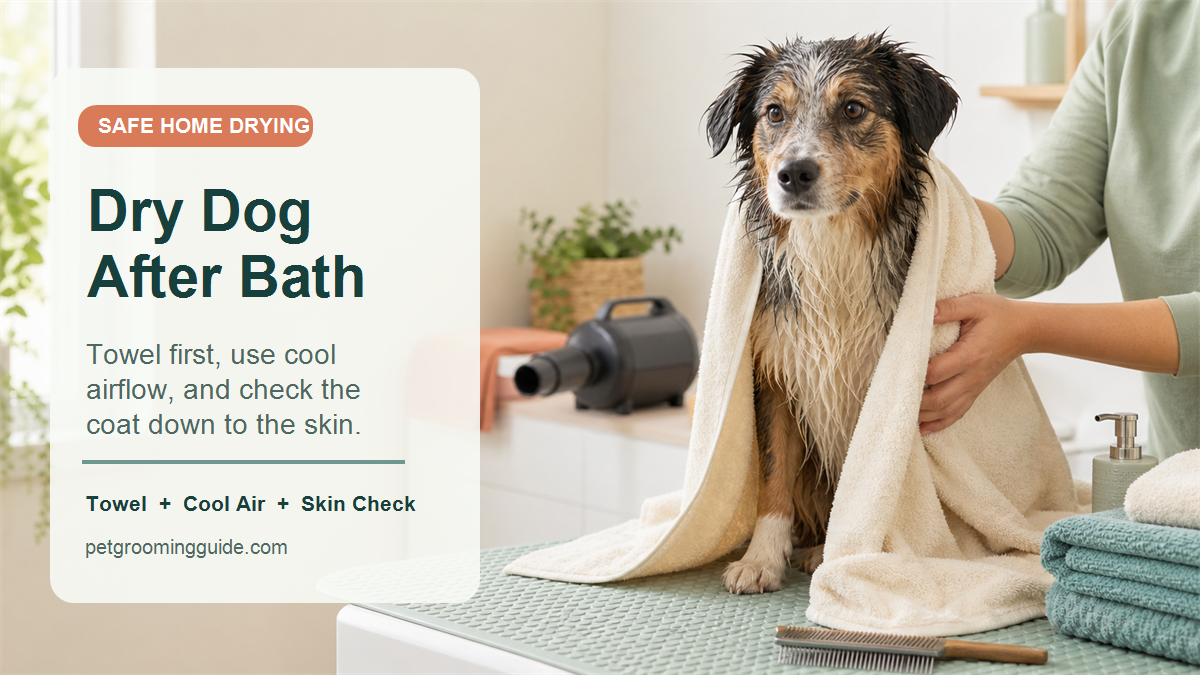
    To dry a dog after a bath, towel first, choose air drying or low-stress airflow based on the coat and the dog, then check dense areas down to the skin. Short smooth coats may dry with towels and supervised air drying in a comfortable room. Dense, double, curly, long, or mat-prone coats often need more careful section-by-section drying so dampness does not sit near the skin. If the bath itself was difficult, start with these dog bathing mistakes before the next wash.

    Stop before you try to finish the job if your dog is overheating, struggling to breathe, panicking, painful, too hard to handle safely, or showing skin, ear, or eye trouble. Use a professional groomer for mats, thick coats you cannot dry to the skin, or dogs who cannot tolerate drying. Call a veterinarian for raw skin, hot spots, open sores, breathing trouble, collapse, vomiting, weakness, eye irritation, ear pain, or a medically fragile dog.

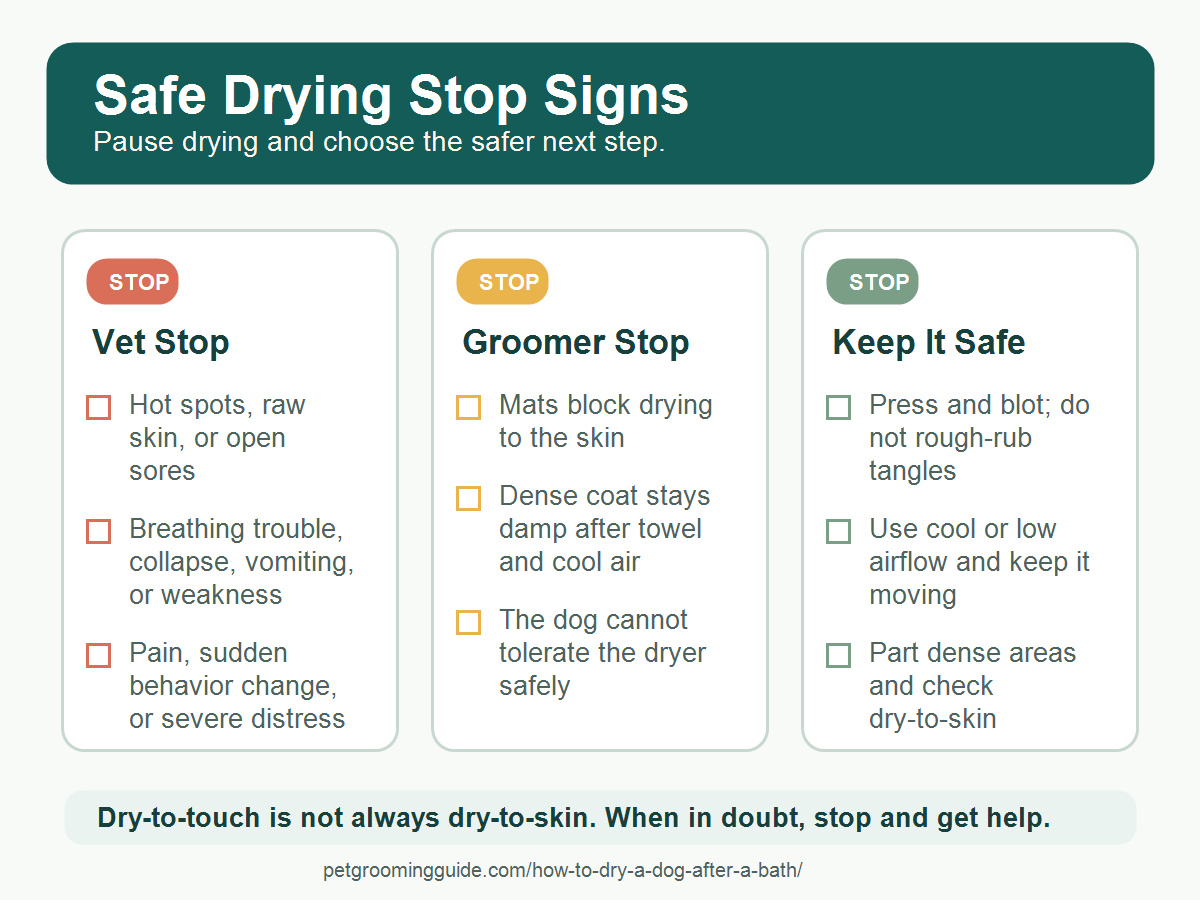
    Safe dog drying stop signs card showing when to call a veterinarian, use a groomer, or keep towel and cool-air drying gentle.
    Use this as a quick safety check while drying. Stop for breathing trouble, heat stress, pain, panic, mats that block drying, or skin trouble.
  • CoatSafer routineWatch for
    Short smoothGentle passes and skin inspectionRedness from too much pressure
    Long silkySection work, ends first, comb checkTangles behind ears, legs, and tail
    Curly or doodle-typeLine brushing and skin-level comb testHidden mats close to skin
    Dense doubleLoose undercoat removal with breaksOverbrushing, scraping, or packed undercoat
    Wire or specialty coatGroomer guidance if technique is unfamiliarWrong tool category or coat damage
    Dog or coat situationSafer drying planStop and get help if
    Short smooth coatTowel well, then allow supervised air drying in a warm, comfortable roomThe dog is cold, shivering, panting hard, or skin looks irritated
    Dense or double coatTowel, dry in sections, and check near the skin in thick areasThe coat stays damp near the skin or the dog cannot tolerate more drying
    Long, curly, or tangle-prone coatBlot gently, use controlled airflow if tolerated, and avoid rubbing tangles tighterYou find mats, pulling, skin-close tangles, or painful spots
    Noise-sensitive or fearful dogUse towels first, add distance and breaks, or skip the dryer if fear risesThe dog trembles, freezes, hides, snaps, growls, or tries to escape frantically
    Puppy, senior dog, flat-faced dog, or medical concernKeep the session short, gentle, and closely supervisedBreathing, balance, fatigue, overheating, pain, or distress appears

    Start With Towels, Not Heat

    Start by letting the dog shake in a safe spot, then use absorbent towels to remove as much water as you can. Press, blot, and squeeze lightly through the towel instead of rubbing hard circles into the coat.

    Rough rubbing can worsen tangles, especially behind the ears, under the collar line, in the armpits, along the belly, on the legs, and near the tail base. Use another dry towel before you use more force.

    Choose Air Drying or Dryer Drying

    Air drying is not automatically good or bad. It depends on coat density, room temperature, humidity, skin condition, and how well the dog stays comfortable while drying.

    Air drying may be enough for some short smooth coats when the room is comfortable and the dog is supervised. Dense, double, long, curly, or mat-prone coats need a closer check because the surface can feel dry while the coat near the skin is still damp. For routine planning by coat type, use the dog grooming schedule by coat type.

    If you use airflow, keep it comfortable, moving, and away from the eyes, ears, nose, and mouth. A dog-safe dryer or forced-air dryer may be useful for some coats, but this guide is not a dryer buying guide. Do not use high heat close to the skin, and do not confine a wet dog in a hot room, crate, car, or small space to speed drying.

    Check Dry-to-Skin, Not Just Dry-to-Touch

    A coat can feel dry on top while moisture remains underneath. Part the coat gently with your fingers and feel near the skin in the areas most likely to hold dampness.

    Check behind the ears, the collar line, chest, armpits, belly, thighs, tail base, and between the toes. If the coat feels cool, damp, clumped, or heavy near the skin, that area is not fully dry.

    Cornell’s canine health guidance notes that thick coats that do not dry fully and matted areas that hold moisture can increase hot-spot risk. That is a reason to dry carefully, not a reason to force a scared or painful dog through a dryer session.

    Use Dryer Air Safely

    Dryer safety is about heat, noise, airflow, restraint, and session length. Keep the airflow moving, check the skin often with your hand, and give breaks before the dog is overwhelmed.

    Human hair dryers can focus heat in a small area. If one is used at all, use only a cool or low setting, keep distance from the coat, keep the dryer moving, and stop if the dog shows distress. Do not aim airflow into the face, ears, eyes, nose, or mouth.

    Stop the dryer for heavy panting, frantic escape attempts, trembling, freezing, growling, snapping, repeated hiding, coughing, breathing trouble, weakness, or collapse. Those are not training moments. They are stop signs.

    Handle Mats and Tangles Before They Become a Drying Problem

    Do not try to blast a matted coat dry at home. Mats can trap moisture and pull on skin, and water can make some tangles feel tighter. If the dryer cannot move air through the coat or you cannot part the coat without pulling, stop.

    Use a professional groomer for mats, pelted coat, skin-close tangles, or a coat that stays damp because air cannot reach the base. Use a veterinarian if the skin under or near the mat looks red, raw, swollen, bleeding, painful, smelly, or irritated.

    Protect the Face, Ears, Eyes, and Paws

    Use a towel for the face instead of blowing air toward it. Dry around the muzzle, beard, cheeks, and folds with gentle blotting. Do not push towel corners, cotton swabs, or liquid into the ear canal.

    Dry the outside of ear flaps, then stop and call a veterinarian if there is ear odor, discharge, redness, swelling, head shaking, pain, or repeated scratching. Stop for eye redness, squinting, pawing at the eye, discharge, or any sign that shampoo, water, or airflow irritated the eye.

    Dry paws enough that the dog can walk safely. Check between toes and pads, but do not dig at sore skin or force a paw hold if the dog panics or pulls hard.

    When to Call a Groomer or Veterinarian

    Call a professional groomer when the coat is too dense to dry to the skin, mats block airflow, the dog cannot tolerate dryer noise, or the dog is too large, strong, slippery, fearful, or painful to handle safely at home.

    Call a veterinarian for hot spots, raw skin, open sores, skin irritation, swelling, discharge, ear pain, eye irritation, breathing trouble, overheating, collapse, vomiting, weakness, severe distress, pain, or any puppy, senior dog, flat-faced dog, or medically fragile dog who does not seem right after the bath.

    Cornell’s hot-spot guidance explains why thick coats and moisture matter. ASPCA dog grooming tips reinforce gentle grooming and protecting sensitive areas. A peer-reviewed heat-stroke article supports treating overheating signs as serious, which is why this guide routes heat stress, breathing trouble, weakness, collapse, or vomiting to a veterinarian instead of giving home treatment steps.

    FAQ

    Can I let my dog air dry after a bath?

    Sometimes. Air drying may be fine for some short smooth coats in comfortable conditions, but dense, double, curly, long, or mat-prone coats usually need a dry-to-skin check and may need controlled airflow.

    How do I know if my dog’s coat is dry to the skin?

    Part the coat in thick areas and feel near the skin. If the base feels cool, damp, clumped, or heavy, that area is not fully dry.

    Can a damp coat cause hot spots?

    Damp, thick, or matted coat can contribute to skin trouble when moisture stays near the skin. Hot spots, raw skin, or painful areas need veterinary guidance.

    Is it safe to use a human hair dryer on a dog?

    Use extreme caution. Human hair dryers can get too hot and too focused, so use only cool or low air, keep distance, keep it moving, check the skin often, and stop if the dog is distressed.

    Should I brush while drying?

    Only if the coat is safe to handle and the dog is calm. Do not brush through mats, painful tangles, damp irritated skin, or areas where the dog flinches, growls, snaps, or panics.

    When should a groomer dry my dog instead?

    Use a groomer when the coat is dense, matted, slow to dry, dryer-sensitive, or too hard for you to dry safely to the skin at home.

    Bottom Line

    Drying a dog safely means removing surface water, choosing the lowest-stress drying method, checking thick coat down to the skin, and stopping early for mats, skin irritation, overheating, breathing trouble, fear, pain, or unsafe handling. The goal is a dry, comfortable dog, not finishing a drying session at any cost.