
Your cat won't stop licking. Not the casual bath-and-be-done grooming, but obsessive, relentless licking that's left bald patches on her belly, her inner thighs, or the base of her tail. You've wondered if it's allergies, stress, or just a weird habit.
You've also probably worried you're missing something serious.
Cat overgrooming is one of the most frustrating issues owners face because it looks identical from the outside, whether the root cause is a flea allergy, a food sensitivity, or anxiety. Here's the part most people get wrong: in a significant percentage of cases studied by veterinary dermatologists, what looks like a behavioral problem is actually a medical one. As of 2026, the consensus across veterinary research is clear.
You cannot treat the behavior until you've ruled out the body. Let's walk through exactly how to figure out which one you're dealing with, step by step.
Quick Answer: Is It Medical or Behavioral?
The answer is simple: assume medical until proven otherwise. That's not a cautious guess. It's the standard protocol in veterinary dermatology.
- If it's medical (fleas, food, environment, pain), treating the behavior won't help.
- If it's behavioral (stress, anxiety, OCD), treating only the skin won't help.
- The only way to know which you're dealing with is a systematic elimination process, starting with your veterinarian.
Don't skip ahead. Don't "just try" a calming diffuser first. The order of operations matters more than anything else you'll do.
Why This Matters More Than You Think
The Real Risk of Guessing Wrong
Here's the uncomfortable truth about overgrooming: it's a symptom, not a diagnosis. When a cat licks herself raw, she's telling you something hurts, itches, or feels wrong. The danger isn't the hair loss itself.
It's what you miss while you're treating the wrong thing.
If you assume stress and try calming treats while your cat actually has flea allergic dermatitis, she keeps suffering. If you assume allergies and switch foods while your cat actually has arthritis pain in her hips, she keeps hurting. Every week you spend guessing is a week the underlying condition progresses.
What Most Owners Get Wrong About Overgrooming
Most owners make one of two mistakes. They either panic and assume it's behavioral (and buy every calming supplement at the pet store), or they panic and assume it's allergies (and switch foods randomly without a plan). Both approaches waste time and money.
The second mistake is thinking overgrooming means your cat is "obsessive." In reality, most cats who overgroom are responding to physical discomfort. The licking releases endorphins, which temporarily relieve the itch or pain. It's a coping mechanism, not a compulsion.
The Medical Causes You Must Rule Out First
Flea Allergic Dermatitis: The #1 Hidden Culprit
This is the most common medical cause of overgrooming, and it's also the most missed. Here's why: a cat with flea allergic dermatitis doesn't need a flea infestation to react. She needs a single flea bite.
One bite triggers a severe allergic response that lasts days.
The problem? Indoor cats still get fleas. Fleas hitchhike into your home on your shoes, your pants, your dog, or through open windows.
You might never see a single flea on your cat and she's still reacting to bites.

What to look for:
- Overgrooming concentrated on the lower back, base of the tail, and inner thighs
- Small scabs or crusty bumps (miliary dermatitis) that feel like sandpaper
- Hair loss that's symmetrical on both sides of the body
- Visible black specks (flea dirt) that turn reddish-brown when wet
The test: Comb your cat over a white paper towel. If you see black specks, wet them with a drop of water. If they bleed red, that's flea dirt.
It means fleas have been on your cat recently.
The rule: Even if you find nothing, your vet will likely recommend a strict flea control trial. That means prescription-strength flea prevention for 3 to 4 weeks minimum, applied or administered exactly as directed. Over-the-counter products often fail.
If overgrooming stops during the trial, fleas were the cause.
Food Allergies and the 8-Week Diet Trial
Food allergies in cats are far more common than most people realize. The usual culprits are chicken, beef, fish, and dairy. These proteins are in almost every commercial cat food, which makes them hard to avoid.
The symptoms: Overgrooming is frequently the only sign. Many cats don't vomit or have diarrhea. They just lick their bellies raw.
The correct approach: An elimination diet trial. This is not a "grain-free" diet or a "limited ingredient" diet you grab at the pet store. OTC limited ingredient diets are often cross-contaminated with other proteins during manufacturing.
You need a prescription hydrolyzed protein diet or a novel protein diet from your vet.

Hydrolyzed protein diets break the protein down into particles so small that the immune system doesn't recognize them as allergens. Novel protein diets use a protein your cat has never eaten, like rabbit, venison, or duck.
The rules that make or break the trial:
| Rule | Why It Matters |
|---|---|
| Strict compliance for 8 to 12 weeks | Reactions can take weeks to clear |
| No treats, no table scraps, no flavored medications | One bite of chicken resets the trial |
| All other cats in the house eat the same food or eat separately | Cross-contamination is real |
| No flavored flea prevention or toothpaste | Hidden proteins are everywhere |
If your cat's overgrooming resolves during the trial, you've confirmed a food allergy. The next step is a "challenge" phase where you reintroduce specific proteins to identify the exact trigger.
Environmental Allergies (Atopy) and Seasonal Patterns
If fleas and food are ruled out, environmental allergies are next. Cats can be allergic to the same things humans are: pollen, mold, dust mites, grass.
The clues:
- Overgrooming that flares up seasonally (spring, summer, or fall)
- Itching that gets worse after spending time outdoors
- Concurrent signs like sneezing, watery eyes, or ear infections
- Poor response to topical treatments but improvement with anti-inflammatory meds
The challenge: Unlike flea allergies or food allergies, you can't eliminate environmental allergens. You can manage them.
Management options:
- Allergy testing (intradermal or blood) to identify specific triggers
- Immunotherapy (allergy shots or sublingual drops) to desensitize the immune system
- Antihistamines or corticosteroids during peak allergy season
- Frequent vacuuming, HEPA air filters, and washing bedding to reduce indoor allergens
Pain as a Trigger: Arthritis, Dental Disease, and More
This is the cause that gets missed most often because it seems unrelated. Cats are masters of hiding pain. They don't limp dramatically or cry out.
Instead, they redirect the discomfort into repetitive grooming behavior.
Common pain sources that trigger overgrooming:
- Osteoarthritis, especially in older cats affecting the hips, knees, or lower spine
- Dental disease (tooth resorption, gingivitis, abscesses)
- Constipation or painful defecation
- Urinary tract disease (FLUTD or cystitis), which can cause lower abdominal licking
- Anal gland issues
What to notice:
- Overgrooming that started in a senior cat with no prior history
- Licking that's focused over a specific joint or area of the spine
- Cats who groom more before or after using the litter box
- Changes in movement, jumping, or litter box habits that accompany the licking
The takeaway: Your vet needs to do a full physical exam including a dental check and joint palpation, not just a skin exam.
The Behavioral Side: When It's Really Stress
Feline Hyperesthesia Syndrome and OCD-Like Grooming
Feline Hyperesthesia Syndrome (FHS) is a neurological and behavioral condition that produces bizarre, dramatic overgrooming. It's also one of the most frequently missed diagnoses because owners describe the symptoms differently than vets expect.
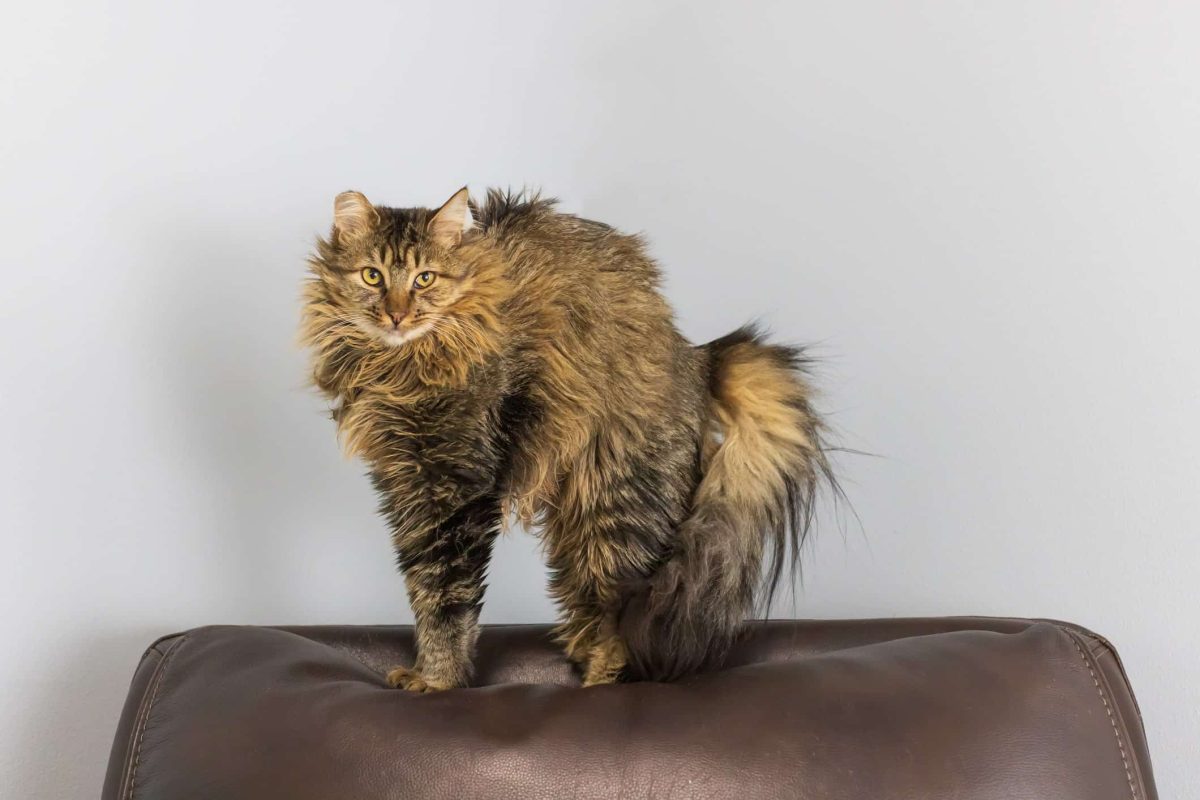
The classic signs:
- Rippling or rolling skin along the back, especially near the tail
- Sudden frantic grooming of the lower back and tail area
- Dilated pupils, darting eyes, or an agitated expression during episodes
- Uncharacteristic aggression when you touch the affected area
- Chasing tails, biting at the tail base, or vocalizing during episodes
What's happening: The cat isn't "being dramatic." She's experiencing a heightened neurological response that feels like tingling, burning, or electric shocks. The grooming is an attempt to soothe that sensation.
Who's at risk: FHS tends to affect younger cats, often between 1 and 5 years old. Siamese, Oriental Shorthair, and other high-strung breeds show a higher prevalence.
The treatment approach: FHS usually requires a combination of environmental management and prescription medication. Medications like fluoxetine (Prozac) or gabapentin are often effective. This is not something you can treat with supplements alone.
Environmental Stressors: New Pets, Moves, and Routine Changes
Cats are creatures of routine, and they're deeply sensitive to change. When their world feels chaotic, they soothe themselves with grooming. It's the feline equivalent of biting your nails or stress-eating.
The most common stressors that trigger overgrooming:
- Moving to a new home
- Adding a new pet (cat, dog, or baby)
- Losing a companion animal
- Changes in your work schedule or time spent away from home
- Renovations, noisy neighbors, or construction
- New furniture that disrupts scent marking
- Litter box issues (dirty, relocated, or changed litter type)
The stress timeline: Unlike medical causes, which often produce gradual or sudden licking based on exposure, stress-related overgrooming usually starts within days to a few weeks after the change. If you can correlate the onset of licking with a specific life event, that's a strong signal.
The multi-cat factor: In multi-cat households, resource competition is a hidden stressor. If one cat guards food, water, or prime resting spots, another cat may develop chronic stress even without visible conflict. Subtle tension like staring, blocked pathways, or hissing can drive overgrooming.
Why Indoor Cats Are at Higher Risk
Indoor cats are safer, healthier, and live longer. They're also more vulnerable to stress-related overgrooming. An indoor cat can't retreat.
She can't climb a tree, chase a squirrel, or find a secluded spot away from a housemate she dislikes. Her entire world is four walls, and when that world feels tense, grooming becomes her only outlet.
The good news? Indoor cats respond remarkably well to environmental enrichment. The fix isn't always medication.
Sometimes it's a cat tree by a window, a puzzle feeder that turns meals into a game, or simply scheduled playtime that burns off anxious energy.
What to look for:
- Overgrooming that started after a specific change in the household
- Grooming that happens most often when you're away or during quiet hours
- A cat who otherwise seems healthy and pain-free
- No response to flea treatment, food trials, or allergy medication
That last point is crucial. If you've methodically ruled out the medical causes and the licking continues, behavioral stress becomes the working diagnosis. But that diagnosis takes time.
You can't confirm it in a week. You confirm it by eliminating everything else first.
How a Veterinarian Actually Diagnoses Overgrooming
The Skin Scrape, Flea Trial, and Physical Exam
When you bring your cat in for overgrooming, your vet isn't going to just glance at the bald patches and hand you a prescription. A proper workup follows a specific sequence, and knowing what's coming helps you prepare.
Step one: The history conversation. Your vet will ask about when the licking started, whether it's seasonal, what changed in your household recently, and what your cat eats. Be specific. If you adopted a new cat three weeks before the licking started, that's critical information.
Step two: The full physical exam. Your vet will check your cat's skin for inflammation, scabs, and parasites. They'll also palpate joints for arthritis, examine the mouth for dental disease, and gently press on the abdomen to check for bladder issues. Cats in pain often overgroom the area over the source of that pain.
Step three: The skin scrape and cytology. Your vet may gently scrape the surface of the skin to check for mites, or press a microscope slide against the area to look for bacteria or yeast. These tests rule out infections that can cause intense itching.
Step four: The flea trial recommendation. Even if your vet finds no fleas, they'll likely recommend strict flea prevention for a full month. That's not a guess. It's standard protocol because flea allergic dermatitis is the most common cause and the easiest to miss.
The Diagnostic Timeline: What to Expect
Here's what a realistic timeline looks like. Most owners are surprised by how long this process takes, but each step exists to eliminate a variable.
| Week | Diagnostic Step | What It Rules Out |
|---|---|---|
| Week 1 | Full exam, skin scrape, flea trial started | Fleas, mites, infections |
| Weeks 2–4 | Evaluate flea trial response | Flea allergic dermatitis |
| Weeks 5–16 | Strict elimination diet trial | Food allergies |
| Weeks 16–20 | Allergy testing or immunotherapy trial | Environmental allergies |
| Weeks 20+ | Behavioral assessment if all medical causes ruled out | Stress, anxiety, FHS |
If your cat improves at any point, you've found your culprit. If not, you move to the next step. This isn't a fast process, and that's frustrating.
But it's the only methodical way to get a definitive answer.
Questions Your Vet Will Ask You
Your vet's questions are designed to narrow the possibilities. Here's what to expect, and how to answer well:
"When did the overgrooming start?" Think back. Was it gradual or sudden? Does it correlate with any changes in your home?
"Is it seasonal?" If the licking gets worse in spring or fall, environmental allergies climb the list of suspects.
"What do you feed, and what treats does she get?" Be honest. If you're feeding table scraps or multiple flavors of treats, that's relevant. Many owners say "just food" when they mean "food plus treats plus the occasional bite of their sandwich."
"Has anything changed in your household?" New pets, new people, new furniture, a move, a schedule shift. All of it matters. Don't dismiss anything as too minor.
"Does she groom more at certain times?" Nighttime licking under the bed points toward stress. Licking immediately after meals points toward food allergies.
"How does she react when you touch the area?" Pain or aggression on contact suggests pain, while indifference suggests itchiness.
Step-by-Step: What to Do This Week
Day 1: The Vet Visit and Initial Workup
Schedule your vet appointment today. Not next week, not "when you get around to it." Today. Every day you wait, your cat is uncomfortable, and the underlying condition is progressing.
What to bring:
- A timeline of when the overgrooming started
- Photos of the affected areas over time (shows progression)
- A list of everything your cat eats, including treats and supplements
- Information about any household changes in the last three months
What to ask your vet:
- "Can you rule out fleas definitively?"
- "Do you recommend a prescription flea trial?"
- "Is there any sign of skin infection, mites, or yeast?"
- "Should we start a food trial, and if so, which diet?"
- "When should we schedule a recheck?"
Your vet may recommend starting a flea trial same-day, or they may want to run additional tests first.
Days 3–7: Flea Control and Itch Relief
Once your vet rules out obvious skin issues and starts a flea trial, your job is to manage the itching while you wait for answers.
Flea control specifics:
- Use only prescription-strength products. Over-the-counter flea preventives from grocery stores and big-box retailers frequently fail.
- Apply or administer exactly as directed. Don't skip doses. Don't extend intervals.
- Treat ALL pets in the household, even if only one is showing symptoms.
- Vacuum thoroughly and regularly. Flea eggs and larvae live in carpets and bedding.
Itch relief options your vet might prescribe:
- A short course of corticosteroids to break the itch-scratch-lick cycle
- Antihistamines like cetirizine or chlorpheniramine
- Omega-3 fatty acid supplements to support skin barrier health
What to do during this week: Monitor your cat's grooming patterns. Take daily photos of the affected areas so you can track even small improvements. Note anything that seems to make the licking better or worse.
Weeks 2–8: The Elimination Diet Trial
If the flea trial doesn't resolve the overgrooming, your vet will likely recommend a strict elimination diet trial. This is the most common point where owners accidentally sabotage the process.
The rules are absolute:
- Feed ONLY the prescription diet. No treats, no table scraps, no other foods.
- Use the same food for all cats in the household to prevent cross-feeding.
- Keep your cat indoors for the entire trial. Outdoor access means she might be hunting or eating something you don't know about.
- Use non-flavored flea prevention. Flavored chews contain proteins that can trigger reactions.
The biology behind the trial: Food allergies don't always cause immediate reactions. The immune system builds up a response over time. It also takes time for the inflammatory chemicals to clear from the skin.
That's why the trial needs a full 8 to 12 weeks. Many cats show improvement by week 4, but some take longer.
What to expect: You'll likely see gradual change, not sudden resolution. Hair regrowth takes 2 to 4 weeks after the itching stops, so a lack of visible hair doesn't mean the trial isn't working. What you're looking for is a decrease in licking behavior.
Weeks 8–12: Evaluating Results and Next Steps
By this point, you have data. You know whether the flea trial changed anything, and you know whether the food trial changed anything.
If overgrooming improved or stopped: You've found your cause. Your vet will guide you through the next phase, which usually involves reintroducing former foods one at a time to identify the exact allergen.
If overgrooming hasn't changed: Update your vet. They'll likely recommend the next diagnostic step, which could be:
- Switching to a different prescription diet to rule out an additional protein sensitivity
- Running allergy testing to identify environmental triggers
- Starting a trial of anti-inflammatory medications to assess response
- Referral to a veterinary dermatologist
If your cat gets worse: Contact your vet immediately. Sudden worsening could signal a secondary skin infection, or it could mean a different underlying issue entirely.
Environmental Changes You Can Make Today
Enrichment: Puzzle Feeders, Play Routines, and Perches
While you're waiting for diagnostic results, environmental enrichment is your best free tool. A bored cat is a stressed cat. A stressed cat overgrooms.
It's that simple.
Puzzle feeders: Turn mealtime into a hunting game. Puzzle feeders require cats to work for their food, which engages their natural predatory instincts and provides mental stimulation. Start with something simple like a treat ball, and progress to more complex puzzles as your cat gets the hang of it.
Play routines: Schedule at least two 10 to 15 minute play sessions per day. Use wand toys that mimic prey movement. Let your cat "catch" the toy at the end of each session to complete the hunt-catch-kill sequence.
Vertical space: Cats feel secure when they can observe from above. Install cat shelves, a tall cat tree, or at minimum clear a window perch where your cat can watch the world. In multi-cat households, vertical space also provides escape routes that reduce conflict.
Reducing Stress in Multi-Cat Households
Multi-cat households are a common source of stress-related overgrooming. Even cats who seem to get along can experience chronic tension from resource competition.
The rule of thumb: You need one more resource than you have cats. That means one litter box per cat plus one extra, one food station per cat plus one, and multiple water sources throughout the house.
Key adjustments to make today:
- Place food and water stations in separate areas so no cat has to pass another to eat
- Position litter boxes in different rooms, away from food and water
- Create multiple high resting spots so each cat has a private observation point
- Use Feliway diffusers in main living areas to release calming pheromones
- Play calming music during your work hours to mask outdoor noises and reduce environmental unpredictability
The Role of Pheromone Diffusers and Calming Aids
Pheromone products like Feliway copy the facial pheromones cats use to mark safe territory. They're not a cure, but they can support a calmer environment while you address underlying issues.
What works:
- Feliway diffusers placed in rooms where your cat spends the most time
- Calming treats containing L-theanine or tryptophan for mild anxiety
- Thundershirts or anxiety wraps that provide gentle, constant pressure
What doesn't work:
- Human anxiety medications (never give your cat these)
- CBD products without veterinary supervision (unregulated and unstudied in cats)
- Punishment or scolding for grooming (increases stress and worsens the behavior)
The honest truth: These aids support treatment. They don't replace diagnosis.
Medications and Treatments: What Works
Anti-Itch Medications (Steroids, Apoquel, Atopica)
When your cat is miserable from itching, your vet has prescription options that work fast. These don't cure the underlying cause, but they break the itch-lick cycle long enough for you to identify and treat the root problem.
Corticosteroids (prednisolone, triamcinolone): These are the fastest-acting anti-itch drugs available. They suppress the inflammatory response within 24 to 48 hours. Most cats show dramatic improvement within a few days.
The downside is that long-term steroid use carries risks including diabetes, weight gain, and immunosuppression. That's why vets use them for short-term relief or seasonal flare-ups, not for lifelong management.
Apoquel (oclacitinib): Originally developed for dogs, Apoquel has shown effectiveness in cats for managing allergic itch. It targets specific inflammatory pathways without the broad immunosuppression of steroids. Many veterinary dermatologists now prescribe it off-label for feline allergies.
Atopica (cyclosporine): This is a longer-term immunomodulator that works well for chronic allergies. It takes 2 to 4 weeks to reach full effect. It's more expensive than steroids but safer for long-term use.
Side effects can include vomiting, diarrhea, and decreased appetite, especially in the first few weeks. Your vet may start with a higher dose and taper down.
What to expect with each:
| Medication | Onset | Best For | Common Side Effects |
|---|---|---|---|
| Corticosteroids | 24–48 hours | Acute flare-ups, seasonal allergies | Increased thirst, appetite, urination |
| Apoquel | 24–72 hours | Itch relief without steroid risks | Vomiting, diarrhea, lethargy |
| Atopica | 2–4 weeks | Long-term allergy management | GI upset, gum swelling, reduced appetite |
The important note: These medications treat symptoms. They don't diagnose the cause. If your vet prescribes steroids and your cat improves, that tells you allergies are involved.
It doesn't tell you whether the trigger is fleas, food, or pollen.
Anti-Anxiety Medications (Fluoxetine, Clomipramine)
If you've ruled out medical causes and your vet confirms behavioral overgrooming, prescription anti-anxiety medication may be the answer. These drugs work, and they're underused because owners hesitate.
Fluoxetine (Prozac): This SSRI is the most common first-line treatment for stress-related overgrooming in cats. It increases serotonin levels in the brain, which helps regulate mood and reduce compulsive behaviors. Most cats need 4 to 8 weeks to show measurable improvement.
It's given once daily, either as a flavored liquid or compounded into a treat.
Clomipramine (Clomicalm): This tricyclic antidepressant is specifically approved for separation anxiety and compulsive behaviors in dogs. In cats, it's used off-label for overgrooming and other obsessive behaviors. It works faster than fluoxetine, often showing effects within 2 to 4 weeks.
The honest expectations:
- These medications don't eliminate grooming overnight. They reduce the urge over time.
- The best results come from combining medication with environmental changes.
- Most cats stay on these medications for 6 to 12 months, then wean off gradually.
- Some cats need lifelong management, especially those with Feline Hyperesthesia Syndrome.
Side effects to watch for:
- Decreased appetite during the first 1 to 2 weeks
- Lethargy or sedation
- Vomiting or diarrhea
- Increased vocalization in some cats
Safety rules: Never stop these medications abruptly. Sudden withdrawal can cause rebound anxiety and behavioral deterioration. Your vet will give you a tapering schedule when it's time to stop.
How Long Medications Take to Work
Owners often abandon treatment too early. They expect a week, and when they don't see results, they stop the medication. That's a mistake.
| Treatment Type | Onset Timeline | Full Effect |
|---|---|---|
| Corticosteroids | 24–48 hours | 3–5 days |
| Apoquel | 24–72 hours | 5–7 days |
| Atopica | 2–4 weeks | 6–8 weeks |
| Fluoxetine | 3–4 weeks | 6–8 weeks |
| Clomipramine | 2–3 weeks | 4–6 weeks |
The rule: Give any medication at least 8 weeks before evaluating effectiveness. If there's zero improvement at that point, your vet may adjust the dose or try a different drug.
The visual cue: Hair regrowth lags behind behavior change. Your cat may stop licking after 3 weeks of fluoxetine, but the bald patches won't fully fill in for another 4 to 6 weeks. That's normal.
Common Mistakes Owners Make
Punishing the Cat or Using E-Collars Too Early
Here's the scenario that breaks our hearts: a frustrated owner yells at their cat for licking. The cat, already stressed, becomes more stressed. The overgrooming gets worse.
The owner, convinced it's "just a behavior problem," orders an e-collar.
Why punishment fails: Cats don't associate punishment with the grooming. They associate it with you. Your voice becomes a stress trigger.
The anxiety that drives the licking intensifies.
Why e-collars are a trap: An e-collar stops the licking physically, but it doesn't stop the urge. The second the collar comes off, the licking resumes. Worse, some cats redirect the behavior to rubbing against walls, head shaking, or developing obsessive paw licking instead.
When an e-collar is appropriate: Only when your cat has created an open wound or hot spot that needs time to heal. Even then, it's a temporary tool lasting days, not weeks. It's always paired with treating the underlying cause.
Giving Up on the Diet Trial Too Soon
Diet trials are boring. They require discipline for 8 to 12 weeks with zero variety in your cat's food. Owners get three weeks in, see no improvement, and conclude "it's not food." Then they switch back to old food and the cycle continues.
The problem with that logic: Food allergies can take 8 weeks to show full resolution. The first few weeks are just clearing the old proteins from your cat's system. Three weeks is not enough time.
The realistic timeline:
- Weeks 1 to 2: Old proteins clearing from the body
- Weeks 3 to 4: Possible partial reduction in licking
- Weeks 5 to 8: Most cats show noticeable improvement if food is the trigger
- Weeks 8 to 12: Full resolution of symptoms
A better approach:
- Commit to the full trial before starting. Mark the end date on your calendar.
- Take weekly photos so you can compare subtle changes.
- If there's zero improvement by week 8, that's the time to reassess.
Relying on OTC Supplements Instead of a Vet Diagnosis
The pet supplement industry is massive, and the marketing is persuasive. Calming chews, CBD oils, allergy support powders. They promise natural relief for your cat's overgrooming.
The reality:
- These products aren't regulated like prescription drugs
- Their effectiveness varies widely between brands
- None of them treat underlying medical causes
- They can delay proper diagnosis for months
What our research shows: Aggregate reviews of calming supplements for cats are mixed, with many owners reporting no improvement. The products that help mild anxiety contain ingredients like L-theanine or tryptophan. None of them treat flea allergies, food allergies, or arthritis pain.
The smarter path: If your cat's grooming is mild and stress-related, a supplement might help as part of a broader enrichment plan. If there's significant hair loss, raw skin, or persistent licking, see your vet first. Supplements can't replace diagnosis.
Cost Expectations and Time Commitments
What a Dermatology Workup Typically Costs
Let's talk money. Overgrooming workups aren't cheap, and the total depends on how far you need to go.
| Diagnostic Step | Typical Cost Range |
|---|---|
| Office visit and exam | $50–$100 |
| Skin scrape and cytology | $50–$150 |
| Flea preventive (3 months) | $40–$120 |
| Prescription diet trial (12 weeks) | $100–$250 |
| Bloodwork (baseline health screen) | $100–$250 |
| Allergy testing (blood or intradermal) | $250–$600 |
| Dermatology specialist consult | $150–$400 |
| Total possible workup | $400–$1,500 |
What drives cost up: Referral to a veterinary dermatologist adds specialist fees. Intradermal allergy testing requires sedation. Immunotherapy (allergy shots) adds ongoing costs.
What saves money: Catching the issue early. Overgrooming that's treated in the first month often resolves with a simple flea trial or diet change. Overgrooming that lingers for a year requires more diagnostics.
Monthly Costs of Prescription Diets and Medications
Ongoing management costs depend on your cat's specific needs.
| Ongoing Treatment | Monthly Cost |
|---|---|
| Prescription hydrolyzed diet | $60–$120 |
| Novel protein diet | $50–$100 |
| Fluoxetine (generic) | $10–$30 |
| Apoquel | $50–$90 |
| Atopica | $80–$150 |
| Flea prevention | $15–$40 |
| Allergy immunotherapy | $20–$60 |
The long-term reality: Food allergies mean lifelong prescription diets. Behavioral overgrooming means potential long-term medication. Neither is cheap, but both are manageable within most budgets.
The tradeoff worth noting: The cost of working up a diagnosis is usually less than the cost of treating the wrong thing for years.
How Long Until You See Hair Regrowth
Hair regrowth is slower than you'd expect. It's also a good indicator of whether treatment is working.
The timeline:
- Weeks 1 to 2 after itch relief: skin healing and reduced redness
- Weeks 2 to 4: fine hair begins to appear
- Weeks 4 to 8: visible regrowth in most treated cats
- Weeks 8 to 12: full coat restoration in many cats
The catch: If your cat keeps licking, hair can't regrow. Regrowth only happens after the behavior stops. So if you see new hair, treatment is working.
If you don't, you're still missing something.
What can delay regrowth:
- Ongoing exposure to the allergen
- Secondary skin infection that hasn't been treated
- Underlying pain that hasn't been addressed
- Overgrooming at night when you're not watching
Expert Tips for Long-Term Management
Seasonal Allergy Management
If your cat's overgrooming flares up at specific times of year, you're likely dealing with environmental allergies. The goal is reducing allergen exposure and boosting skin defenses.
Your action plan for allergy season:
- Start prevention two weeks before the season begins. Don't wait for symptoms.
- Wipe your cat's coat with a damp cloth daily to remove pollen and dust
- Use an HEPA air filter in your main living area
- Wash your cat's bedding weekly in hot water
- Vacuum daily during peak season
- Consider giving a prescription antihistamine during flare-ups
The data point: Environmental allergen counts peak between 6 AM and 10 AM. Keeping windows closed during those hours reduces indoor exposure significantly.
Maintaining a Low-Stress Home Environment
Stress management is an ongoing practice, not a one-time fix. You can't eliminate all stress from your cat's life, but you can create a foundation of stability.
The framework we recommend:
| Element | Daily Practice |
|---|---|
| Routine | Feed, play, and clean the litter box at consistent times |
| Enrichment | Rotate toys weekly to maintain novelty |
| Territory | Maintain multiple resting spots and scratching surfaces |
| Predictability | Warn your cat before sudden changes (visitors, moves) |
| Safety | Provide hiding spots where your cat can retreat undisturbed |
The key principle: Boredom and stress feed each other. A cat with enough mental and physical stimulation has less capacity for anxious grooming.
What to monitor: Note grooming intensity on a scale of 1 to 10 each day, plus any household changes. You'll spot patterns that guide adjustments.
When Overgrooming Can Return and What to Do
Overgrooming is like any chronic condition. It can come back, especially under stress or during allergy season. That doesn't mean your treatment failed.
It means your cat is responding to her environment.
The return protocol:
- Step 1: Check for fleas first. Always. It's the most common relapse trigger.
- Step 2: Ask yourself what changed in the last two weeks.
- Step 3: Review whether medications or diet were altered or missed.
- Step 4: Contact your vet if licking persists more than 3 to 4 days.
What usually triggers relapse:
- Inconsistent flea prevention
- Introducing a new pet or person
- Moving or renovating
- Changing diets without veterinary guidance
- Stopping anxiety medication abruptly
The reassuring part: Relapses are treatable. You now know the diagnostic process. You can run through the checklist faster than you did the first time.
When to Seek Immediate Help
Warning Signs: Open Sores, Bleeding, or Infection
Most overgrooming cases are chronic and slow. You have time to work through a diagnostic plan. But some situations demand immediate veterinary attention.
Go to the vet now if you see:
- Open wounds or self-inflicted trauma from intense licking
- Bleeding, weeping, or crusting areas
- A foul odor coming from your cat's skin
- A hot, swollen, painful area that your cat resists touching
- Sudden, frantic grooming that seems uncontrollable
- Your cat refusing to eat, drink, or use the litter box
Why it's urgent: Open wounds invite bacterial infection. A minor irritation can become a serious skin infection within 48 hours. If your cat's immune system is compromised for any reason, infection spreads faster.
Emergency Symptoms That Require a Same-Day Vet Visit
Some symptoms point to conditions beyond simple overgrooming. These warrant immediate evaluation.
Call your vet right away if you notice:
- Self-mutilation that breaks the skin (especially on the tail or lower back)
- Seizures or collapse followed by grooming episodes
- Labored breathing or coughing alongside the licking
- Significant weight loss over the past month
- Vomiting or diarrhea combined with overgrooming
- Lethargy and hiding that's out of character
The context: Overgrooming usually means a chronic, manageable condition. But when it appears alongside systemic signs, you need to rule out endocrine issues like hyperthyroidism, organ disease, or toxicity.
When in doubt, call. A quick phone conversation with your vet costs nothing. It can prevent a serious situation from becoming an emergency.
Breed-Specific and Age-Related Patterns
Which Breeds Overgroom Most
Breed genetics play a role in overgrooming, especially for behavioral types. Knowing your cat's predisposition helps set expectations.
| Breed | Predisposition | Typical Overgrooming Pattern |
|---|---|---|
| Siamese | OCD-like compulsive grooming | Symmetrical alopecia on belly and thighs |
| Oriental Shorthair | Anxiety-related overgrooming | Focused on flanks and tail base |
| Burmese | Stress sensitivity | Lower abdomen and inner thighs |
| Abyssinian | Psychogenic alopecia | Lateral trunk and back |
| Persian | Hair texture makes licking detectable | Matting and fur pulling |
| Domestic Shorthair | Medical causes more common | Any area, depends on trigger |
What matters: Breed tells you the likelihood, not the diagnosis. Even a Siamese with genetic predisposition can have fleas.
Age-Based Patterns You Should Know
Overgrooming looks different at different life stages. The cause shifts as cats age.
Kittens (under 1 year):
- Usually environmental stress or food allergies
- Teething discomfort can trigger chewing and licking
- Early intervention prevents habit formation
Adult cats (1 to 7 years):
- Most common age range for flea allergies
- Onset of chronic stress behaviors
- Reproductive status matters. Intact cats overgroom more during hormonal cycles.
Senior cats (7+ years):
- Pain is the dominant cause
- Dental disease, osteoarthritis, and hyperthyroidism
- Cognitive decline can trigger repetitive behaviors
The senior red flag: If your older cat suddenly starts overgrooming, prioritize pain workup over behavioral diagnosis.
The Indoor-Outdoor Divide
Indoor cats overgroom more frequently overall. Outdoor cats overgroom less often but for different reasons.
| Factor | Indoor | Outdoor |
|---|---|---|
| Primary overgrooming cause | Behavioral stress | Fleas and environmental allergies |
| Seasonal pattern | Year-round, often tied to routine changes | Strongly seasonal |
| Response to environmental change | Rapid, often within days | Muted, unless territory is disrupted |
| Injury and pain risk | Lower | Higher, from fights and accidents |
The practical upshot: If your outdoor cat starts overgrooming, check for fleas, ticks, and wounds first. If your indoor cat starts, review household changes and stress factors alongside the medical workup.
When Overgrooming Signals Something More Serious
Sometimes overgrooming is a clue to a systemic condition. It's not just skin and behavior.
Conditions that present with overgrooming:
- Hyperthyroidism (senior cats, weight loss, increased appetite)
- Feline leukemia virus (FeLV) or feline immunodeficiency virus (FIV)
- Chronic kidney disease (older cats, increased thirst, poor coat)
- Diabetes mellitus (weight loss, increased appetite, weakness)
- Gastrointestinal disease (inflammatory bowel disease, parasites)
The clue: Overgrooming that persists despite normal skin and negative allergy workup should trigger broader bloodwork. That's where these conditions show up.
Real Scenarios: What This Looks Like in Practice
Scenario One: The Sudden Licker
Milo, a 4-year-old domestic shorthair, started licking his belly raw three weeks after his owner brought home a new puppy. The owner assumed stress and bought calming treats. Three weeks later, Milo's belly was worse.
What actually happened: The owner never checked for fleas. The puppy brought fleas into the house, and Milo, who'd never had them before, had a severe allergic reaction.
The fix: A prescription flea preventive for both animals and a short steroid course to break the itch cycle. Milo stopped licking within five days. His hair grew back over the next two months.
The lesson: New animals bring fleas. Stress isn't always the answer, even when there's an obvious trigger.
Scenario Two: The Chronic Relapser
Sophie, a 7-year-old Siamese, had overgroomed on and off for two years. Her owner had tried calming diffusers, anxiety wraps, and every OTC supplement at the pet store. Nothing worked long-term.
What actually happened: Sophie had a chicken allergy. Her owner fed a "limited ingredient" diet from a pet store, which still contained chicken fat. The reactions never fully resolved.
The fix: A prescription hydrolyzed protein diet for ten weeks. Sophie stopped licking in week six. The owner transitioned her to a novel protein diet with rabbit and she's been clear for eight months.
The lesson: OTC "limited ingredient" foods aren't truly limited. Only prescription diets control cross-contamination.
Scenario Three: The Pain Misdirection
Jasper, an 11-year-old Maine Coon, started licking his lower back and tail area. His owner assumed it was just "old age nervousness." Then Jasper started missing the litter box.
What actually happened: Jasper had severe dental disease and arthritis in his lumbar spine. The oral pain triggered stress grooming, and the arthritis made the licking area worse because it hurt to move.
The fix: Dental extractions and anti-inflammatory medication for the arthritis. Jasper's grooming returned to normal within a month.
The lesson: Sometimes overgrooming is a distraction from pain elsewhere in the body.
Frequently Asked Questions
Is overgrooming ever normal?
No. Normal grooming serves a purpose. It removes dirt, distributes skin oils, and regulates temperature.
A healthy cat spends 15 to 30 minutes per day grooming. When grooming causes hair loss, it's a medical or behavioral signal. The licking is producing a physical effect you can see.
That's never normal.
Can cats overgroom from boredom alone?
Yes, but boredom is usually a secondary trigger, not the sole cause. A cat with an undiagnosed flea allergy may start licking. The licking becomes self-reinforcing because endorphins relieve the itch.
Once the habit forms, it can persist even after the trigger resolves. Environmental enrichment helps. But it's not a substitute for ruling out medical causes first.
Will the hair grow back?
In most cases, yes. Hair regrowth begins 2 to 4 weeks after the underlying cause is resolved. The fur returns once the licking stops.
Some cats with long-standing overgrooming may have permanent changes in hair texture or density. That's rare. Full regrowth is the expected outcome with effective treatment.
Can I treat this without going to the vet?
We strongly advise against it. The overlap between symptoms is too broad. A cat with food allergies and a cat with anxiety look identical.
Without a vet's guidance, you'll guess wrong more often than not. You'll spend months on the wrong treatment while your cat continues to suffer. A vet visit is faster, cheaper, and more reliable than trial and error.
How long does the full diagnostic process take?
Plan for 4 to 5 months if you need to rule out every cause. The flea trial takes a month. The food trial takes another 8 to 12 weeks.
Allergy testing comes after that. It feels slow, but each step is necessary. Most cats find their diagnosis earlier, usually during the flea trial or food trial.
What's the most common cause I should check first?
Flea allergic dermatitis, without question. It's the most frequent diagnosis, it's the easiest to test, and it's the most commonly missed. Even if you never see fleas, run the prescription flea trial.
A month of prevention costs less than any other diagnostic step, and it resolves the most cases.
Final Verdict: Your Action Plan
The Order of Operations That Matters
You've made it through the full guide. Now here's the condensed version that actually works when you step away from this screen.
| Step | Action | Timeline |
|---|---|---|
| 1 | Vet visit, full exam, skin scrape | Week 1 |
| 2 | Flea trial with prescription prevention | Weeks 1–4 |
| 3 | Strict elimination diet if flea trial fails | Weeks 4–16 |
| 4 | Allergy testing if diet fails | Weeks 16–20 |
| 5 | Behavioral diagnosis and treatment | After medical causes ruled out |
The principle that governs everything: Medical before behavioral. Always. Without exception.
The Single Best Thing You Can Do for Your Cat Today
If you're reading this and your cat has been overgrooming for more than a week, don't wait for a perfect plan.
Do these three things today:
- Check for fleas using the wet paper towel test
- Take photos of every affected area for your vet
- Call your vet and schedule a workup appointment
That's it. Three actions. They cost you fifteen minutes and one phone call.
Why this matters: Overgrooming is treatable. The cats that suffer longest are the ones whose owners stall, guess, or give up at the first hurdle. The diagnostic process is methodical, and it works.
What it asks of you is patience and consistency.
The final truth: Your cat isn't giving you a hard time. She's having a hard time. The licking is her way of saying something is wrong.
Your job is to listen, take her to the vet, and follow the process until you find the answer. When you do, she'll stop. And you'll both get to rest.