
Cat hair on your black jeans, in your coffee, pressed into the sofa cushions like it was upholstered there on purpose. If you're looking up how to reduce cat shedding, you've probably already bought a brush, used it twice, and watched nothing change. Here's what most advice skips entirely: shedding and hair loss are two different problems, and the right fix depends completely on which one you've actually got.
Feline hair grows on a cycle, so a diet change won't show up in the coat for 6 to 12 weeks. That's not a slow product. That's just how follicles work.
Guidance from the Cornell Feline Health Center draws the same line we do: normal shedding is managed, abnormal hair loss is diagnosed. So before you spend a penny, spend two minutes on your cat's skin.
Quick Answer
Reduce cat shedding by brushing regularly with a tool matched to the coat type. Feed a complete diet with adequate protein and omega-3 fatty acids. Keep every pet on year-round flea prevention.
Add wet food or a water fountain to improve hydration. If hair is missing rather than falling, see a vet first. Expect visible improvement in 6 to 12 weeks, not days.

Image source: Bing (Web (fair-use with source credit))
The Two-Minute Triage: Is Your Cat Shedding, or Losing Hair?
This is the fork in the road. Get it wrong and every other step is wasted effort.
Shedding means hair is releasing normally from healthy follicles. You'll find it on the sofa, on your clothes, in the brush. The cat still has a full, even coat.
Hair loss (alopecia) means hair is gone from the cat. You'll see thin patches, bald skin, or fur that looks moth-eaten. That's a medical finding, not a grooming problem.
Do this triage before you buy a single tool. It takes two minutes.
The part-the-coat test
Sit your cat somewhere with good light. Part the fur with your fingers in three places: the shoulders, the flank, and the base of the tail. Then look at the skin, not the fur.
Healthy feline skin is pale pink or pigmented, smooth, and dry. Here's what should worry you:
- Redness or a rash of tiny crusty bumps. This is miliary dermatitis. It feels like grit under your fingertips along the spine and neck.
- Flaking or greasy scale. Points to a skin barrier problem, poor grooming, or a systemic issue.
- Scabs, sores, or broken skin. Something is making your cat scratch or chew.
- Visible bald skin. Not thin fur. Actual skin showing through.
If the skin is clean and the coat is even, you're dealing with normal shedding. Good news. Skip to Branch A.
If the skin is angry or the fur is genuinely missing, you're not in a brushing conversation anymore.
Cut ends versus tapered tips: how to spot barbering
A huge number of "shedding" complaints are actually barbering. That's when a cat licks and chews its own fur down to stubble. The follicle is fine.
The hair is being cut off at skin level by the cat's own tongue and teeth.
You can check this at home with nothing but daylight and a bit of patience.
- Pluck or gently pinch a few hairs from the thin area.
- Look at the free end. A naturally shed hair has a fine, tapered point.
- A barbered hair has a blunt, chopped-off end. Like a mown lawn.
Run your palm backwards over the area too. Barbered fur feels prickly and uniform, like velvet stubble. Genuine alopecia feels smooth and bare.
Cats are private groomers. Plenty of owners swear their cat never over-licks, then get a shock when the vet points out the belly. Trust the hair ends, not the observation.
The wet paper flea dirt check
Flea allergy dermatitis is the most common cause of itch-driven hair loss in cats. And you don't need an infestation to get it. One bite on a sensitive cat is enough.
You also probably won't see live fleas. Cats are efficient groomers and swallow the evidence.
So look for flea dirt instead:
- Comb the cat over the lower back and tail base with a fine-toothed flea comb.
- Tap the debris onto a sheet of white paper or kitchen towel.
- Dampen it with a few drops of water.
- Wait 30 seconds.
If the black specks bleed a rusty red halo, that's digested blood. That's flea dirt. Your cat has fleas, full stop, whether you've seen one or not.
Plain black grit that stays black is just dirt. Do this check on all pets in the house, not just the itchy one.
Why Cats Shed in the First Place (And Why Indoor Cats Never Seem to Stop)
Understanding the cycle explains why brushing helps, why diet takes months, and why your indoor cat sheds in February.

Image source: Bing (Web (fair-use with source credit))
The anagen, catagen, telogen and exogen cycle in plain English
Every hair on your cat runs through four stages.
| Stage | What's happening | Why it matters to you |
|---|---|---|
| Anagen | Active growth. The follicle is building hair. | Nutrition affects hair quality here, and only here. |
| Catagen | Growth stops. The follicle winds down. | Brief transition phase. |
| Telogen | Resting. The hair sits in place, fully formed but dead. | Loose hair is stored here, waiting. |
| Exogen | Release. The hair detaches and falls. | This is the shedding you actually see. |
Two things follow from this.
First, brushing doesn't cause shedding and doesn't stop it. It collects telogen and exogen hairs before gravity and your sofa do. That's the whole mechanism.
You're intercepting hair that was leaving anyway.
Second, when you improve the diet, you're only affecting hairs currently in anagen. Every hair already sitting in telogen still has to fall out first. That's the 6 to 12 week lag, and it's non-negotiable.
Cats also have compound follicles. One pore can hold a single thick guard hair plus a cluster of finer secondary hairs. That's why a single follicle failure drops a surprising amount of fur.
Photoperiod: how artificial light flattens the seasonal shed
Shedding in cats is driven mainly by day length, not temperature. The eye registers changing daylight hours, and that signals the coat to turn over.
An outdoor or conservatory cat sees real seasonal light. You get two clear peaks: a heavy spring shed as the winter undercoat drops, and a lighter autumn shed as the winter coat comes in. In the northern hemisphere that's roughly March to May and September to November.
Flip those months in Australia, New Zealand, or South Africa.
An indoor-only cat lives under artificial light 12 to 16 hours a day, year round, with central heating smoothing out the temperature swings. The seasonal signal never arrives properly.
The result is low-grade shedding spread flat across all 12 months. It's not more hair overall. It just never stops long enough for you to notice a break.
If your indoor cat "sheds constantly," this is why. It's normal. There's no seasonal fix, only a maintenance routine.
Single coat, double coat, Rex: why the fix differs
Coat type decides your tools. Using the wrong one on the wrong cat does real damage.
| Coat type | Example breeds | Shedding pattern | Right approach |
|---|---|---|---|
| Dense double coat | Maine Coon, Norwegian Forest Cat, Siberian, British Shorthair, Chartreux | Heavy, seasonal peaks, big undercoat drops | Undercoat removal, frequent sessions |
| Long single or fine coat | Persian, Himalayan, Ragdoll | Moderate volume, high mat risk | Daily combing, mat prevention first |
| Short dense coat | American Shorthair, Domestic Shorthair, Russian Blue | Steady, hair works into fabric | Rubber curry, twice weekly |
| Fine or sparse coat | Siamese, Oriental, Bengal, Burmese | Light | Grooming mitt, minimal intervention |
| Rex coat | Cornish Rex, Devon Rex, Selkirk Rex | Very light, fragile hair | Hands and a soft cloth only. No de-shedding blades. |
| Hairless | Sphynx, Peterbald | Effectively none | Skin wiping and bathing, not brushing |
A de-shedding blade on a Devon Rex or a thin-skinned senior isn't just useless. It strips a coat that has nothing to spare.
Red Flags That Mean a Vet Visit, Not a Better Brush
Some shedding patterns are a purchase decision. Some are an appointment. Here's how to tell them apart.
Symmetrical thinning on the belly and inner thighs
If the hair loss is mirror-image on both sides, that's a pattern, and patterns are diagnostic.
The classic presentation is a bald or stubbly strip down the belly, inner thighs, and sometimes the inside of the forelegs. Owners often only spot it when the cat rolls over. The back and head look perfect.
That distribution means the cat can reach it with its tongue. It's self-induced. The three usual causes are flea allergy dermatitis, a food allergy, or environmental allergy (feline atopic skin syndrome).
Pain from the bladder or a joint can also drive licking over one specific spot.
No brush fixes this. Neither does fish oil.
Circular scaly patches and broken hairs
Round or oval bald patches with flaky, crusty edges point toward ringworm (dermatophytosis), usually caused by the fungus Microsporum canis. It's a fungal infection of the hair shaft, and the hairs snap off rather than fall out.
Kittens, rescues, longhaired cats, and multi-cat households are the highest risk groups.
Ringworm is zoonotic. It spreads to humans, and children and immunocompromised adults catch it readily. If you see this pattern:
- Wear gloves when handling the cat.
- Don't share bedding or towels.
- Book a vet appointment before you groom, because brushing spreads spores through the house.
Diagnosis needs a Wood's lamp screen plus fungal culture or PCR. A negative Wood's lamp doesn't rule it out. Many strains don't fluoresce.
The senior cat pattern: heavy shed, weight loss, big appetite
Any cat aged 8 or over with a sudden coat change deserves bloodwork. Hyperthyroidism is the one to catch.
The tell is a combination, not a single sign:
- Heavy shedding or a coat that looks unkempt and greasy
- Weight loss despite a huge appetite
- Increased thirst and urination
- Restlessness, yowling at night, sometimes vomiting
- Matting over the spine because grooming has become uncomfortable
A total T4 blood test costs far less than months of supplements that were never going to work. Chronic kidney disease and diabetes mellitus produce similar coat decline in older cats.
Sudden clumps one to three months after a move, surgery, or illness
If your cat suddenly sheds in handfuls with completely normal skin underneath, think back roughly 4 to 12 weeks.
Any major physiological stress can push a large batch of follicles into telogen at once. Surgery, general anaesthesia, a high fever, pregnancy, a house move, boarding, or a new pet will do it. The hairs then release together weeks later.
That's telogen effluvium.
The good news: it's self-limiting. The coat regrows. You manage the mess, keep the diet solid, and it resolves over a few months.
The lag is what throws people, because by the time the hair drops, the stressful event feels like ancient history.
The Decision Tree: Find Your Branch Before You Buy Anything
Run your triage findings through this table. Whichever row matches is your branch. As of 2026, this is still how veterinary dermatology approaches the same question, just with more diagnostics behind it.
| What you found | Most likely cause | Your branch |
|---|---|---|
| Even coat, healthy skin, lots of loose hair | Normal shedding | Branch A: brushing protocol |
| Even coat but dull, dry, flaky, brittle hair | Diet, hydration, or skin barrier issue | Branch B: fix it from the inside |
| Matting over the back and tail base, cat is overweight or elderly | Cat can't physically groom itself | Branch C: assisted grooming |
| Flea dirt found, itching, scabs along the spine | Fleas, mites, or ringworm | Branch D: parasites and fungus |
| Symmetrical belly and thigh loss, blunt cut hair ends, no fleas | Over-grooming (medical or behavioural) | Branch E: rule out medical, then stress |
| Sudden heavy shed in a cat aged 8+, weight loss, big appetite | Possible hyperthyroidism | Vet bloodwork first, no branch |
| Round scaly patches, broken hairs, other pets or people itching | Ringworm | Vet first, handle with gloves |
A few honest notes on using this.
Branches overlap. A flea-allergic overweight senior can sit in three rows at once. Work the medical branches first, then the management ones. Parasites and endocrine disease before brushes and supplements.
Always.
Branch A is not a consolation prize. Most cats genuinely are just shedding normally, and the routine below will cut what ends up on your furniture by a serious margin.
Nothing here gets you to zero. Any product promising to stop shedding is selling you something biology won't deliver. A healthy cat sheds. The realistic goal is capturing that hair in a brush instead of your carpet.
Year-round parasite prevention sits underneath all five branches. Guidance from the Companion Animal Parasite Council recommends monthly prevention for every pet in the household, all 12 months, including indoor-only cats. Fleas ride in on trouser legs and dogs.
Branch A: Normal Seasonal Shedding and Your Brushing Protocol
Skin is clean, coat is even, hair is everywhere. This branch is pure mechanics. You're removing telogen hair on your schedule instead of the cat's.
Matching frequency to coat type
Frequency matters more than tool price. A cheap comb used four times a week beats a premium de-shedder used monthly.
| Coat type | Baseline | During seasonal shed | Session length |
|---|---|---|---|
| Short, fine (Siamese, Bengal) | Once weekly | Twice weekly | 3 to 5 minutes |
| Short, dense (Domestic Shorthair, British Shorthair) | Twice weekly | 3 to 4 times weekly | 5 minutes |
| Medium (Maine Coon, Norwegian Forest Cat) | 3 times weekly | Daily | 5 to 10 minutes |
| Long (Persian, Ragdoll, Himalayan) | Daily | Daily, sometimes twice | 10 to 15 minutes |
| Rex, Sphynx | Weekly wipe-down | No change | 2 minutes |
| Senior, arthritic, or overweight | Daily, light | Daily, light | 5 minutes, split into two |
Short and frequent always beats long and thorough. A 5 minute session your cat tolerates is worth more than a 20 minute session that ends in a bite and six weeks of avoidance.
Line brushing for longhairs, step by step
Surface brushing a longhaired cat is the classic mistake. The top coat looks glossy while a felted mat builds against the skin underneath.
Line brushing fixes that. It's the technique professional groomers use, and it isn't complicated.
- Sit the cat on a towel on a table or your lap, so it can't slide away.
- Start at the bottom. Work from the lowest point on the body upward, in horizontal sections.
- Part the coat with your free hand. Push the fur upward to expose a clean line of skin.
- Brush only the hair below that parting, in short strokes, in the direction the coat lies.
- Move the parting up an inch and repeat. Work the section until it's clear before moving on.
- Do one body area at a time. Shoulders, then flank, then hindquarters, then the tail.
Pressure should be light enough that you could do it on your own forearm. Slicker brushes cause "brush burn" when people press. Cat skin is thinner than dog skin and it abrades easily.
The mat hotspots to check every session:
- Behind the ears
- Under the chin and around the collar line
- Armpits and the chest between the front legs
- The "trousers" behind the hind legs
- The base of the tail
- The belly, where cats hate being handled and mats form fastest
Why the steel comb is the verification tool, not the brush
Here's the rule that changes results more than any product: brush to remove, comb to verify.
A slicker brush glides beautifully over a coat that's still packed with undercoat. A fine-toothed stainless steel comb doesn't lie. If it snags, you haven't finished.
Work like this:
- Brush first with your removal tool of choice, section by section.
- Then run a steel greyhound comb from skin outward through each section.
- If the comb passes cleanly to the skin, that area is done. Move on.
- If it catches, stop and work that spot with your fingers or a mat splitter before brushing again.
Never force a comb through a snag. You'll tear skin, and cat skin lifts away from the body far more than people expect. Tent it up and you can cut it without ever touching a blade.
One more thing worth knowing. If your cat tolerates roughly five minutes and then starts tail-flicking, that's your session length. Stop there and finish the rest tomorrow.
Grooming tolerance builds over months of good experiences and collapses in one bad one.
Branch B: Coat Quality Problems and Fixing It From the Inside
Your cat isn't losing hair. The hair it has just looks bad. Dull, dry, brittle, maybe flaky at the roots, and it breaks and drops more than it should.
This branch is slower than the others. It's also the one people abandon too early.
What actually builds a hair shaft
Hair is mostly protein. Building it burns through a serious share of a cat's daily protein intake, and cats are obligate carnivores with higher protein needs than dogs.
The specific building blocks that matter for coat:
- Methionine and cysteine. Sulphur-containing amino acids. Keratin is packed with them.
- Taurine. Essential for cats. They can't make enough of it themselves.
- Linoleic acid. An essential omega-6 fatty acid that maintains the skin's water barrier.
- Arachidonic acid. Here's the feline quirk. Dogs convert linoleic acid into arachidonic acid. Cats can't do it efficiently, so it has to come from animal fat in the diet.
- Zinc, copper, biotin, vitamin A, vitamin E. Deficiencies in any of these show up in the coat first.
That last point is why plant-heavy or poorly formulated diets wreck feline coats. The animal fat isn't optional.
What to check on your bag or can right now: look for the AAFCO "complete and balanced" statement (US) or a FEDIAF-compliant claim (UK and EU). If it isn't there, the food isn't formulated to meet feline requirements. That's the floor, not the ceiling, but it rules out the worst offenders fast.
Nutrient requirements for cats are published by the National Research Council in Nutrient Requirements of Dogs and Cats, which is what the AAFCO and FEDIAF profiles are built on.
Omega-3 supplements: dosing, rancidity, and the 6 to 12 week reality
Fish oil helps a dry, dull coat. It won't stop normal shedding, and anyone selling it as a shedding cure is stretching the truth.
EPA and DHA are the active parts. They reduce skin inflammation and support the barrier that keeps moisture in. In cats with mild dryness or seasonal flaking, aggregate owner reports and clinical use both point the same way: a modest but real improvement in gloss and less flaking.
Get the practical details right, because most people don't.
| Issue | What to do |
|---|---|
| Dosing | Weight-based on EPA plus DHA milligrams, not teaspoons. Ask your vet for a number for your cat's weight. |
| Introduction | Start at roughly a quarter dose. Build up over 10 to 14 days. Sudden full doses cause loose stools. |
| Storage | Fridge, dark, tightly capped. Fish oil oxidises fast. |
| Rancidity check | Smell it. Fresh oil smells faintly of fish. Rancid oil smells sharp and paint-like. Bin it. |
| Antioxidant | Choose a product with added vitamin E. It slows oxidation in the bottle and in the cat. |
| Calories | Oil is pure fat. Cut food slightly if your cat is already overweight. |
A real warning on cod liver oil. It's high in preformed vitamin A. Cats are unusually sensitive to vitamin A excess, and chronic over-supplementation causes hypervitaminosis A, a painful bony disease of the spine and joints. Use a plain fish body oil or a product formulated for cats.
Don't improvise with human cod liver oil.
In the US, look for the NASC Quality Seal. Supplements aren't regulated to medicine standards, and the seal at least signals audited manufacturing.
Now the part nobody wants to hear. You will see nothing for 6 weeks. A fair assessment comes at 12 weeks, once a meaningful chunk of the coat has cycled through anagen.
If you quit at week three, you paid for the trial and skipped the result.
Hydration, wet food, and dry indoor air
Cats evolved from desert ancestors and have a weak thirst drive. Many chronically run a little dry, and it shows in the skin.
The moisture gap is bigger than people realise:
- Canned or pouch food: roughly 75 to 80% moisture
- Dry kibble: roughly 6 to 10% moisture
A cat eating only dry food has to make up that entire deficit at the water bowl. Plenty don't.
Practical fixes that work:
- Swap one meal a day to wet food. Even a partial switch moves total water intake meaningfully.
- Add a water fountain. Cats prefer moving water. Aggregate owner feedback consistently reports higher drinking after a fountain goes in.
- Move the bowl. Cats dislike drinking next to their food or litter tray. Put water in a separate room.
- Use wide, shallow bowls. Whisker contact with bowl sides puts a lot of cats off. Ceramic or stainless, not plastic.
As a rough guide, a cat needs somewhere around 50 to 60 ml of water per kg of body weight daily from all sources. A 4.5 kg cat is looking at roughly 225 to 270 ml a day, food included.
Then there's the air. Central heating in winter drags indoor humidity below 30%, and dry air pulls moisture straight out of skin. That's why flaking and static spike from November to March in cold climates.
Target 40 to 50% relative humidity. A cheap hygrometer tells you where you stand, and a humidifier in the room the cat sleeps in does the rest.
Troubleshooting this branch: if you've fixed the diet, added moisture, run 12 full weeks, and the coat is still dry and flaky, stop supplementing and book bloodwork. Persistent poor coat quality in an otherwise well-fed cat points at malabsorption, chronic kidney disease, hyperthyroidism, or inflammatory bowel disease.
Branch C: The Cat Who Can't Groom Itself
Cats spend a large share of their waking hours grooming. That self-grooming is how loose hair gets distributed, removed, and swallowed. When a cat physically can't do it anymore, hair backs up.
You'll spot this branch by where the problem is, not how much hair there is.
Obesity, arthritis, and the lumbar blind spot
The tell is location. Look at the lower back, the rump, and the base of the tail.
If those areas are matted, greasy, scurfy, or dull while the chest, front legs, and face look perfectly groomed, your cat can't reach behind itself anymore. The parts it can reach are immaculate. The parts it can't are neglected.
Two causes dominate:
- Excess weight. An overweight cat physically cannot twist far enough to reach its own spine and rear. Body condition score is the measure, and 5 out of 9 is ideal. You should feel ribs easily under a thin fat layer and see a waist from above.
- Osteoarthritis. Radiographic arthritis is extremely common in older cats, and most of it goes undiagnosed. Cats don't limp dramatically. They just stop jumping, stop grooming, and get grumpy about being touched over the hips.
Other reasons a cat stops grooming properly: dental pain, oral tumours, and cognitive decline in very senior cats.
Don't just groom around the problem. A cat who stopped grooming last month has a reason. Weight loss plans, arthritis pain relief, and a dental check all belong in this branch alongside the brush.
Daily light grooming for seniors
Older, stiff, or heavy cats need a different session style. Shorter, gentler, more often.
- Keep it to 5 minutes, split into two sessions if the cat gets restless.
- Groom where the cat already is. Don't lift an arthritic cat onto a table. Work on the sofa or a heated bed.
- Support the body. Never twist a stiff cat to reach the far side. Walk around instead.
- Use a softer tool. Elderly cat skin is thinner and less elastic. A rubber curry or a soft slicker, not a de-shedding blade.
- Watch for pain signals. A cat that turns and hisses only when you touch the hips is telling you something about joints, not attitude.
Focus on the four blind-spot zones every session: lumbar spine, rump, base of tail, and the trousers behind the hind legs.
Hairball frequency is worth tracking here too. A cat that suddenly stops producing hairballs isn't necessarily better. It might just have stopped swallowing hair because it stopped grooming.
When a comb cut or sanitary trim earns its keep
Sometimes clipping is the kindest option. Not for shedding volume, but for welfare.
A trim genuinely helps when:
- Mats have merged into a pelt, a solid sheet of felted fur against the skin. You cannot brush this out. Attempting it is painful and pointless.
- The cat is soiling its own coat, common in overweight or arthritic cats who can't clean their rear. A sanitary trim around the anus and hind legs solves it immediately.
- Skin underneath is inflamed or infected. Mats trap moisture and hold it against the skin.
Your realistic options:
| Option | Best for | Notes |
|---|---|---|
| Sanitary trim | Soiling around the rear, mild matting under the tail | Small area, quick, often done awake at a groomer |
| Comb cut | Longhairs who mat repeatedly, kept at 1/4 to 1/2 inch | Leaves protective coat length, less shocking than a shave |
| Full lion cut | Severe generalised matting | Removes the problem entirely. Regrowth takes several months. |
| Sedated clip at a vet | Pelted cats, painful cats, cats who won't tolerate handling | Requires a pre-anaesthetic health check |
Two cautions. Shaving does not reduce shedding. The cat still sheds, the hairs are just shorter and pricklier, and they work into fabric more aggressively.
And in some cats, particularly dense-coated breeds, the coat regrows unevenly or with altered texture.
Never attempt scissors on a mat. Feline skin tents upward with the mat, and it is genuinely easy to cut straight through it. Use a mat splitter, or clippers with a #10 blade laid flat, or hand it to a professional.
Branch D: Fleas, Mites, and Ringworm
If your wet paper test came back rusty red, or the skin has crusty gritty bumps, this is your branch. And it's not a grooming problem at all.
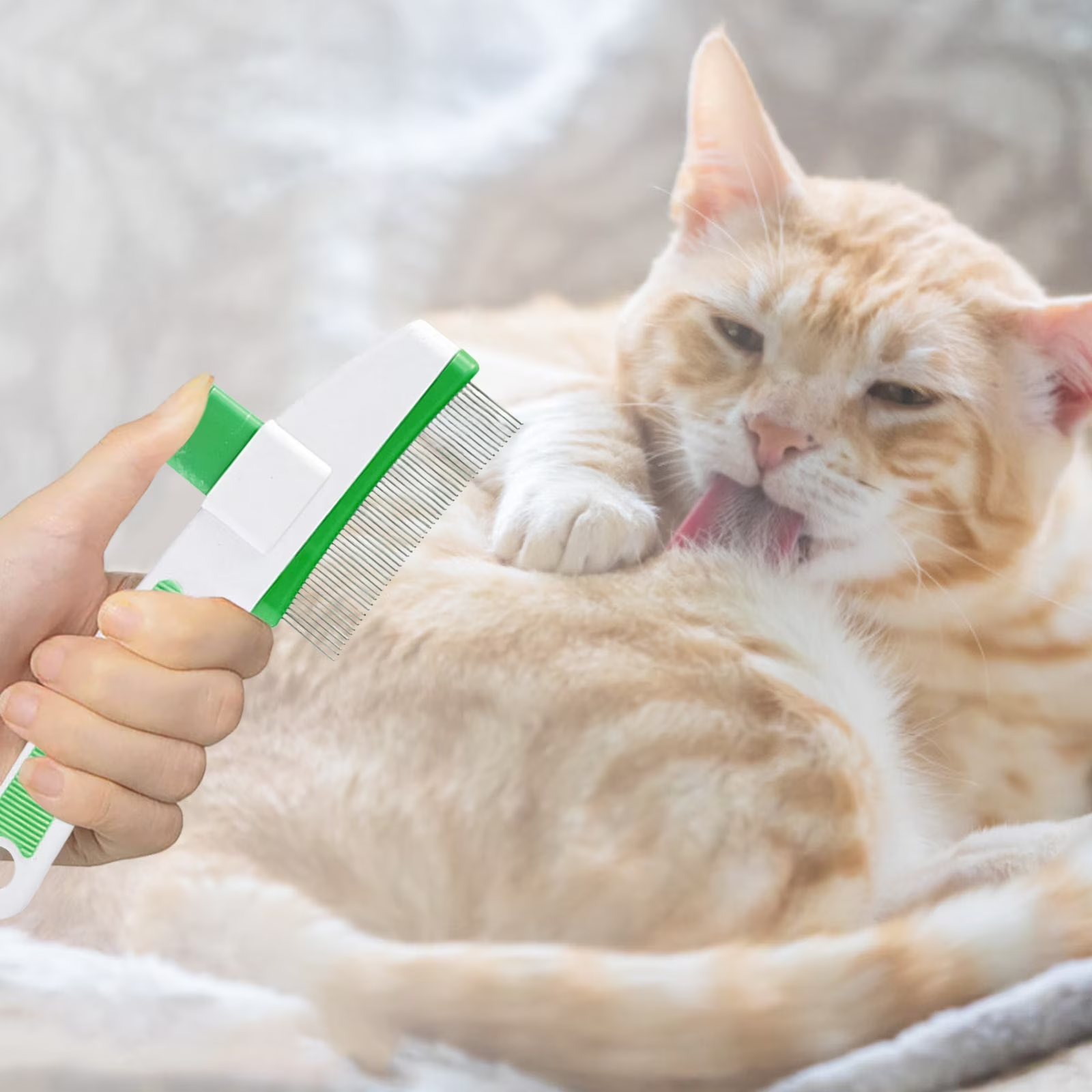
Image source: Bing (Web (fair-use with source credit))
Why most of the flea problem isn't on your cat
Adult fleas on the animal make up only a small fraction of the total population. The overwhelming majority exists as eggs, larvae, and pupae in your carpets, skirting boards, sofa cushions, and the cat's bedding.
That single fact explains why flea treatment "fails" for so many people.
Here's the sequence. Eggs fall off the cat and scatter through the house. They hatch into larvae that burrow away from light into carpet fibres.
Larvae spin cocoons and become pupae, and pupae are effectively armoured. Nothing you spray reaches them reliably.
Pupae then wait for vibration, warmth, and carbon dioxide before emerging. That's why you get a fresh wave of fleas days after a treatment that seemed to work.
The full cycle runs about 2 to 4 weeks at normal room temperature. Central heating means it never stops in winter, which is exactly why indoor-only cats in the UK and northern US still get fleas in January.
The three-month household clearance timeline
Clearing an established flea population takes 3 months minimum. Anyone promising faster is only killing adults.
What you have to do:
- Treat every pet in the house. Every cat, every dog, every month. One untreated animal keeps the cycle running.
- Use a veterinary-grade product. Many supermarket products have poor efficacy or resistance issues. Vet-supplied options are consistently more reliable.
- Keep going for 3 full months minimum. You're waiting out the pupae, not the adults.
- Vacuum aggressively. Daily at first, focusing on skirting boards, under furniture, and along carpet edges. Vibration triggers pupae to hatch, which is exactly what you want while treatment is active.
- Wash all bedding at 60°C. Cat beds, your bedding, blankets, the sofa cover.
- Consider a household product with an insect growth regulator if the infestation is heavy. Follow label directions exactly.
Then switch to year-round monthly prevention and never stop. The Companion Animal Parasite Council and its European counterpart ESCCAP both recommend 12-month prevention, not seasonal.
Flea allergy dermatitis needs a note of its own. In an allergic cat, a single bite triggers weeks of itching. So the hair loss continues even after the fleas are gone. Your cat can be flea-free and still bald for a month afterwards.
That's expected. Don't declare the treatment a failure.
Mites, and how they differ from fleas
Not everything itchy is a flea.
- Cheyletiella ("walking dandruff"). Large surface mites that produce heavy scurf along the back, and the flakes appear to move. It's zoonotic. Owners get itchy red bumps on the forearms and torso.
- Otodectes cynotis (ear mites). Dark, crumbly, coffee-ground discharge in the ears with fierce head shaking and scratching. Cats scratch the hair off around the ears and neck.
- Notoedres cati (feline scabies). Intense itching starting at the ear margins and spreading to the face and neck, with thick grey crusts. Highly contagious between cats.
- Demodex mites. Less common in cats. Causes patchy hair loss, often around the face and eyes.
Diagnosis needs a vet doing skin scrapes, tape preps, and cytology. You cannot tell these apart by eye, and the treatments differ.
Handling ringworm safely at home
Ringworm isn't a worm. It's a fungal infection of the hair shaft, most often Microsporum canis, and it spreads readily to people.
If you suspect it:
- Wear gloves. Wash your hands and forearms after handling.
- Isolate the cat to one easily cleaned room if you have other pets or young children.
- Stop brushing until diagnosis. Brushing aerosolises fungal spores across the whole house.
- Wash bedding separately and vacuum thoroughly, disposing of the bag.
Treatment usually runs 6 weeks or longer, often combining oral antifungals with topical dips or rinses, and it's confirmed finished by culture, not by how the cat looks. The Koret Shelter Medicine Program at UC Davis publishes detailed ringworm protocols, and they consistently stress that environmental decontamination matters as much as treating the cat.
Spores survive in the environment for a long time. Half-finished treatment is how households end up passing it back and forth for months.
Branch E: Stress and Over-Grooming, But Rule Out Medical First
This is the branch people jump to fastest and diagnose wrongest. The internet loves "stress licking." Veterinary dermatology data does not support it as the usual answer.
Over-grooming is medical until proven otherwise. True psychogenic alopecia, hair loss driven purely by anxiety, is uncommon. When cats are presented for "stress licking," most turn out to have an underlying itch or pain problem.
So the order matters. You earn a behavioural diagnosis. You don't assume it.
The exclusion sequence
Work through this with your vet before anyone says the word stress.
| Step | What it rules out | Timeline |
|---|---|---|
| Strict flea control on all pets | Flea allergy dermatitis | 8 to 12 weeks |
| Skin scrape, tape prep, cytology | Mites, bacterial or yeast overgrowth | Same visit |
| Wood's lamp plus fungal culture | Ringworm | Culture takes up to 2 to 3 weeks |
| Elimination diet trial | Food allergy | 8 to 12 weeks, absolutely strict |
| Bloodwork and urinalysis | Hyperthyroidism, diabetes, kidney disease | Days |
| Pain assessment, imaging if needed | Cystitis, arthritis, anal gland disease | Varies |
The elimination diet trial is where most attempts fall apart. It means a novel protein or hydrolysed protein diet and nothing else. No treats, no flavoured medications, no dental chews, no scraps, no licking the dog's bowl.
One lapse resets the clock.
Localised over-grooming deserves special attention. A cat licking one specific spot bald, particularly over the bladder, a joint, or the tail base, is often signalling pain in exactly that location. Feline idiopathic cystitis frequently presents as belly licking.
When it genuinely is behavioural
Once medical causes are excluded, look at what changed in the cat's world. Cats are territorial, routine-driven animals, and the triggers are rarely dramatic.
Common ones:
- A new cat, dog, baby, or partner in the house
- A house move, renovation, or new furniture
- An outdoor cat visiting the garden and staring through the window
- Litter tray changes: new litter, new location, a covered box, or too few trays
- Owner schedule changes, especially long absences after a period of constant company
- Loss of a bonded companion cat
The fixes are environmental, not pharmaceutical, at least to start.
- Litter trays: one per cat plus one spare, in separate locations, uncovered, unscented.
- Vertical space. Cat trees, shelves, window perches. Height reduces conflict in multi-cat homes.
- Multiple resource stations. Separate food, water, and resting spots so cats aren't forced to share.
- Block the view of intruding cats with window film on the lower half of the glass.
- Predictable routine. Feed at consistent times. Cats settle on rhythm.
- Daily play. Two short wand sessions ending in a food reward mimics the hunt-catch-eat sequence and lowers arousal.
- Synthetic feline facial pheromone diffusers. Evidence is mixed but they're harmless and some owners report clear results.
The Indoor Pet Initiative at Ohio State University's veterinary college is the most useful free resource we've found on structuring an indoor cat's environment properly.
Give environmental changes 8 weeks before judging. If the licking continues despite a clean medical workup and a genuinely enriched environment, ask your vet about behavioural medication. Some cats respond well, and it isn't a failure to need it.
One thing to skip: Elizabethan collars as a standalone fix. They stop the licking without addressing why, and a stressed cat in a cone is a more stressed cat. They have a place short term while a wound heals, not as a treatment plan.
Choosing the Right Tool for Your Cat's Coat
Now the equipment. Notice this comes after the branches, not before. A tool only helps once you know which problem you're solving.

Image source: Bing (Web (fair-use with source credit))
Slicker versus de-shedding blade versus undercoat rake
These three get confused constantly, and they do genuinely different jobs.
| Tool | How it works | Best for | Avoid on |
|---|---|---|---|
| Slicker brush | Fine bent wire pins lift loose hair from the undercoat | Medium and long coats, general de-shedding, mat prevention | Rex coats, thin-skinned seniors, bare or inflamed skin |
| De-shedding blade | A fine-toothed edge pulls undercoat through the guard coat | Dense double coats in heavy seasonal shed | Single coats, longhairs prone to matting, any cat with existing hair loss |
| Undercoat rake | Widely spaced long teeth reach deep without cutting | Thick double coats, Maine Coons, Norwegian Forest Cats | Fine or sparse coats where there's no undercoat to reach |
On slicker brushes, look for coated or rounded pin tips. Bare wire tips scratch skin, and cats remember. A flexible or cushioned head follows body contours better over ribs and hips.
On de-shedding blades, the honest position is this: they work extremely well on the right cat and cause real problems on the wrong one. The blade cuts as much as it pulls. On a dense-coated Siberian in April, that's exactly what you want.
On a Devon Rex or a 15-year-old with thinning fur, you're removing coat the cat needs.
Manufacturer guidance from tool makers like FURminator specifies short-hair and long-hair variants plus size options, commonly around a 2-inch head for small cats and 3-inch for large ones. Using the long-hair version on a shorthair pulls too deep.
Aggregate user reviews for de-shedding tools show a consistent split: dramatic results on double-coated cats, complaints of skin irritation and cut fur on everything else. That split is coat type, not product quality.
Frequency limit: even on suitable cats, once or twice a week during a seasonal shed is plenty. Daily de-shedding blade use thins the coat.
Rubber curry brushes and grooming gloves for handling-averse cats
If your cat bolts at the sight of a brush, start here.
Rubber curry brushes and silicone grooming mitts work by static and friction rather than by penetrating the coat. Loose hair sticks to the nubs. They also feel like being stroked, which is the whole point.
They're the right choice for:
- Shorthaired cats where there's no undercoat to rake out
- Cats with sensitive skin or a history of brush-related reactions
- Rescue cats and kittens meeting a grooming tool for the first time
- Anyone in the desensitisation phase, working up to a proper brush
- Bath time, where a rubber curry doubles as a shampoo applicator
The trade-off is depth. A mitt won't clear a packed undercoat on a Maine Coon. It's a starting tool and a maintenance tool, not a seasonal-shed tool.
Self-groomer brushes that mount to a wall corner or table leg are worth a mention too. Cheap, and some cats use them obsessively. Others ignore them completely.
Low risk either way.
The steel comb, and why it's the one tool to buy first
If you buy exactly one thing, make it a stainless steel greyhound comb.
It removes loose hair, finds mats before they set, and verifies your work in a way no brush can. Dual-density versions have coarse teeth at one end and fine at the other, which handles most coat types with a single tool.
What to look for:
- Solid stainless steel, not plated. Plated teeth chip and then snag hair.
- Rounded tooth tips. Sharp tips scratch.
- Teeth long enough to reach skin on your cat's coat length. Longhairs need longer teeth.
A fine-toothed flea comb belongs in the same drawer. It's a diagnostic instrument, not a grooming tool, and it costs almost nothing.
Tools that do real damage on the wrong coat
Some things genuinely aren't worth the risk.
- Dog slicker brushes with bare, sharp pins. Cat skin is thinner. These abrade it.
- De-shedding blades on Rex, Sphynx, seniors, or any cat with existing bald patches. Nothing to remove, real damage to cause.
- Shedding blades, the looped metal blade designed for horses and short-coated dogs. Too aggressive for feline skin.
- Scissors near mats. The most common at-home grooming injury, and entirely avoidable.
- Human hairbrushes. Wrong pin spacing, wrong flexibility, and they skate over the top coat.
- Vacuum grooming attachments on noise-sensitive cats. Some cats tolerate them. Most find them terrifying, and a bad first experience sets you back months.
One last practical point on maintenance. Clean hair out of your brush every session, and wash tools monthly in warm soapy water. Sebum and skin debris build up on pins and get pressed back into the coat.
Dry steel tools properly so they don't pit.
Bathing: When It Helps, When It Backfires
Most cats never need a bath. They're built to groom themselves, and a healthy shorthair with normal skin does a better job than you will.
But bathing does have a place. Done right, a bath loosens and removes a large volume of dead undercoat in one go. Done wrong, it strips sebum, dries the skin, and makes flaking worse.
When a bath actually helps
Reach for the shampoo in these situations:
- Peak seasonal shed on a double-coated cat. A bath plus a thorough comb-out during drying removes far more undercoat than brushing alone.
- Greasy or scurfy coat, common in overweight cats, seniors, and Sphynx or Rex breeds where sebum builds up with nothing to distribute it.
- Medicated washes prescribed by a vet for ringworm, mites, or bacterial skin infections.
- A cat that's got into something it shouldn't lick off.
- Allergy households where reducing the dander load on the coat helps a family member.
Skip the bath if the cat is healthy, comfortable, and grooming normally. You're solving a problem that doesn't exist.
The protocol, in order
The sequence matters more than the product.
- Brush and comb thoroughly first. Water turns loose tangles into set mats. Never bathe a matted cat.
- Trim claws a day or two before if the cat is likely to object.
- Fill the sink or tub first. Running water frightens most cats. A few inches of lukewarm water is plenty.
- Put a towel or rubber mat down. Cats panic on slippery surfaces, and most bath-time injuries start with a scrabbling cat.
- Wet the coat with a jug or a low-pressure spray, working from the neck back. Keep water out of the ears and eyes.
- Dilute the shampoo in a jug of warm water before applying. Neat shampoo is hard to rinse from dense coats.
- Work it in with a rubber curry brush, not your fingernails. It distributes product and pulls loose hair at the same time.
- Rinse twice as long as you think you need. Shampoo residue is the top cause of post-bath itching and flaking.
- Towel dry, then comb while damp. This is where the undercoat comes out in handfuls.
- Air dry in a warm room, or use a dryer on the lowest heat and lowest noise setting if your cat tolerates it.
Never use a hot dryer close to the skin. Cats overheat quickly, and their skin burns before they show obvious distress.
Products and frequency
| Product type | Use it for | Watch out for |
|---|---|---|
| Cat-specific general shampoo | Routine washing, greasy coats | Must be formulated for feline skin pH |
| Oatmeal or colloidal oatmeal | Dry, itchy, flaky skin | Not a treatment for the underlying cause |
| Hypoallergenic or fragrance-free | Sensitive cats, allergy households | Fewer ingredients means fewer reactions |
| Medicated (chlorhexidine, antifungal) | Vet-diagnosed infections only | Contact time matters. Follow the label exactly. |
| Waterless foam or wipes | Spot cleaning, cats who won't tolerate water | Won't remove much undercoat |
Frequency is where people go wrong. Bathing a cat more than about once a month strips protective oils and dries out the skin. That produces flaking, which produces itching, which produces more hair loss. If your cat's coat looks worse three baths in, that's your answer.
Never use human shampoo. Feline skin pH is different from ours, and human formulations disrupt the barrier. Baby shampoo included.
Mistakes That Make Shedding Worse
Some of these cost money. Some cost your cat's tolerance of being handled. A couple can genuinely injure or kill.
Scissoring mats and the skin laceration risk
This is the injury vets and groomers see most often from home grooming, and it happens the same way every time.
The owner grips the mat, slides scissors underneath, and snips. What they don't realise is that a tight mat pulls the skin up with it. The skin tents into a ridge directly under the blade.
One cut, and you've opened a wound that needs stitches.
Feline skin is thin and loosely attached, so it lifts far more readily than you'd expect from handling a dog. And a mat gives you no visibility.
Do this instead:
- Split the mat with a mat splitter or seam ripper, working from the outer edge inward, never against the skin.
- Work it apart with your fingers first. Tease the edges loose, don't pull the base.
- Use clippers with a #10 blade laid flat against the skin, sliding under the mat. This is what groomers do.
- Hand it over if the mat is tight, close to skin, or near the armpit, groin, or ear. Those areas have the thinnest skin.
If your cat suddenly reacts violently to touch on a matted area, the mat is already pulling and the skin underneath may be inflamed or ulcerated.
Shaving a cat to "stop" shedding
Shaving does not reduce the amount of hair a cat sheds. Every follicle keeps cycling on exactly the same schedule. You've just made the shed hairs shorter.
Short hairs are arguably worse. They work into upholstery and clothing fibres more deeply than long ones and are harder to lift out.
There are other costs:
- The coat insulates in both directions. Shaved cats can get cold indoors and sunburn near windows.
- Regrowth in dense-coated breeds is sometimes patchy or comes back with a different texture.
- Some cats show behavioural changes after a shave, likely from the loss of tactile feedback.
Clip for matting, hygiene, or medical access. Not for shedding volume.
Permethrin, essential oils, and human products
Permethrin kills cats. This isn't an exaggeration. Many dog flea spot-on treatments contain permethrin at concentrations that cause tremors, seizures, and death in cats, who lack the liver enzyme pathway to process it.
The rules:
- Never apply a dog flea product to a cat. Read the active ingredient every single time.
- If you have a dog on a permethrin spot-on, keep the cat away until the application site is completely dry, usually 24 to 48 hours.
- Don't let cats groom treated dogs.
- If exposure happens, this is an emergency. Contact a vet immediately.
Essential oils are the second trap. Cats lack the glucuronidation pathway needed to metabolise many phenols and terpenes. Tea tree (melaleuca) oil is the notorious one, but citrus, pine, eucalyptus, wintergreen, peppermint, cinnamon, and pennyroyal all cause problems.
That applies to shampoos, sprays, "natural" flea remedies, and diffusers running in the same room. Tea tree oil is a recurring feature in feline poison control reports from well-meaning owners.
Keep the ASPCA Animal Poison Control Center number saved. Charges may apply, but the advice is immediate and expert.
The slower-burn mistakes
These won't hurt your cat, but they'll waste your time and money.
- Quitting a supplement at week three. The follicle cycle hasn't turned over yet. You've bought a trial and thrown away the result.
- Brushing past tolerance. One painful session can undo six months of trust. Stop before the cat asks you to.
- Treating only the itchy cat for fleas. The others in the household are reinfesting it.
- Buying the tool before the diagnosis. A large share of shedding complaints turn out to be flea allergy or over-grooming.
- Free-feeding a cat that can't reach its own back. Weight is the mechanical cause of the matting.
- Expecting zero. A healthy cat sheds. The goal is capture, not elimination.
- Over-bathing to reduce dander. It dries the skin barrier and produces more flaking, not less.
Reading Your Cat's Stop Signals During Grooming
Grooming tolerance is a currency. You spend it every session, and you can go bankrupt in one go.
Most cats will tell you they're done well before they bite. People miss it because the signals are subtle and the cat looks relaxed right up until it isn't.
Tail flick, skin ripple, ear position
Learn these four and you'll almost never get scratched.
- Tail movement. A slow tip flick is early irritation. A thumping or lashing tail means stop now. Cats don't flick their tails when they're content.
- Skin rippling along the back. The fur over the spine twitches and rolls. A classic sign of overstimulation, and it often precedes a bite by seconds.
- Ear position. Ears rotating sideways or flattening back mean the cat has stopped enjoying this. Forward and relaxed is fine.
- Pupil dilation. Wide pupils in normal room light signal arousal, not affection.
Secondary signals worth watching: turning the head sharply toward your hand, a low tail-base twitch, sudden stillness, or a burst of self-grooming that's really a displacement behaviour.
Petting-induced aggression is a real, documented feline behaviour. The cat appears to enjoy handling, then abruptly bites or grabs. It isn't spite or unpredictability.
It's the cat reaching a threshold you didn't notice.
Stop at the first signal, not the third.
The 60-second desensitisation plan
If your cat already hates being brushed, forget about full sessions. You're rebuilding an association, not grooming.
Here's the progression. Move up only when the current step is boring to the cat.
| Stage | What you do | Move on when |
|---|---|---|
| 1 | Leave the brush on the floor. Feed treats near it. | Cat ignores the brush entirely |
| 2 | Hold the brush, pet the cat with your other hand, treat. | Cat stays relaxed with brush visible |
| 3 | One single stroke with the brush. Treat. Stop. | Cat accepts one stroke without tension |
| 4 | Three strokes on the shoulders only. Treat. Stop. | Cat stays settled through all three |
| 5 | 30 seconds, shoulders and back. Treat. Stop. | Consistent relaxation for a week |
| 6 | 60 seconds, add the sides. | Cat approaches when you pick up the brush |
Rules that make it work:
- Always end before the cat wants you to. Leave them wanting more, every time.
- Use genuinely high-value food. Lickable treat tubes, plain cooked chicken, a smear of cat-safe paste. Kibble won't cut it.
- Start where cats like being touched: cheeks, chin, shoulders, along the back. Never start with belly, feet, or tail.
- Never chase, corner, or scruff. Scruffing as routine restraint is discouraged in current feline handling guidance because it increases fear without improving safety.
- Same time, same place. After a meal, when they're already sleepy, works well.
The American Association of Feline Practitioners publishes feline-friendly handling guidelines that back all of this. Their core principle is simple: reduce fear, and handling gets easier for everyone.
Expect this to take 4 to 8 weeks with a genuinely brush-averse cat. That's the trade. Two months of patience buys you years of easy grooming.
For cats who won't accept it at all, a professional groomer experienced with cats, or a vet visit with pre-visit anxiety medication, is a legitimate option. Fighting your cat weekly is not.
What This Costs: Tools, Supplements, and Vet Workups
Budget matters here, because the branch you're on decides whether this is a $30 problem or a $600 one.
Grooming tools and consumables
| Item | Typical range (USD) | Typical range (GBP) | Notes |
|---|---|---|---|
| Stainless steel greyhound comb | $10 to $30 | £8 to £25 | Buy this first if you buy nothing else |
| Fine-toothed flea comb | $5 to $12 | £4 to £10 | Diagnostic tool, not optional |
| Slicker brush | $8 to $25 | £6 to £20 | Coated pin tips matter more than brand |
| Rubber curry or grooming mitt | $6 to $15 | £5 to £12 | Best entry tool for nervous cats |
| Undercoat rake | $12 to $25 | £10 to £20 | Double coats only |
| De-shedding blade tool | $20 to $45 | £18 to £40 | Right cat only. Check the coat type first. |
| Mat splitter | $10 to $20 | £8 to £16 | Safer than scissors, always |
| Cat shampoo | $8 to $20 | £7 to £16 | Cat-formulated only |
| Pet clippers | $40 to $150 | £35 to £120 | Quiet models cost more and are worth it |
A complete home kit for a shorthair runs roughly $25 to $40. A longhair kit with a splitter and a proper slicker lands around $50 to $70.
Ongoing monthly costs
| Item | Monthly cost (USD) | Notes |
|---|---|---|
| Flea prevention, per cat | $10 to $25 | Vet-grade products cost more and work better |
| Omega-3 supplement | $10 to $30 | Weight-based dosing, buy small bottles for freshness |
| Wet food top-up | $15 to $45 | Depends on brand and how much you swap |
| Water fountain | $25 to $60 once | Plus filters, roughly $5 to $12 monthly |
Professional and veterinary costs
| Service | Typical range (USD) | What you get |
|---|---|---|
| Professional cat groom | $50 to $120 | Bath, dry, full comb-out, nail trim |
| Sanitary trim only | $25 to $50 | Quick, often walk-in |
| Sedated dematting or lion cut at a vet | $150 to $400+ | Includes pre-anaesthetic check and monitoring |
| Vet consult for skin problem | $50 to $120 | Exam, initial assessment |
| Skin scrape plus cytology | $50 to $150 | Rules out mites, yeast, bacteria |
| Fungal culture or PCR for ringworm | $40 to $120 | PCR is faster, culture is the gold standard |
| Total T4 blood test | $50 to $100 | Hyperthyroidism screen in cats aged 8+ |
| Full bloodwork panel plus urinalysis | $150 to $300 | Kidney, liver, thyroid, glucose |
| Referral dermatology workup | $300 to $800+ | Allergy testing, biopsy if needed |
| Prescription hydrolysed diet, monthly | $60 to $120 | For an 8 to 12 week elimination trial |
Prices vary widely by region and clinic type. Urban US and central London clinics sit at the top of these ranges. Rural practices sit near the bottom.
The cost logic worth understanding: a $60 vet consult that identifies flea allergy dermatitis saves you months of supplements and brushes that were never going to work. And a $15 monthly flea prevention habit is dramatically cheaper than a $400 sedated dematting after a coat pelts.
Pet insurance often covers dermatology workups but almost never covers grooming or routine flea prevention. Check your policy wording on "pre-existing" before assuming skin conditions are included.
Managing the Hair That Still Ends Up on Everything
Even with a perfect routine, hair escapes. Here's how to keep the house liveable without vacuuming twice a day.
Source control beats air purifiers
Grooming does more than any device. Every gram of hair you catch in a comb is a gram that never lands on your sofa.
The order of effectiveness for household hair:
- Regular brushing (biggest single lever)
- Washable covers on the surfaces cats actually use
- Vacuuming with the right tool
- Filtration
Practical wins:
- Give the cat one designated bed in each favourite room and wash the covers weekly. Cats concentrate hair where they sleep. Contain it and you've won half the battle.
- Washable throws over the sofa and the end of the bed. Far easier than cleaning upholstery.
- A damp rubber glove dragged across fabric pulls hair out better than any lint roller. So does a rubber squeegee on carpet.
- A 10 minute no-heat tumble before washing cat bedding pulls loose hair out first.
- Vacuum choice matters. Look for a tangle-free or anti-hair-wrap brushroll. Standard rollers wrap with hair in weeks and lose suction.
For car interiors, a rubber-bristled brush plus a vacuum beats any specialised gadget.
Fel d 1, dander, and allergy households
If someone in the house is allergic to the cat, understand what they're actually reacting to. It isn't hair.
Fel d 1 is a protein produced mainly in a cat's saliva and sebaceous glands. It transfers to the coat during grooming, dries onto skin flakes (dander), and goes airborne. The hair is just the delivery vehicle.
That reframes everything:
- No cat is truly hypoallergenic. Sphynx cats still produce Fel d 1. Some breeds and individuals produce less, but "less" isn't "none".
- Shaving doesn't help allergies. The protein is on the skin.
- Male cats, particularly unneutered males, produce more Fel d 1 than females. Neutering reduces it.
- Regular brushing does help, because you're removing dander-carrying hair before it becomes airborne.
Measures that genuinely reduce allergen load, roughly in order of impact:
- Keep the cat out of the allergic person's bedroom, permanently. This one matters most.
- Brush the cat frequently, ideally outdoors or in one easy-clean room.
- Wipe the coat with a damp cloth or a cat-safe grooming wipe a few times a week.
- Run a HEPA air purifier (99.97% capture at 0.3 microns) sized for the room, in the bedroom and main living space.
- Change HVAC filters more often than the label suggests. Cat hair loads them fast.
- Hard flooring instead of carpet where possible. Carpet is an allergen reservoir.
- Wash hands after handling, and don't rub your eyes.
Some manufacturers now sell diets containing an egg-derived anti-Fel d 1 antibody that binds the protein in saliva. Published manufacturer research reports meaningful reductions in active allergen on the coat, though it doesn't eliminate it. It's an add-on to the measures above, not a replacement.
Anyone with cat-triggered asthma should be working with a doctor, not just a vacuum. Environmental control helps. It isn't a treatment plan on its own.
What Realistic Results Look Like at 2, 6, and 12 Weeks
Expectations are where most people give up. Knowing the timeline stops you abandoning something that was working.
Weeks 1 to 2: mechanical wins only
Brushing produces immediate results. That's it.
You'll notice less hair on clothes and furniture within a few days of starting a proper routine. That's not the coat improving. You're catching hair in a comb instead of on the sofa.
What you should see:
- Visibly less hair on high-traffic surfaces
- A satisfying pile of undercoat after each session
- Possibly a slight increase in visible shedding at first, as you release hairs already sitting in telogen
What you won't see: any change in coat quality, gloss, or the underlying shedding rate. Nothing you feed has reached a follicle yet.
If nothing improved at all in two weeks, your brushing isn't reaching skin level. Run the comb test.
Weeks 3 to 6: the first real signals
This is where the biology starts moving.
| What you changed | What shows by week 6 |
|---|---|
| Diet or omega-3 supplement | Early gloss returning, less flaking. Shedding volume unchanged. |
| Hydration (wet food, fountain) | Softer skin, less dandruff |
| Flea treatment started | Itching and scratching drop noticeably. Hair still missing. |
| Weight loss programme | Cat reaching further back. Fewer new mats forming. |
| Humidity correction | Less static, less flaking, hair clinging less to fabric |
| Grooming desensitisation | Cat tolerates 3 to 5 minutes without complaint |
The most common week-6 mistake is judging a supplement now. Too early. Gloss is a surface change.
Shedding volume is a follicle change, and follicles are slower.
For flea-allergic cats, week 6 is also when owners panic. The fleas are gone but the belly is still bald. That's normal.
Hair regrowth trails the itch relief by weeks.
Weeks 8 to 12: the honest verdict
By 12 weeks, enough of the coat has cycled through anagen for you to judge properly.
What a successful outcome looks like:
- Noticeably less loose hair overall. Not zero. Owner reports on consistent grooming plus diet correction describe a substantial drop, not elimination.
- Coat feels different. Denser, smoother, less brittle when you run a hand backwards through it.
- Fewer hairballs. Less swallowed hair means less vomiting.
- No new mats forming between sessions on a longhair.
- Regrowth visible on previously bald areas if the cause was fleas, mites, or resolved over-grooming. Look for fine, short, often darker fuzz coming through.
Regrowth speed varies. Fine hair typically appears within 4 to 8 weeks of the cause being fixed, but full-length coat on a longhaired cat takes several months.
If you're at 12 weeks with no improvement, stop adding products. Go back to the vet with specifics: what you changed, when, and what didn't shift. A workup at that point is far more productive than another supplement.
Even with everything right, spring will still be heavy on a double-coated cat. You're managing a biological process, not switching it off. The measure of success is how much hair ends up in your brush versus your carpet.
Frequently Asked Questions
Does brushing actually reduce shedding, or just move the hair?
It moves the hair, and that's the whole point. Brushing removes dead telogen and exogen hairs before they fall onto your furniture. It doesn't change how much your cat sheds biologically.
Consistent brushing also prevents matting and cuts hairball frequency, since your cat swallows less loose fur during self-grooming.
How often should I brush my cat to control shedding?
It depends on coat type. Shorthairs need once or twice weekly, rising to three or four times during seasonal shed. Medium coats need three sessions a week.
Longhairs like Persians and Ragdolls need daily combing, no exceptions. Keep sessions short, roughly 5 to 10 minutes, and stop before your cat gets irritated.
Will fish oil or supplements stop my cat shedding?
No supplement stops shedding. Omega-3 fatty acids improve coat gloss, reduce flaking, and support the skin barrier, which can reduce breakage and dryness-driven hair loss. Allow 6 to 12 weeks before judging results, since only hairs in the active growth phase respond.
Always dose by weight and ask your vet for a specific EPA plus DHA figure.
Is my cat shedding too much, or is something wrong?
Check the skin, not the hair volume. Even coat with clean skin means normal shedding, however much you're vacuuming. Bald patches, symmetrical thinning on the belly or thighs, scabs, crusty bumps, or blunt chewed hair ends mean something medical.
Sudden heavy shedding in a cat aged 8 or over needs a thyroid blood test.
Do indoor cats shed all year round?
Yes, and artificial lighting is why. Shedding is triggered by day length, not temperature. Indoor cats living under 12 to 16 hours of household light never get a clear seasonal signal, so the coat turns over gradually all year.
Outdoor cats show two distinct peaks instead, heaviest in spring. Total annual hair volume is similar either way.
Does shaving a cat reduce shedding?
No. Every follicle keeps cycling on the same schedule, so shaving only makes the shed hairs shorter. Short hairs actually embed deeper into upholstery and clothing.
Clipping is justified for severe matting, hygiene problems, or medical access, never for shedding volume. Shaved cats also lose insulation and can sunburn near windows.
Your Shedding Action Plan, Branch by Branch
Everything above condenses into one page. Find your branch, do these things, in this order.
If your cat's skin and coat are healthy (Branch A)
- Buy a stainless steel greyhound comb and a slicker or rubber curry matched to the coat type.
- Set a brushing schedule and put it in your calendar. Frequency beats duration.
- Line brush longhairs. Comb to verify you reached skin.
- Increase frequency during spring and autumn shed.
- Add washable throws where the cat sleeps. Vacuum weekly with a tangle-free brushroll.
Expected result: substantially less hair around the house within 2 weeks.
If the coat is dull, dry, or brittle (Branch B)
- Check the food carries an AAFCO or FEDIAF complete-and-balanced statement.
- Confirm the protein source is animal-based, not plant-heavy.
- Add a weight-dosed omega-3 supplement with vitamin E. Store it in the fridge.
- Swap at least one meal to wet food. Add a fountain in a separate room from food and litter.
- Get indoor humidity to 40 to 50% in winter.
- Reassess at 12 weeks. If nothing changed, request bloodwork.
If mats form on the back, rump, and tail base (Branch C)
- Body condition score your cat. Address weight with your vet if it's above 5 out of 9.
- Ask for an arthritis and dental assessment in the same visit.
- Groom daily, briefly, focusing on the blind-spot zones.
- Book a sanitary trim or comb cut if mats are already set. Never scissor them.
- Track hairball frequency as a proxy for whether self-grooming has restarted.
If you found flea dirt, scabs, or scaly patches (Branch D)
- Start vet-grade flea prevention on every pet, same day.
- Commit to 3 full months minimum, then continue year-round.
- Vacuum daily at first. Wash all bedding at 60°C.
- See a vet for skin scrapes and cytology if there's crusting, ear discharge, or head shaking.
- Suspect ringworm? Gloves on, stop brushing, isolate, book the appointment.
Never apply a dog product to a cat. Check for permethrin every single time.
If hair loss is symmetrical or the ends look chewed (Branch E)
- Complete the medical exclusion sequence first. Fleas, mites, fungus, diet trial, bloodwork.
- Only then look at environmental triggers.
- Fix litter tray numbers, add vertical space, separate resource stations.
- Two short wand play sessions daily, ending in food.
- Give environmental changes 8 weeks. Discuss behavioural medication if it persists.
The four things worth doing regardless of branch
- Year-round flea prevention on every pet. Cheapest insurance in the whole plan.
- A steel comb and a weekly habit. Even for cats who barely shed.
- Hands on the cat regularly. You'll find lumps, wounds, weight changes, and mats early.
- A vet visit for anything that isn't just loose hair. Bald skin, scabs, chewed ends, or a senior cat with a suddenly wrecked coat.
Get the branch right and the rest is straightforward. Get it wrong and you'll spend a year brushing a cat with fleas.