
Getting the bath over with is the easy part. Knowing how to dry a cat after a bath is where most owners get it wrong, and it's the stage that decides whether your cat ends up warm and fluffy or shivering under the bed with a matted undercoat. A wet cat isn't just inconvenient.
A wet cat is a cat losing body heat fast.
Here's the number that matters most. A healthy cat runs at 38.1 to 39.2 °C (100.5 to 102.5 °F), and hypothermia starts below roughly 37.2 °C (99 °F). Soaked fur strips out the insulating air layer that keeps that temperature stable, so the clock starts ticking the moment your cat leaves the water.
Which is exactly why the drying method you pick matters more than the shampoo you used.

Image source: Pexels / Karin Chantanaprayura (Pexels License)
Quick Answer
Dry a cat after a bath by blotting, not rubbing. Press a microfibre towel firmly against each section for 10 to 15 seconds. Swap to a fresh dry towel once the first one saturates.
Keep the room at 24 to 27 °C (75 to 80 °F) with no drafts. Use a no-heat pet dryer only if your cat tolerates noise. Never use a human hairdryer on a cat.
Why a Wet Cat Is a Bigger Problem Than a Dirty One
A dry cat with a bit of grubby fur is fine for another day. A wet cat is on a countdown.
Cats lose heat quickly relative to their size because of a high surface-area-to-body-mass ratio. Their coat works by trapping a warm layer of air against the skin. Water collapses that layer completely.
Evaporation then pulls even more heat out, the same reason you feel cold stepping out of a shower into a breeze.
There's a second problem nobody warns you about. Long and semi-long coats that dry on their own almost always dry badly. The hairs set in whatever tangled position they landed in, then felt together into mats behind the ears, in the armpits, at the tail base, and along the trouser fur on the back legs.
Once a mat sets, brushing it out hurts, and plenty of those cats end up needing a groomer's clippers.
Then there's the ears, the belly, and the mood. Water that sits in the outer ear canal creates a warm, damp pocket that can tip into otitis externa. A damp cat that bolts under the bed sulks for hours and files the whole experience under "bathroom equals terror," which makes the next bath twice as hard.
The mistake almost everyone makes: you towel the back and sides, the topcoat feels dry to the hand, and you let the cat go. Underneath, the down hair is still holding water. On a dense double coat, that hidden layer can stay wet for four to eight hours.
What Happens Under That Coat When a Cat Gets Soaked
Understanding coat structure is what separates a proper dry from a surface wipe. Cat fur isn't one type of hair. It's three, and they behave completely differently when wet.
Topcoat vs. Undercoat: Why "Feels Dry" Lies to You
The topcoat is made of guard hairs. These are the long, coarse, slightly oily hairs you see and stroke. They're semi water-repellent thanks to sebum, they shed water quickly, and they dry first.
Beneath them sit awn hairs, which are shorter and finer.
Under both of those is the down hair, the soft crimped undercoat. This layer behaves like a sponge. It has no meaningful oil coating and the fibres are fine and densely packed, so water wicks straight in and stays put.
On a Maine Coon, Siberian, or British Shorthair, the undercoat holds most of the water in the coat.
So here's the test that tells you the truth. Part the coat with your fingers, right down to the skin, on the flank and behind the shoulder blade. Press the back of your hand against the skin.
- Skin feels dry and warm: you're genuinely done
- Skin feels cool or damp, or the hair root feels slick: you're not close
- Hair springs apart into fluffy sections when parted: dry
- Hair stays clumped in a parting line: still wet
Do this check in three places minimum. The chest, the belly, and the base of the tail are the last areas to dry and the first ones people skip.
How Fast Cats Lose Body Heat
Faster than you'd guess, and much faster in some cats than others. Post-bath chilling isn't a rare freak event. It's the single most common thing that goes wrong at home.
| Cat profile | Chill risk | Why |
|---|---|---|
| Kitten under 4 weeks | Very high | Can't thermoregulate independently at all |
| Kitten 4 to 12 weeks | High | Tiny body mass, minimal fat reserves |
| Healthy adult, short coat | Low to moderate | Dries fastest, good reserves |
| Healthy adult, dense double coat | Moderate | Undercoat holds water for hours |
| Senior 11+ years | High | Reduced muscle mass, slower thermoregulation |
| Thin, ill, or post-surgical | High | Little insulation, compromised reserves |
| Sphynx and hairless breeds | High | No coat, higher resting heat loss |
Watch for these signs during and after drying. Shivering is the obvious one, but it's not the first. Before that you'll usually see the cat curl into a tight ball with the tail wrapped over the paws, ear tips and paw pads going cool to the touch, and a general flatness or reluctance to move.
If shivering doesn't stop within a few minutes in a warm room, or your cat turns lethargic, call your vet. The Cornell Feline Health Center is a solid, non-commercial reference for feline health basics.
Hidden chill sources people forget: air conditioning, ceiling fans, a cracked window, an extractor fan left running, and cold tile or stone flooring. A cat lying belly-down on cold tile with a damp undercoat is losing heat through direct contact, not just evaporation. Turn the AC off before the bath, not after.
The 6 Things That Change Your Drying Method
There's no single correct way to dry a cat. Anyone who gives you one flat set of steps is ignoring the six variables that decide the answer. Run through these before you fill the sink.
Coat Type
This is the biggest branch by far. A Domestic Shorthair and a Persian are not the same drying job, and treating them the same is how mats and chills happen.
| Coat category | Example breeds | Water it holds | Drying difficulty |
|---|---|---|---|
| Hairless | Sphynx, Peterbald, Donskoy | Minimal, but skin folds trap it | Easy but fast-chilling |
| Short single coat | Domestic Shorthair, Siamese, Bengal, Burmese | Low | Easy |
| Curly / Rex | Cornish Rex, Devon Rex, Selkirk Rex | Low to moderate | Easy, but no rough handling |
| Semi-longhair | Balinese, Somali, Turkish Angora | High | Moderate |
| Long fine coat | Persian, Himalayan | Very high, mats fast | Hard |
| Dense double coat | Maine Coon, Norwegian Forest, Siberian, British Shorthair, Ragdoll | Very high in undercoat | Hardest |
One oddity worth knowing. The Turkish Van has a notably water-resistant coat texture, so the topcoat sheds water more readily than most longhairs. It still needs a proper undercoat check.
Age and Health Status
Kittens, seniors, and unwell cats get the cautious route every time. No exceptions, no dryers, no long sessions.
- Under 8 weeks: towels and body heat only, in a very warm room, and only bathe if genuinely necessary
- Senior cats (11+): shorter sessions, warmer room, more towels, minimal restraint
- Arthritic cats: they can't hold a braced position, so support the body and keep sessions to a few minutes
- Known heart disease (HCM) or respiratory issues: speak to your vet before bathing at all, since handling stress carries real risk
- Post-surgical or medicated baths: follow your vet's specific instructions over anything here
Temperament and Noise Tolerance
Be honest about your cat, not hopeful. A dryer is only a good tool for a cat that can tolerate it, and forcing one on a panicking cat is worse than air drying.
Rate your cat before you start:
- Tolerant: accepts handling, may grumble, doesn't escalate. Any path works.
- Tense: flattened ears, tail flicking, dilated pupils, stiff body. Towels only, short sessions.
- Panicking: yowling, open-mouth breathing, thrashing, redirected biting. Stop. Wrap and wait.
Professional force dryers commonly run at 85 dBA or more. That's genuinely loud for an animal whose hearing extends well above ours, and it's the number one reason cats fight the dryer.
Room Temperature and Drafts
Aim for 24 to 27 °C (75 to 80 °F) in the drying room. Turn the heating up 20 minutes before the bath so the walls and floor are warm too, not just the air.
Close the door. Block the gap under it if your cat is a bolter. Turn off fans, AC, and extractors.
A small bathroom is the best room in the house for this because it heats fast and contains the cat.
How Wet the Cat Actually Got
A full-immersion bath and a rear-end rinse are two different jobs. If you only cleaned a soiled back end or spot-cleaned a patch, you're drying a small area and it takes five minutes with a towel.
Scale the effort to the soaking. Don't run a full force-dry routine on a cat that got damp paws.
Solo or Two-Person Job
Two people isn't overkill for a longhair or a nervous cat. One person supports and reassures, the other dries. Sessions get shorter, restraint gets gentler, and the scratch risk drops sharply.
If you're solo with a difficult cat, a zippered grooming bag or a snug towel wrap gives you a free hand safely. Never scruff an adult cat for extended handling.
The Decision Tree: Pick Your Drying Path
Run your six variables through this table and you'll land on one of four paths. As of 2026, this is still the framework professional feline groomers work from, and it hasn't changed because the physiology hasn't changed.
| If your cat is… | And… | Then take |
|---|---|---|
| Short-haired, healthy adult | Room is 24 to 27 °C, no drafts | Path A (towels only) |
| Sphynx or hairless | Any healthy adult | Path A, plus fold and ear drying |
| Curly Rex coat | Healthy adult | Path A, no brushing while wet |
| Any coat, kitten under 12 weeks | Any | Path A only, warm room, no dryer |
| Any coat, senior or unwell | Any | Path A only, short sessions |
| Semi-longhair or double coat | Cat tolerates noise | Path B or C |
| Long fine coat (Persian type) | Cat tolerates noise, you have 30+ minutes | Path C (comb and blow) |
| Dense double coat | Cat won't accept a dryer | Path A in a very warm room, then comb repeatedly |
| Any cat | Panicking, open-mouth breathing, thrashing | Path D (stop, wrap, wait) |
The four paths in one line each:
- Path A: Towel blotting only, then a warm rest zone. The default for most cats.
- Path B: Towels first, then a low-speed pet dryer on ambient air for the last 30 to 40 percent.
- Path C: Towels, then a pet force dryer worked section by section with a comb. For dense and long coats.
- Path D: Abort the dry. Burrito wrap in dry towels, warm sealed room, let the cat decompress.
If you're hovering between two paths, take the gentler one. A slightly slower dry in a warm room is almost never harmful. A stressed, over-handled cat is.
Path A: Towel-Only Drying (And Why It's Often the Right Call)
For a healthy short-haired adult cat in a warm room, towels aren't the budget option. They're the correct option. Skipping the dryer isn't a compromise here, and plenty of feline-only groomers dry short coats exactly this way.
Image source: Web (Bing) / sustainmycrafthabit.com (Web image (fair-use with source credit))
The Press-and-Hold Method
Rubbing is the enemy. It tangles the coat, felts long fur into mats, generates static, and triggers the wrestling reflex in cats who were tolerating things fine a second ago. Blotting does the same job better.
- Strip water in the tub first. Run a closed hand down each leg and the tail like you're wringing a rope. Squeeze gently. This alone removes a surprising amount of water.
- Wrap in towel one immediately. Lay the towel over the back and bring it under the chest, front legs in or out depending on your cat. Lift the cat out already wrapped.
- Press and hold, 10 to 15 seconds per section. Flat palm, firm pressure, no movement. Work back, sides, chest, then legs.
- Swap towels the moment one saturates. A wet towel just moves water around. This is the step people skip, and it's why drying feels endless.
- Do the belly, armpits, groin and tail base deliberately. Sit the cat upright against your chest if that's easier. These four spots hold water longest.
- Ears next. Hold a dry cotton ball at the outer ear opening and let it wick. Never push anything into the canal.
- Face and head last, by hand. A damp corner of towel, gentle dabbing, nothing near the eyes.
- Comb only when damp, never soaking. Wide-tooth comb, working from the ends inward. Skip this entirely on Rex coats.
- Repeat the skin-parting check. Flank, chest, tail base. Cool or damp means keep going.
How Many Towels You Really Need
More than you think, and having them stacked within arm's reach before the bath is half the battle. Reaching across the room for a towel is when cats escape.
| Coat type | Towels to stage | Best type |
|---|---|---|
| Sphynx / hairless | 2 | Soft microfibre, low pile |
| Short single coat | 3 | Microfibre 300 to 500 GSM |
| Curly / Rex | 3 | Microfibre, no aggressive terry |
| Semi-longhair | 4 to 5 | Microfibre plus one chamois |
| Long fine coat | 5 | Microfibre, plus a comb ready |
| Dense double coat | 5 to 6 | Chamois first, then microfibre |
Split-fibre microfibre absorbs several times its own weight and wrings out fast, which is why it beats a standard terry bath sheet. A synthetic chamois is worth having as your first towel on a double coat because it pulls bulk water out quickly. Then you switch to microfibre for the finishing work.
Cat-sized is around 60 x 90 cm (24 x 36 in). Anything larger just gets in the way.
Setting Up a Warm Rest Zone
Where the cat goes next matters as much as the towelling. Don't open the bathroom door onto a cold hallway and let a damp cat sprint under the bed.
Set this up before the bath:
- A carrier or open bed lined with two dry towels, in the same warm room
- A heated cat bed or self-warming mat if you have one, on a low setting only
- A folded towel or rug over cold tile
- Doors and windows shut, fans and AC off
- A lickmat or a few treats, so the room stops being purely a bad memory
Then leave your cat alone in there for 20 to 30 minutes. Cats finish the job themselves through grooming and body heat, and they do it far better when nobody's hovering. Check ears at the 30 minute mark, check the skin under the coat again, and keep an outdoor-access cat indoors until they're completely dry.
Path B: Towel Plus Low-Speed Pet Dryer
This is the middle path, and it suits more cats than people expect. You do the bulk of the work with towels, then use a low-speed pet dryer on ambient air for the last stretch, mainly on the undercoat.
Path B fits a healthy adult with a semi-long or moderately dense coat who tolerates handling and doesn't panic at motor noise. It's also the sensible step up if towel-only drying keeps leaving you with a damp chest and belly two hours later.
What "Low-Speed" and "Ambient" Actually Mean
Ambient means no heating element. The air leaves the nozzle at room temperature plus a couple of degrees picked up from motor friction, nothing more. Manufacturer specs confirm this is a deliberate design choice, not a limitation.
Low-speed means running a variable-speed unit at its lowest or second-lowest setting. Entry-level handheld pet dryers typically sit around 40 to 60 CFM of airflow. That's plenty for finishing a semi-longhair and gentle enough that most cats will sit through it.
The Path B Sequence
- Towel to roughly 60 to 70 percent dry first. Same press-and-hold method, same towel swaps. The dryer is a finisher here, not the main event.
- Start the dryer in the corridor or with the door ajar. Let it run for 20 seconds before it comes near the cat.
- Bring it in at arm's length, pointed at the floor. Watch the ears. Flat ears means back off.
- Aim across the body, not at it. Start at the shoulder, hold the nozzle 25 to 30 cm (10 to 12 in) away, and let the airflow skim along the coat.
- Keep the nozzle moving constantly. Never park it on one spot, even on cool air.
- Work in 2 to 3 minute bursts. Pause, stroke, treat, resume. Short sessions beat one long fight.
- Skip the head entirely. Head and face stay a towel job, always.
- Finish with a comb-through and the skin-parting check.
Reading Your Cat Mid-Dry
Cats give you a clear warning ladder before they explode. Learn the rungs and you'll never get scratched.
| Signal | What it means | What to do |
|---|---|---|
| Ears sideways, tail tip flicking | Mild irritation | Increase distance, keep going briefly |
| Body low and braced, pupils widening | Real stress building | Pause, towel instead, try again later |
| Growl, hiss, or head-whipping at the nozzle | Last warning | Stop the dryer now |
| Open-mouth breathing, drooling, yowling | Acute distress | Switch to Path D immediately |
| Going limp and unresponsive | Shutdown, not calm | Stop, wrap, warm room, monitor |
That last one catches people out. A cat that suddenly goes floppy and still isn't relaxing. That's learned helplessness, and it does more long-term damage to your handling relationship than a cat who fights.
Noise Is the Deal-Breaker, Not the Air
Most cats that refuse a dryer are refusing the sound, not the airflow. Quiet-rated pet dryers run around 55 to 65 dBA. Professional force dryers commonly hit 85 dBA or higher.
Cats hear well into the ultrasonic range, far above human hearing. A motor that sounds like a loud hairdryer to you carries a whole band of high-frequency whine your cat is getting the full force of. If you're buying a dryer specifically for a cat, the decibel figure matters more than the CFM figure.
Path C: Force Drying a Dense or Long Coat
Force drying is the professional method. For a Persian, a Maine Coon, or a heavily coated Ragdoll it's the only way to get the undercoat properly dry in a reasonable time. High-velocity air pushes water out of the coat mechanically rather than evaporating it with heat.
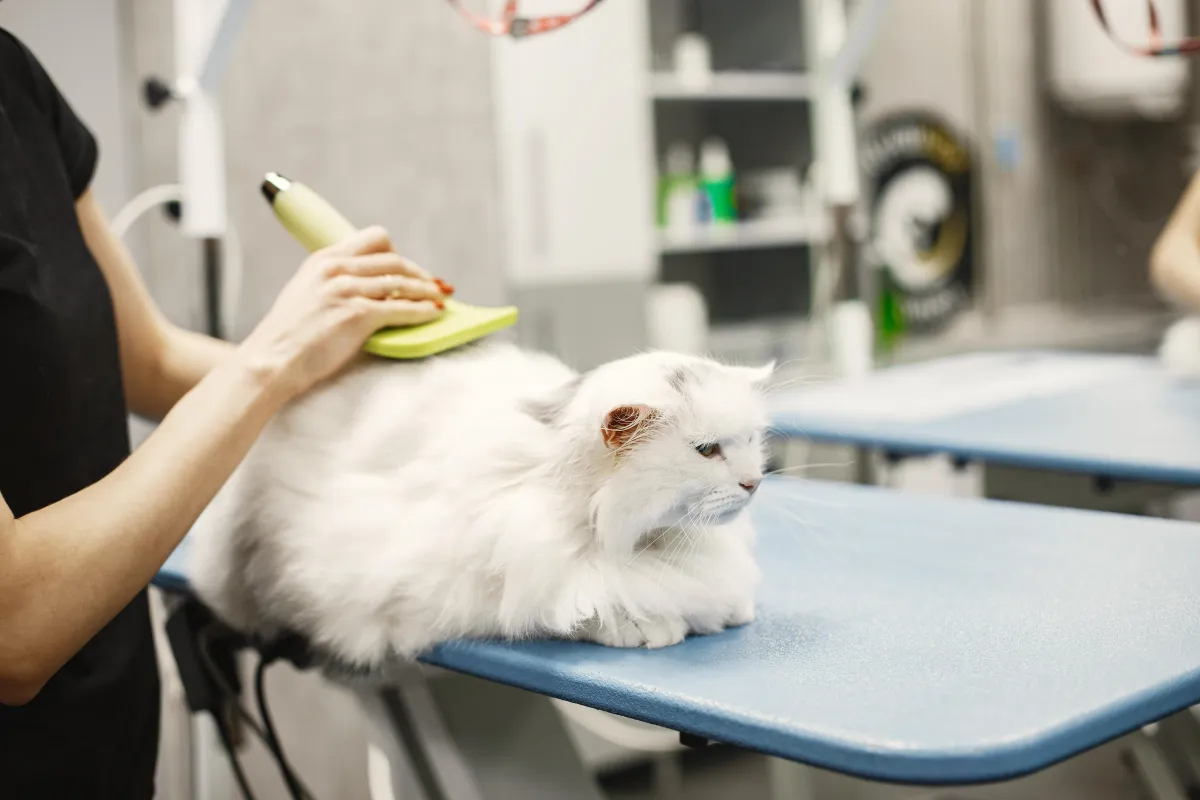
Image source: Bing (Web (fair-use with source credit))
Take this path only if three things are true. Your cat tolerates noise and handling, you own an actual pet force dryer (not a repurposed hairdryer), and you have 30 to 50 minutes. If any one of those is missing, drop back to Path A or book a groomer.
The Comb-and-Blow Technique
This is what separates a proper force dry from just blasting a cat with air. The dryer follows the comb, section by section. Groomers call it line drying.
You part the coat with a wide-tooth or greyhound comb, exposing a line of skin. Then you direct the airflow into that parting so it hits the wet undercoat directly instead of skidding over the top of the guard hairs.
- Part a horizontal line low on the flank, near the belly.
- Blow into the parting until the hair below the line fluffs and separates.
- Comb that section through while the air is still on it.
- Move the parting up about 2 cm and repeat.
- Work upward in stripes until you reach the spine.
- Switch sides, repeat the whole thing.
You're looking for a specific visual cue. Wet undercoat lies flat and clumps into strands. Dry undercoat lifts, separates into individual fibres, and moves in the airflow.
Once a section fluffs, it's done. Move on.
Combing while blowing does double duty. It dries the section faster and pulls out loose down hair at the same time, which is why a force dry noticeably reduces shedding and hairball frequency for a few weeks afterwards.
Section Order: Back to Belly, Face Last
Order matters because it manages stress. Start where the cat is least sensitive and finish where they're most sensitive, so the difficult bits happen once the cat has already accepted the process.
| Order | Area | Notes |
|---|---|---|
| 1 | Back and rump | Least sensitive, good acclimatisation zone |
| 2 | Sides and flanks | Line dry in stripes here |
| 3 | Chest and ruff | Dense on Maine Coons and Norwegians |
| 4 | Front legs and armpits | Mats form here, comb carefully |
| 5 | Back legs and trousers | Longest coat on many breeds |
| 6 | Belly and groin | Support the cat upright, brief bursts |
| 7 | Tail | Comb downward, work from the base out |
| 8 | Head, face, ears | Towel and hand only, no dryer |
Never point a force dryer at the face. The air pressure is genuinely uncomfortable in the eyes and it can drive water and debris into the ear canal.
Force Dryer Specs Worth Understanding
You don't need the biggest unit made. Cats are smaller and more noise-sensitive than the large dogs these machines were designed for.
| Spec | Useful range for cats | Why it matters |
|---|---|---|
| Airflow | 40 to 90 CFM | Above this is often overkill and louder |
| Nozzle air speed | Up to about 200 MPH | High speed is what pushes water out |
| Heat setting | Ambient or no-heat only | Any heated setting is a burn risk |
| Speed control | Variable, essential | Fixed-high units are unusable on nervous cats |
| Noise | Under 70 dBA preferred | The single biggest tolerance factor |
| Nozzle types | Cone, flat, comb attachment | Flat for body, cone for legs |
| Filter | Removable and washable | Cat undercoat clogs filters fast |
Typical retail pricing as of 2026 runs roughly $90 to $180 (£75 to £150) for a decent mid-range variable-speed unit, and $200 to $450 (£170 to £380) for a professional two-stage force dryer. Entry-level handhelds sit around $35 to $70 (£30 to £60), and aggregate user reviews consistently flag those cheaper units for two things: fixed speed and high pitch.
Clean the filter after every session. Fine down hair blocks it quickly, airflow drops, and a blocked filter makes the motor run hotter than it should.
Path D: The Panicking Cat, Stop, Wrap and Wait
If your cat is thrashing, screaming, breathing through an open mouth, or trying to bite, the drying session is over. Not paused. Over.
This isn't giving up. It's the correct decision, and the low-stress handling principles taught in feline-friendly veterinary practice back it up. Pushing through a panic response does three kinds of damage: physical injury risk, cardiac stress, and permanent negative association with handling.
The Burrito Wrap Reset
The fix is simple and it works. Dry towels, a warm sealed room, and time.
- Kill the noise. Dryer off, everything quiet.
- Lay a large dry towel flat. Place the cat in the middle, facing away from you.
- Fold one side over the body and tuck it under. Then the other side. Then fold the bottom up over the back feet.
- Leave the head out. Never cover the face.
- Hold the wrapped cat against your chest for 60 seconds. Steady pressure, no rubbing, no talking at them.
- Set them down in a warm room, still wrapped, and leave.
The towel wicks water passively for the next 15 to 20 minutes while the cat calms. Swap for a fresh dry towel once, then let them out of the wrap in the same warm room and walk away.
Why Waiting Beats Fighting
A cat left alone in a warm, draft-free room with dry towels will finish the job themselves. Their grooming reflex kicks in as soon as the stress drops, and licking redistributes the coat while body heat handles the rest.
The risks of forcing it are real. Cats in acute stress can develop stress-induced hyperthermia, a genuine temperature rise rather than just panting. In cats with undiagnosed hypertrophic cardiomyopathy, extreme handling stress can trigger decompensation.
Violent head-shaking can burst a blood vessel in the ear flap and cause an aural haematoma.
Then there's you. Cat bites carry a high infection risk because the puncture is deep and narrow, and Pasteurella multocida is present in most feline mouths. Wash any bite immediately and seek medical advice for punctures, especially on the hand.
Getting Back on Track Next Time
A cat that has one bad drying experience isn't ruined. A cat that has five is much harder work.
- Wait at least a week before any handling that resembles the session
- Restart with the dryer switched off, just sitting on the floor near the food bowl
- Feed treats near the unplugged dryer for several days
- Then run it in a different room during meals
- Only reintroduce airflow once the sound alone triggers nothing
If your cat needs regular bathing for medical reasons and Path D keeps happening, that's a conversation with your vet. Some cats genuinely need a sedated groom, and that's a legitimate, safe option rather than a failure.
Breed-Specific Drying: Sphynx, Persian, Maine Coon and Rex Coats
Breed changes the job more than any other single factor. Here's what differs.

Image source: Web (Bing) / pinterest.com (Web image (fair-use with source credit))
Sphynx and Hairless Breeds
Sphynx, Peterbald, Donskoy and Bambino cats get bathed weekly or fortnightly, so drying becomes routine rather than an event. It's also the fastest dry of any cat, usually 5 to 15 minutes total.
The catch is the skin folds. Water pools in the neck creases, the armpits, the groin, between the toes, and in the deep folds around the shoulders. Left damp, those pockets are exactly where Malassezia yeast overgrowth takes hold.
- Pat every fold individually with a soft towel corner
- Dry between the toes, they're often missed
- Wick the outer ear with a cotton pad, since hairless breeds produce more ear wax
- No dryer needed, but a warm room absolutely is
- Get them into a fleece or a heated bed straight after, since hairless cats chill faster than any coated breed
Persian and Himalayan
The long fine coat mats faster than anything else on this list, and it mats while it's drying. Air drying a Persian is how you end up at the groomer paying for a lion cut.
Take Path C if you possibly can. If the dryer isn't an option, comb the coat through every 15 minutes as it dries, which realistically means committing two or three hours.
Watch these mat hotspots: behind the ears, under the collar line, the armpits, the britches on the back legs, and the tail base. A Persian's flat facial structure also means water tracks into the eye folds, so dab those dry with a soft cloth.
Maine Coon, Norwegian Forest, Siberian and Ragdoll
Dense double coats are the longest drying job, full stop. The guard hairs feel dry within 15 minutes. The undercoat can still be wet four hours later.
The ruff around the chest and neck is the worst offender, followed by the trousers on the hind legs. Do the skin-parting check in both spots specifically, not just the flank.
Seasonal timing matters too. During spring and autumn coat blow, undercoat density spikes and drying time can jump by half again. Bathing a Siberian in moulting season means budgeting for it.
Cornish Rex, Devon Rex, Selkirk Rex and LaPerm
Curly coats dry quickly, but they damage easily. Brushing or slicker-brushing a wet Rex coat breaks the fragile hairs and flattens the curl pattern for that growth cycle.
- Blot only, never rub
- No brushing or combing while wet
- Air dry, or use a low-speed dryer on the gentlest setting
- Let the curl reform on its own as it dries
- Devon Rex in particular have sparse coats and chill quickly, so keep the room warm
British Shorthair and Other Plush Short Coats
Deceptive. The coat is short but genuinely dense, and it holds water like a much longer coat would. Treat a British Shorthair closer to a double coat than a Domestic Shorthair.
Extra towel swaps, a longer session, and a proper skin check on the chest and flanks. Aggregate owner feedback consistently notes people underestimate exactly this breed.
Turkish Van
The Van coat has a distinctive water-resistant texture, so the topcoat sheds water noticeably faster than other semi-longhairs. That's a genuine advantage. It doesn't mean the undercoat is dry, so run the same skin-parting check.
Drying a Kitten: Different Rules Entirely
Kittens are not small cats when it comes to thermoregulation, and this is where the most serious mistakes happen.
Kittens under 4 weeks old cannot regulate their own body temperature. They rely on the queen and littermates for warmth. A wet neonatal kitten can become hypothermic within minutes, and hypothermia shuts down digestion, which makes the whole situation worse fast.
The Hard Rules for Kittens
- Under 8 weeks: don't bathe at all unless a vet has told you to, or the kitten is contaminated with something harmful
- Never use any dryer on a kitten. No force dryer, no low-speed pet dryer, no hairdryer, not on any setting
- Room temperature must be higher. Neonatal kittens need an environment around 29 to 32 °C (85 to 90 °F). Older kittens still want the top of the 24 to 27 °C range
- Total handling time under 5 minutes. Speed matters more than perfection
- Body heat is your best tool. A kitten wrapped in a warm dry towel against your chest dries faster and safer than any equipment
If You Must Wash a Very Young Kitten
Sometimes there's no choice. Flea infestation, faecal soiling, or contamination with a toxic substance all force the issue.
- Warm the room first, to 29 to 32 °C for neonates.
- Spot clean if you can. A damp cloth on the soiled area beats full immersion every time.
- Use lukewarm water only, and keep the kitten's head above water throughout.
- Have three warm dry towels ready. Warm them on a radiator beforehand if possible.
- Wrap immediately and blot, don't rub.
- Swap to towel two within 60 seconds, then towel three.
- Hold the wrapped kitten against your body for 10 to 15 minutes.
- Move to a heat source. A heating pad on low, half-covered so the kitten can move off it, or a well-wrapped warm water bottle.
Never place a kitten directly on a heat pad without a barrier, and always leave an unheated area they can crawl to.
Warning Signs in a Wet Kitten
Act on any of these immediately. Kittens deteriorate much faster than adult cats.
| Sign | What it indicates |
|---|---|
| Cool ears, paws, or mouth | Early hypothermia |
| Shivering | Body actively fighting heat loss |
| Limp, floppy body tone | Moderate to severe hypothermia |
| Crying then going silent | Deterioration, not settling |
| Refusing to feed | Digestion shutting down from cold |
| Pale or greyish gums | Emergency, call a vet now |
If a kitten feels cold to the touch, warm it slowly before anything else, and don't attempt to feed a cold kitten. Contact your vet if the kitten doesn't recover normal warmth and activity within 20 to 30 minutes.
Human Hairdryer vs. Pet Dryer: The Honest Comparison
They look like the same machine. They aren't, and the difference isn't marketing.
A human hairdryer is built around a heating element. That's its whole purpose. A pet dryer is built around airflow, and the better ones have no heating element at all.
One dries hair by heating it. The other dries a coat by physically pushing water out of it.
| Feature | Human hairdryer | Pet dryer (no-heat / force) |
|---|---|---|
| Primary mechanism | Heat plus modest airflow | High airflow, ambient air |
| Nozzle air temperature | Commonly 60 to 90 °C | Room temp plus a few degrees |
| Airflow | Low, roughly 15 to 25 CFM | 40 to 120 CFM |
| Heat control | "Cool shot" is a brief burst, not a mode | No heat at all on most models |
| Undercoat penetration | Poor, dries the topcoat only | Good, that's the design goal |
| Burn risk to cat skin | Genuine | Effectively none on ambient |
| Typical noise | 70 to 85 dBA | 55 to 85 dBA depending on model |
| Time to dry a double coat | Very long, often incomplete | 30 to 50 minutes |
Heat Output Numbers That Matter
Feline skin is considerably thinner than human skin. That's the entire problem in one sentence.
Human hairdryers commonly push air out at 60 to 90 °C at the nozzle. Even the "low" or "warm" setting on most consumer units runs well above what a cat's skin can tolerate at close range. There's no cool setting on a standard hairdryer that stays cool, since "cool shot" is a momentary button, not a running mode.
Cats also can't tell you it's too hot in a way you'll recognise fast enough. A dog pulls away. A cat that's already tense and being restrained often freezes instead, so the heat sits on one patch of thin skin while you keep working.
Thermal injury from grooming dryers is a documented and preventable problem. It shows up as reddened skin, then a hot spot (pyotraumatic dermatitis) a day or two later, usually on the flank or the back of the legs where people hold the nozzle longest.
When a Human Hairdryer Is Genuinely Never OK
Never on heat. Not on low, not on warm, not "just for a minute."
There's a narrow exception worth being honest about. If your hairdryer has a true cool-only setting that runs continuously with no heating element engaged, and your cat is calm, you can use it at low speed and a good distance to finish a short coat. Most units don't have that.
Check yours before you assume.
The rules if you go that route:
- Cool setting only, confirmed by holding your inner wrist in the airflow for 30 seconds
- Lowest speed
- Minimum 30 cm (12 in) distance
- Constant movement, never parked
- Nothing near the face, ears, or genitals
- Stop at the first sign of tension
And a hard safety point that has nothing to do with heat. Never operate a mains-powered dryer near a filled bath or sink. Empty the water first.
Bathroom outlets should be GFCI protected in the US or RCD protected in the UK, and that protection exists for exactly this scenario.
Towels, Dryers and Drying Bags: What to Buy and What to Skip
Most people over-buy the dryer and under-buy the towels. It should be the other way round for the majority of cats.
Buy these first:
- Microfibre pet towels, a pack of four to six. The highest-value purchase here. Split-fibre microfibre absorbs several times its own weight and wrings out in seconds.
- One synthetic chamois. Worth it for a double coat or a longhair. Use it as the first towel to pull bulk water, then switch to microfibre.
- A wide-tooth or greyhound comb. Metal, not plastic. Plastic combs snag and snap wet hair.
- Cotton balls or pads. For wicking the outer ear. Cheap and genuinely important.
Buy these if your cat's coat or temperament calls for it:
- A variable-speed pet dryer. Only for a semi-long, long, or dense double coat, and a cat that tolerates noise.
- A zippered cat grooming bag. Restrains the body while leaving one limb accessible at a time. Useful for solo handling of a wriggler, not for a panicking cat.
- A pet drying bag or mesh pouch. The cat sits inside, a dryer hose connects, and ambient air circulates. Divides opinion. Some cats settle in them, plenty hate the enclosure.
- A heated cat bed or self-warming mat. Genuinely useful for the warm rest zone, especially for Sphynx, seniors, and cold-climate homes.
Skip these:
- Fixed-speed budget force dryers. No speed control means no way to start gently. Aggregate reviews flag this constantly.
- Cage dryers for home use. These have been implicated in overheating deaths in grooming settings and have driven grooming safety legislation in several US states. No home scenario justifies one.
- Slicker brushes on a soaking coat. They tear wet hair and scratch skin. Damp coat only, and never on a Rex.
- Standard terry bath sheets as your main towel. They hold water rather than wicking it, they're bulky, and they shed lint into a wet coat.
Cost Ranges and Realistic Specs
Typical retail as of 2026. Prices vary by region and voltage, since UK and EU units run at 230 V while US units run at 120 V, which affects wattage and model availability.
| Item | USD | GBP | Worth it for |
|---|---|---|---|
| Microfibre pet towels (4-pack) | $12 to $30 | £10 to £25 | Every cat, no exceptions |
| Synthetic chamois towel | $10 to $20 | £8 to £18 | Double coats, longhairs |
| Greyhound comb | $10 to $25 | £8 to £20 | Semi-long and long coats |
| Cat grooming bag | $15 to $35 | £12 to £30 | Solo handling a wriggler |
| Pet drying bag | $20 to $45 | £18 to £40 | Cats that settle in enclosures |
| Entry handheld pet dryer | $35 to $70 | £30 to £60 | Sphynx, short coats, light use |
| Mid-range variable-speed dryer | $90 to $180 | £75 to £150 | Most home longhair owners |
| Professional two-stage force dryer | $200 to $450 | £170 to £380 | Multiple longhairs, show cats |
| Heated cat bed | $25 to $60 | £20 to £50 | Seniors, Sphynx, cold homes |
| Professional cat groom (bath and dry) | $60 to $130 | £45 to £100 | One-off or occasional |
Here's the honest maths. A single professional groom costs roughly what a mid-range dryer costs. If you're bathing a Persian monthly, the dryer pays for itself in three or four sessions.
If you bathe a shorthair twice a year, buy towels and book a groomer when you need one.
How Long Drying Actually Takes by Coat Type
Underestimating this is what causes rushed sessions and damp cats. These figures assume a warm, draft-free room at 24 to 27 °C.
| Coat type | Towel stage | With dryer | Air dry only |
|---|---|---|---|
| Sphynx / hairless | 2 to 3 min | 5 min | 10 to 15 min |
| Short single coat | 5 min | 10 to 15 min | 45 to 90 min |
| Curly / Rex | 4 to 6 min | 10 to 15 min | 45 to 75 min |
| British Shorthair (plush) | 8 min | 20 to 30 min | 2 to 4 hrs |
| Semi-longhair | 8 to 10 min | 20 to 30 min | 2 to 4 hrs |
| Long fine coat (Persian) | 10 min | 30 to 45 min | 3 to 6 hrs, high mat risk |
| Dense double coat | 10 to 15 min | 30 to 50 min | 4 to 8 hrs at the undercoat |
Three things stretch these numbers:
- Moulting season. Spring and autumn coat blow can add 30 to 50 percent to a double coat's drying time.
- Humidity. Air drying in a humid climate slows evaporation noticeably. Tropical and coastal homes should lean toward a dryer for anything longer than a short coat.
- A cold room. Below about 21 °C, air drying stops being safe for anything other than a quick spot clean.
Note the air-dry column for double coats. Eight hours is a long time for an undercoat to sit damp against skin, which is why longhair owners should lean toward Path B or C rather than "just let them sort it out."
Mistakes That Cause Mats, Chills and Scratches
Our research into grooming incident patterns and owner-reported problems keeps surfacing the same handful of errors. Most of them are technique, not equipment.
Mistakes that cause mats:
- Rubbing instead of blotting. Circular rubbing tangles guard hairs and felts the undercoat together. The number one cause of post-bath matting.
- Air drying a longhair. The coat sets in whatever position it settled in. Mats form behind the ears and in the britches within hours.
- Brushing a soaking wet coat. Wet hair stretches and snaps. Wait until it's damp.
- Not combing during the dry. On Path C, the comb does half the work. Skip it and you dry a tangled coat into a tangled coat.
- Leaving shampoo or conditioner residue in. Residue dries stiff and sticky, and stiff coat mats faster. Rinse until the fur squeaks between your fingers.
Mistakes that cause chills:
- Trusting the topcoat. It feels dry long before the skin is. Part the coat and check.
- Letting a damp cat out into a cold hallway. Keep them in the warm room until you've done the skin check.
- Leaving the AC, extractor fan, or a window on. Turn everything off before you start, not after.
- Cold tile floors. Lay a towel or rug down. Contact cooling is real.
- Reusing a saturated towel. It stops absorbing and starts holding water against the skin.
- Bathing a senior or unwell cat in a cool room. These cats need the top of the temperature range and a shorter session.
Mistakes that get you scratched:
- Not staging your kit. Reaching across the room for a fresh towel is when cats escape.
- Scruffing an adult cat. It doesn't calm them and it escalates struggle.
- Bringing the dryer in at full speed with no warm-up. Start it in the next room, always.
- Pushing past the first growl. The warning ladder exists. Use it.
- Doing the face first. Save the sensitive areas for when the cat has already accepted the process.
- No nail trim beforehand. A trim 24 to 48 hours before a bath makes the whole thing safer for you.
Mistakes with ears, eyes and airflow:
- Pointing a dryer at the face. Never, on any setting.
- Pushing cotton buds into the ear canal. Wick at the opening only.
- Ignoring the ears entirely. Trapped water is a straightforward route to otitis externa.
- Parking the nozzle on one spot. Even ambient air will over-dry skin if it sits there.
- Skipping the belly, armpits, groin and tail base. These four spots are missed more than any others combined.
Warning Signs That Mean Stop Immediately
Some signals mean pause and adjust. These mean stop, full stop, and reassess.
| Warning sign | What it suggests | Action |
|---|---|---|
| Open-mouth breathing or panting | Acute stress or overheating | Stop, quiet room, monitor breathing |
| Drooling with no food present | Nausea or extreme stress | Stop, wrap, leave alone |
| Sudden limpness or unresponsiveness | Shutdown, not calm | Stop, warm wrap, watch closely |
| Shivering over 5 minutes in a warm room | Hypothermia developing | Warm bedding, call vet if no change |
| Pale, white, or greyish gums | Circulatory emergency | Vet now |
| Violent repeated head-shaking | Water in the ear, haematoma risk | Stop, check and dry the outer ear |
| Yelping or flinching at nozzle contact | Possible heat or pressure injury | Stop, inspect the skin |
| Red, hot, or blistered skin patch | Thermal burn | Stop, cool cloth, contact vet |
| Wheezing or laboured breathing | Respiratory distress | Emergency, vet now |
| Hiding and refusing food hours later | Prolonged stress response | Monitor, vet if it lasts over 24 hours |
Cats with hypertrophic cardiomyopathy deserve a specific mention. HCM is the most common feline heart disease and it's frequently undiagnosed. Handling stress can push an affected cat into respiratory distress.
If your cat has a known heart murmur, talk to your vet before bathing at all.
Watch yourself too. Cat bites are deep puncture wounds that seal over quickly and trap bacteria underneath, which is why the infection rate is high. Wash any bite under running water immediately.
The CDC advises seeking medical care for animal bite punctures, and hand bites in particular should be seen the same day.
Ears, Armpits and Tail Base: The Spots Everyone Misses
Four areas account for most of the damp-cat problems owners report, and they're all easy to skip because they're awkward to reach.
Ears
Water in the outer ear is the most common post-bath complaint after matting. The feline ear canal is L-shaped, with a vertical section that drops down before turning horizontally. Water that gets past the flap sits in that bend and doesn't drain on its own.
Here's how to handle it:
- Hold a dry cotton ball lightly against the ear opening and let it wick for 10 seconds
- Fold the ear flap back gently and dab the inner surface of the pinna
- Never insert cotton buds, tissue, or anything else into the canal
- Check both ears again 30 minutes later, since water tracks out slowly
- If your vet has prescribed a drying ear solution, follow their instructions rather than improvising
Signs that water stayed in: repeated head-shaking, tilting the head to one side, scratching at the ear, or a yeasty smell within a day or two. That's a vet visit, not a wait-and-see.
Armpits and Groin
These are skin-on-skin contact areas, so air can't circulate and evaporation stalls. They're also where mats form fastest on longhairs and where yeast overgrowth starts on Sphynx cats.
Lift each front leg out and away from the body, then blot directly into the armpit. Do the same at the groin with the cat sitting or lying on their side. On a longhair, comb these areas out while damp, working from the ends inward.
If your cat won't tolerate having a leg lifted, do one limb per short session and come back to it. Better a few interrupted attempts than one struggle.
Tail Base and Under the Tail
The tail base sits right where a cat can't easily groom and where fur is often densest. On Persians and Maine Coons it's a reliable mat hotspot.
Blot along the top of the tail base, then lift the tail and dry underneath. Male cats add a wrinkle: the supracaudal gland at the tail base produces oil, and cats with stud tail have greasier fur there that traps water and shampoo residue. Rinse and dry that patch extra carefully.
Dry the tail itself by squeezing along its length inside a towel, then comb downward from base to tip.
Belly, Chest and Between the Toes
The chest ruff on a Maine Coon or Norwegian Forest Cat is often the very last thing to dry. It's dense, it's deep, and it faces downward where you can't see it.
Sit the cat upright against your chest, or lay them on their side if they'll allow it. Part the ruff to the skin and check it specifically. On the belly, work in short bursts because most cats are touchy about it.
Toes get forgotten every time. Water sits between the pads and in the fur tufts between them on longhaired breeds. Squeeze each paw gently inside a corner of towel.
| Missed spot | Why it holds water | Quick fix |
|---|---|---|
| Outer ear canal | L-shaped canal traps it | Wick with cotton, recheck at 30 min |
| Armpits | Skin-on-skin, no airflow | Lift leg, blot directly |
| Groin | Same, plus dense fur | Short bursts, cat on side |
| Tail base | Dense fur, oil gland | Blot then comb downward |
| Chest ruff | Deep, faces downward | Sit cat upright, part to skin |
| Between toes | Fur tufts hold water | Squeeze each paw in towel |
Building a Cat That Tolerates the Dryer
Most cats can learn to accept a dryer. Almost none will accept one introduced cold, at full speed, while wet and already stressed.
The technique is counter-conditioning. You pair the thing your cat dislikes with something they love, at an intensity low enough that they never react. Then you increase the intensity by a hair.
That's it.
The Desensitisation Ladder
Our research suggests most cats need 5 to 15 short sessions to move from "flees the room" to "tolerates airflow." Some get there in a week. Some take two months. Neither is a failure.
Only move up a step when your cat is completely relaxed at the current one across two or three sessions.
- Dryer visible, switched off, on the floor. Feed a meal near it. That's the whole session.
- Dryer moved closer over several days. Treats, then leave.
- Dryer running in another room with the door open. Feed during the noise. Two minutes maximum.
- Dryer running in the same room, pointed away, at maximum distance. Lickmat out.
- Dryer running closer, still pointed away. Under a minute.
- A brief puff of air across the shoulder, dryer at arm's length, lowest speed. Three seconds, then off, then treat.
- Five seconds. Then ten. Then twenty.
- Short real sessions on a dry cat. Blow out loose undercoat for two minutes, treat, stop.
- Only then use it on a wet cat.
Keep every session under three minutes. End before your cat wants you to end, not after.
What Speeds It Up
- High-value food. Lickmats with wet food or cat-safe paste beat dry treats, because licking is self-soothing.
- A consistent location. Same room, same mat, same routine every time.
- Pheromone diffusers. Feline facial pheromone products are widely used in Cat Friendly Practice settings. Plug one in 30 minutes before.
- Nail caps or a trim beforehand. Lowers the stakes for you, so your handling stays relaxed.
- A second person to feed while you handle the dryer.
What Sets It Back
- Skipping steps because it's going well. The classic error.
- Ending a session on a bad note. Always finish while the cat is still calm.
- Trigger stacking. Bath, plus dryer, plus nail trim, plus a car ride in one day. Cats add stressors together.
- Using the dryer on a wet, cold cat before the ladder is finished. All your groundwork evaporates.
- Punishing or restraining harder when they resist. Guarantees a longer road.
The Fear Free and Cat Friendly handling frameworks used by veterinary teams run on exactly this logic: low intensity, high reward, stop early. It works at home too.
When to Skip the Bath (and the Drying) Altogether
Plenty of cats never need a bath. Healthy adult cats with normal grooming behaviour keep themselves clean with a barbed tongue that works remarkably well.
If there's no medical reason and no contamination, the safest drying method is not creating a wet cat in the first place.
Situations Where a Bath Is Genuinely Necessary
- Contamination with something toxic or irritant: antifreeze, motor oil, paint, tar, pesticide, cleaning chemicals
- Prescribed medicated bathing for ringworm, Malassezia, seborrhoea, or a bacterial skin infection
- Flea shampoo treatment on a vet's advice
- Heavy faecal soiling on a long coat that spot cleaning won't shift
- A cat physically unable to self-groom: obese, arthritic, senior, or recovering from surgery
- Sphynx and hairless breeds, which need regular bathing to manage skin oil
- Show preparation for CFA, TICA or GCCF exhibition
- Skunk contact or other severe odour
If your cat has been in contact with a toxic substance, call your vet or a poison control service before bathing. Some substances need specific handling, and some shouldn't be washed off with plain water. The ASPCA runs an animal poison control line for exactly this.
Lower-Effort Alternatives
| Alternative | Best for | Limits |
|---|---|---|
| Waterless foam shampoo | Light odour, mild grubbiness | Won't remove heavy soiling |
| Pet grooming wipes | Paws, rear end, quick clean-ups | Surface only |
| Cornstarch-based dry shampoo | Greasy patches, longhairs | Needs thorough brushing out |
| Damp cloth spot clean | One dirty area | Doesn't reach the undercoat |
| Sanitary trim by a groomer | Repeated rear-end soiling | Ongoing cost |
| Full brush-out instead | Loose coat, mild dander | Doesn't clean skin |
Waterless products are genuinely useful for cats who can't cope with water. Check the label says it's formulated for cats, since feline skin sits at roughly pH 6.2 to 7.4 and dog or human products are often wrong for it. Cats also groom off whatever you apply, so anything on the coat gets swallowed.
One thing dry shampoo won't fix: mats. Powder makes matted fur worse by adding grit into the tangle. Mats need combing out or clipping, not bathing and not powdering.
When to Hand It to a Groomer or Your Vet
There's no prize for doing this yourself. Some cats and some coats are a professional job, and recognising that early saves everyone stress.
Book a Professional Groomer If
- Your cat has a dense double coat or long fine coat and you don't own a force dryer
- The coat is already matted before the bath, because bathing a matted cat tightens the mats
- You've tried twice and both attempts ended in Path D
- You're solo with a large, strong cat like a Maine Coon
- Your cat needs regular bathing and the sessions are getting worse, not better
- You want a sanitary trim, a comb-out, or a lion cut done safely
Look for a groomer who works with cats specifically, ideally cat-only. Ask two questions before booking: do you use cage dryers, and how do you handle a cat that panics? A good groomer answers both without hesitation.
Cat-only salons are more common in the US and Japan than in the UK, so book ahead if you find one.
Expect $60 to $130 (£45 to £100) for a full bath and dry. A lion cut or heavy de-matting costs more.
Involve Your Vet If
- Your cat has known hypertrophic cardiomyopathy, a heart murmur, or respiratory disease
- Your cat is a senior with arthritis or reduced mobility
- The bath is medicated and you're unsure of the protocol
- Your cat has an open wound, surgical site, or skin lesion
- Your cat is so severely matted that clipping under the mats risks cutting the skin
- Your cat becomes aggressive to the point of injury risk during handling
- Something went wrong: burned skin, persistent shivering, head-tilting, or lethargy after a session
Sedated grooming is a real and reasonable option. It typically runs $150 to $400 or more (£120 to £350+), and for a cat that genuinely cannot cope, it's kinder than repeated traumatic sessions at home. Your vet assesses anaesthetic risk first, which is why a heart or kidney check often comes with it.
The Honest Cost Comparison
| Route | Upfront cost | Per session | Best for |
|---|---|---|---|
| Towels only at home | $15 to $50 | Free | Shorthairs, Sphynx, most cats |
| Home dryer setup | $100 to $250 | Free | Regular longhair bathing |
| Professional groom | None | $60 to $130 | Occasional, or difficult coats |
| Sedated veterinary groom | None | $150 to $400+ | Severe matting, high-stress cats |
Bathe a Persian monthly and home equipment wins on cost inside four months. Bathe twice a year and the groomer is cheaper and better.
Frequently Asked Questions
Can I let my cat air dry after a bath?
Yes, for a healthy short-haired adult cat in a warm, draft-free room at 24 to 27 °C. Air drying takes 45 to 90 minutes for a short coat. Avoid it for longhairs, double coats, kittens, seniors, and unwell cats.
Long coats mat as they air dry, and dense undercoats can stay damp for four to eight hours.
Is it safe to use a human hairdryer on a cat?
Not on any heat setting. Human hairdryers push air out at roughly 60 to 90 °C, and feline skin is much thinner than human skin, so burns happen easily. If your dryer has a true continuous cool-only mode, low speed at 30 cm distance is acceptable for a calm cat.
Never aim it at the face or ears.
How long does it take a cat to dry after a bath?
It depends entirely on coat type. A Sphynx takes 10 to 15 minutes. A short-haired cat takes 45 to 90 minutes air drying, or 10 to 15 minutes with a dryer.
A dense double coat can take four to eight hours to dry at the undercoat without a dryer, or 30 to 50 minutes with a proper force dryer.
How do I know when my cat is actually dry?
Part the coat with your fingers down to the skin and press the back of your hand against it. Dry skin feels warm and the hair springs apart into fluffy sections. Damp skin feels cool and the hair stays clumped in the parting line.
Check the chest, belly, and tail base, not just the back.
What should I do if my cat panics while I'm drying her?
Stop immediately. Switch the dryer off, wrap her in a dry towel with the head free, and hold her against your chest for a minute. Then set her down in a warm sealed room and leave.
She'll finish drying herself through grooming and body heat. Forcing the session risks injury and makes future baths much harder.
Can I use a dryer on cool setting near my cat's face?
No. Never direct airflow at a cat's face, eyes, or ear canals, even on cool. The pressure is uncomfortable, and air can drive water and debris into the ear.
Dry the head and face by hand with a damp towel corner, and always leave it until last in the drying sequence.
Your Drying Plan in One Page
Everything above, boiled down to what you actually do. Read this once before the bath and you won't need to reread the rest mid-session.
Before You Turn the Tap On
- Heat the room to 24 to 27 °C, 20 minutes ahead
- Turn off AC, fans, extractors. Shut windows and the door
- Stack your towels within arm's reach (3 for a shorthair, 5 to 6 for a double coat)
- Put a rug or folded towel over cold tile
- Brush out any mats now, since bathing tightens them
- Set up the warm rest zone: lined bed or carrier, treats, lickmat
- Trim nails 24 to 48 hours earlier
- Grab a second person if the cat is big, long-coated, or nervous
Pick Your Path
| Your cat | Path |
|---|---|
| Short coat, healthy adult, warm room | A: towels only |
| Sphynx or hairless | A, plus folds, toes and ears |
| Rex or curly coat | A, no brushing while wet |
| Kitten, senior, or unwell | A only, shorter session, warmer room |
| Semi-longhair, tolerates noise | B: towels then low-speed dryer |
| Persian, Maine Coon, dense double coat | C: towels then force dry with a comb |
| Panicking at any point | D: stop, wrap, warm room, walk away |
The Sequence That Doesn't Change
- Squeeze water out of legs and tail while still in the tub
- Wrap in towel one before lifting the cat out
- Press and hold 10 to 15 seconds per section. Never rub
- Swap towels the moment one saturates
- Do belly, armpits, groin, tail base deliberately
- Wick the outer ears with cotton. Nothing goes in the canal
- Face and head last, by hand only
- Comb when damp, never soaking, never on a Rex
- Part the coat to the skin on chest, flank and tail base to check
- Warm rest zone for 20 to 30 minutes, then leave them alone
Stop Immediately If
- Open-mouth breathing, panting or drooling
- Sudden limpness, or a growl escalating to a bite attempt
- Shivering that won't settle in a warm room
- Yelping at nozzle contact, or any red hot patch of skin
- Pale gums or laboured breathing, which means vet now
The Three Rules People Break Most
Blot, don't rub. Rubbing is what causes mats, static, and struggling.
No heat, ever. Ambient air or towels. A hairdryer's heat setting is a burn risk on skin this thin.
Check the skin, not the surface. The topcoat dries hours before the undercoat. Part the fur and feel.
Do the two-hour check afterwards. Find your cat, feel the ear tips and paw pads, part the fur on the chest. Warm and dry means you did it right, and your cat will have forgotten the whole thing by dinner.