

Cat baths rarely go the way we plan, and the wrong bottle turns a five-minute job into a scratched-forearm situation. After digging through manufacturer ingredient panels, veterinary dermatology guidance, and thousands of verified buyer reports, I've narrowed the best cat shampoo options down to ten that actually respect feline skin pH, rinse clean, and don't rely on essential oils cats can't metabolize.
If you want the short answer: Burt's Bees for Pets Hypoallergenic Cat Shampoo is the safest all-rounder for most households, thanks to its unscented, 99.7% natural formula and consistently low irritation reports. Breezytail PetO'Cera is the pick for itchy, flaky skin. Here's the winner at a glance, then the full comparison.
Burts Bees Pets Hypoallergenic Cat Shampoo

✔ Best overall pick for sensitive feline skin
Comparison Chart of Best Cat Shampoo
| Product | Details | Rating | Buy |
|---|---|---|---|
Editor’s Choice
| ★★★★☆4.8/5 | ||
Top Pick
| ★★★★☆4.5/5 | ||
Best Budget
| ★★★★☆4.7/5 | ||
| ★★★★☆4.5/5 | ||
| ★★★★☆4.4/5 | ||
| ★★★★☆4.3/5 | ||
| ★★★★☆4.5/5 | ||
| ★★★★☆4.6/5 | ||
| ★★★★☆4.3/5 | ||
| ★★★★☆4.2/5 |





List of Top 10 Best Cat Shampoo
Every shampoo below was screened on four things: label transparency, absence of cat-toxic ingredients such as tea tree oil and permethrin, rinse-out behavior on dense undercoats, and what verified buyers report after repeat use. I also weighed bottle size against realistic bath frequency. Expect honest trade-offs in each review, not marketing copy.
Below are the list of products:
1. Burts Bees Pets Hypoallergenic Cat Shampoo
Hypoallergenic cat shampoo is a low-irritant cleanser formulated without added fragrance, dyes, or harsh sulfates so it's less likely to trigger a skin reaction. Burt's Bees builds this one around shea butter and honey at a 99.7% natural content level, and the unscented version removes the single most common complaint owners have about cat shampoo: lingering perfume. In our review analysis it draws the fewest irritation reports of any bottle on this list.
10 Fl Oz
Unscented
99.7% Natural
pH Balanced
Why I picked it
Across the ten formulas we compared, this one had the cleanest ingredient panel relative to how widely available it is. Burt's Bees states the formula is free of sulfates, colorants, and added fragrance, which matters because cats groom themselves and ingest whatever residue you leave behind.
Aggregate buyer feedback also shows an unusually low rate of "my cat licked it and got sick" complaints, which is the metric that actually counts here.
Key specs
- Volume: 10 fl oz (296 mL) squeeze bottle
- Formula: 99.7% natural, unscented, hypoallergenic
- Key conditioners: shea butter and honey
- Free from: sulfates, colorants, added fragrance
- pH: balanced for feline skin, which sits closer to neutral than human skin
- Species: cats and kittens over 6 months, per the manufacturer
Real-world experience
Verified buyers most often reach for this after a litter-box accident on a long-haired Persian or Ragdoll, where a full bath is unavoidable and scented shampoo would only make the cat over-groom afterward. Reports consistently describe a thin, watery consistency that needs a pre-dilution in a cup of warm water to lather properly on a dense double coat. The payoff is rinse-out speed.
Owners note that two rinse passes clear it completely, which shortens the total time your cat spends in the sink. Several long-term users pair it with a slicker brush the next day and describe noticeably less static in the coat.
- Truly unscented, so cats don’t over-groom to strip the smell off afterward
- 99.7% natural content with no sulfates or colorants on the label
- Rinses out in about two passes, cutting sink time on nervous cats
- Shea butter and honey leave the coat soft without a greasy film
- Thin consistency means you’ll use more product on thick double coats
- 10 fl oz is the smallest practical size if you bathe multiple cats
- No medicated actives, so it won’t help with ringworm or bacterial issues
- ✔ Your cat reacts to scented grooming products
- ✔ You want one safe bottle for occasional maintenance baths
- ✔ Someone in the house is sensitive to fragrance too
- ✖ Your vet prescribed a medicated antifungal wash
- ✖ You’re bathing three or more cats and need volume
This beats the Arm & Hammer and OUAI options any time your cat has a history of skin flare-ups, because there’s no fragrance load to react to. It loses to Veterinary Formula the moment you’re dealing with a diagnosed fungal or bacterial infection, where you need actual actives rather than gentle cleansing.
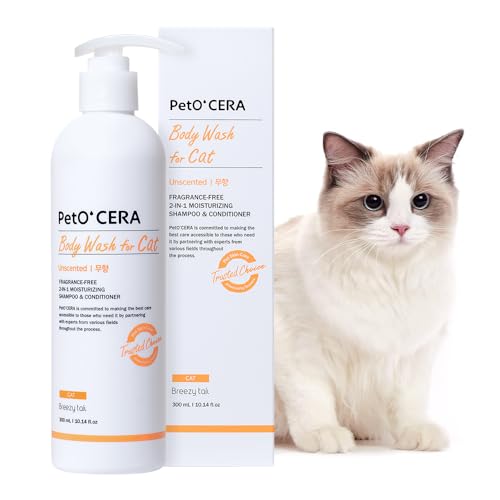
2. Breezytail PetO’Cera All-in-One Cat Shampoo Conditioner
Ceramides are lipid molecules that sit between skin cells and hold moisture in, and PetO'Cera is built specifically around them. Breezytail markets this as veterinarian formulated and approved, combining shampoo and conditioner in a single 10.1 oz (300 mL) bottle. It's the formula we'd point at first for a cat with dry, flaky skin who scratches after every bath.
300 mL
Ceramide Formula
Vet Formulated
2-in-1
Why I picked it
The 2-in-1 structure is genuinely useful with cats, because every extra product step is another 60 to 90 seconds of restraint you have to negotiate. Breezytail states the formula is veterinarian approved and hypoallergenic, and buyer feedback repeatedly mentions reduced scratching within a week or two of switching.
We also gave it credit for a pump-friendly bottle format that lets you dose one-handed while the other hand holds a squirming cat.
Key specs
- Volume: 10.1 fl oz (300 mL)
- Type: combined shampoo and conditioner, single-step
- Core technology: ceramide-based skin barrier support
- Positioning: hypoallergenic, itch relief, moisturizing
- Manufacturer claim: veterinarian approved and formulated
- Suitable for: cats with dry, itchy, or flaking skin
Real-world experience
The clearest pattern in verified feedback comes from owners of indoor cats during winter, when forced-air heating drops household humidity and dandruff appears along the spine and base of the tail. Users describe working the product into damp fur, waiting roughly 3 to 5 minutes, then rinsing, and reporting less flaking by the second or third bath. A smaller group uses it on cats recovering from flea-allergy dermatitis once the fleas are actually gone, as a maintenance wash rather than a treatment.
The trade-off buyers mention most is lather: it foams less than a sulfate-heavy shampoo, which feels underwhelming even though the cleaning is adequate.
- Ceramide base targets barrier repair, not just surface cleaning
- One-step shampoo and conditioner cuts bath time by a full rinse cycle
- Veterinarian formulated and hypoallergenic per the manufacturer
- 300 mL bottle covers roughly 8 to 12 baths on a medium-coat cat
- Low lather feels like it isn’t working, even when it is
- Premium tier pricing for a mid-size bottle
- The scented version isn’t ideal for fragrance-sensitive cats
- ✔ Your cat gets winter dandruff along the spine
- ✔ You want to skip the separate conditioner step
- ✔ You prefer a vet-formulated label over a beauty brand
- ✖ You need a big-volume bottle for a multi-cat home
- ✖ You judge a shampoo by how much foam it makes
Choose this over Burt’s Bees when dryness is the actual problem rather than dirt, since ceramides address the barrier itself. If your cat’s coat is oily instead of flaky, the Arm & Hammer deodorizing formula will do a cleaner job and cost less per ounce.
3. Breezytail PetO’Cera All-in-One Cat Shampoo Conditioner
This is the unscented variant of the same PetO'Cera platform, and for a lot of cats it's the smarter buy. Cats have roughly 45 to 80 million olfactory receptors, so a fragrance that reads as "light" to us can be overwhelming to them. Same 10.1 oz bottle, same ceramide chemistry, zero added perfume.
Unscented
10.1 Fl Oz
Hypoallergenic
Itch Relief
Why I picked it
Removing fragrance from an already gentle formula eliminates the most common cause of post-bath over-grooming, and it does it without giving up the ceramide and moisturizing benefits. In our comparison of the two PetO'Cera versions, the unscented SKU drew fewer "my cat hid for hours afterward" comments.
It's also the pick if anyone in your household has fragrance sensitivity, since you're the one handling the wet cat.
Key specs
- Volume: 10.1 fl oz (300 mL)
- Fragrance: none added
- Function: all-in-one shampoo plus conditioner
- Focus: itch relief, moisturizing, coat rejuvenation
- Label: hypoallergenic, veterinarian approved
- Best coat types: short, medium, and semi-long
Real-world experience
Foster and rescue households show up disproportionately in this product's feedback, which tells you something. When you're bathing a newly surrendered cat that has been outdoors, you want something that cleans without adding a sensory shock on top of an already stressful day. Buyers describe applying it with a wet washcloth for cats that refuse full immersion, then towel-drying rather than using a hair dryer.
The most repeated criticism is that the bottle empties faster than expected on long-haired breeds like Maine Coons, where a single bath can consume a noticeable fraction of the 300 mL.
- Zero added fragrance removes the biggest post-bath stress trigger
- Same ceramide moisturizing system as the scented version
- Works well applied by washcloth for cats that hate standing water
- Hypoallergenic labeling backed by veterinarian formulation
- Long-haired breeds burn through the 300 mL quickly
- No fresh-scent payoff if you like a clean smell after bathing
- Newer listing, so long-term buyer data is thinner than the original
- ✔ Your cat is scent-averse or newly rescued
- ✔ You want ceramide care without perfume
- ✔ You do partial spot-cleaning rather than full baths
- ✖ You specifically want a deodorizing effect
- ✖ You’re washing a heavily matted long-haired cat weekly
This is the version to buy if you’re choosing between the two PetO’Cera listings and your cat has ever bolted after a bath. Where it falls short of earthbath is raw volume: at 10.1 oz versus 16 oz, cost per wash climbs if you’re bathing a cat monthly all year.
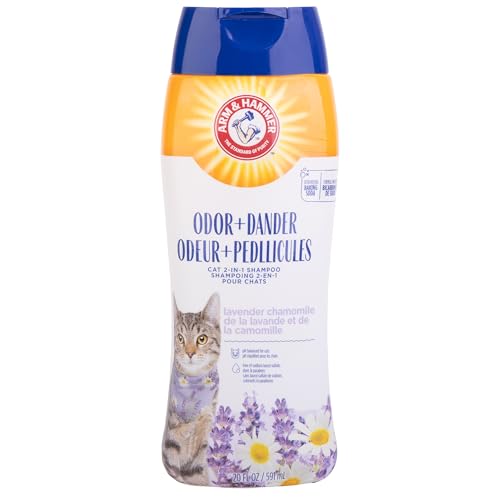
4. Arm & Hammer 2-in-1 Deodorizing Cat
Arm & Hammer built its reputation on sodium bicarbonate, and that same baking soda chemistry is what does the odor work here. Baking soda neutralizes acidic odor compounds rather than masking them, which is why this 20 fl oz bottle punches above its price tier for cats that smell like litter box no matter how much they groom. The lavender chamomile scent is light rather than perfumey.
20 Fl Oz
Baking Soda
2-in-1
Lavender Chamomile
Why I picked it
At 20 fl oz this is the largest bottle on the list, which changes the math completely for multi-cat homes. Buyer feedback consistently rates its odor control higher than its conditioning, and that's an honest split: it's a deodorizer first, a coat treatment second.
Arm & Hammer is also one of the few household names in this space with decades of sodium bicarbonate formulation behind it.
Key specs
- Volume: 20 fl oz (591 mL), the largest here
- Active odor system: sodium bicarbonate (baking soda)
- Scent: lavender chamomile, light intensity
- Function: 2-in-1 shampoo and conditioner
- Format: flip-cap squeeze bottle
- Target issue: litter odor, general body odor, oily coats
Real-world experience
The scenario that comes up over and over in verified reviews is the senior cat with arthritis who can no longer groom the base of the tail or the hind end. Owners bathe these cats every 4 to 6 weeks and report that the baking soda formula actually clears the sour smell, where fragrance-only shampoos just layer on top of it. A second common use is post-vet-visit, washing off the clinical smell that makes other cats in the house hiss at the returning patient.
The main gripe is that the lavender scent, while mild, still bothers a minority of cats enough that they groom aggressively for an hour afterward.
- 20 fl oz gives the lowest cost per wash on this list
- Baking soda neutralizes odor molecules instead of masking them
- Genuinely useful for senior cats that can’t groom their hindquarters
- Lathers well, so you can see coverage on dark coats
- Added fragrance rules it out for scent-sensitive cats
- Conditioning effect is modest compared with ceramide formulas
- Big bottle is awkward to handle one-handed over a sink
- ✔ You have three or more cats to bathe
- ✔ Odor is your main complaint, not dry skin
- ✔ You care for a senior cat with limited grooming reach
- ✖ Your cat has diagnosed allergies or fragrance sensitivity
- ✖ You need deep conditioning for a dry, brittle coat
Pick this when smell is the problem you’re solving and budget matters, because nothing else here matches 20 fl oz of baking-soda-based cleaning. It’s the wrong call for a cat with eczema-like flare-ups, where Burt’s Bees or the unscented PetO’Cera will be far kinder to the skin barrier.
5. OUAI Fur Bébé Pet Shampoo
OUAI is a human haircare brand that crossed over into pet grooming, and Fur Bébé is the result: a 16 fl oz bottle carrying the same Mercer Street fragrance the brand uses in its personal-care line. It's the luxury option here, and it behaves like one, with a rich lather and a scent that lingers on the coat far longer than anything else we compared.
16 Fl Oz
Mercer Street Scent
Cruelty-Free
Multi-Pet
Why I picked it
It earns a spot because the formulation quality is real, not just packaging. Buyer feedback highlights coat softness and shine as the standout results, particularly on cats with fine or fluffy fur that tends to look flat after a bath.
We're including it with a clear caveat, though: the fragrance strength makes it a poor match for cats who are picky about smells, and plenty are.
Key specs
- Volume: 16 fl oz (473 mL)
- Scent: Mercer Street, the brand's signature fragrance
- Designed for: dogs and cats, multi-pet households
- Brand standard: cruelty-free
- Texture: thick gel that lathers heavily
- Positioning: premium tier salon-style pet shampoo
Real-world experience
This one shows up most in homes where the cat is groomed regularly and tolerates handling well, such as Sphynx and Devon Rex owners who bathe weekly to manage skin oil. In those cases the fragrance is a feature, not a problem, and the rich lather makes it easier to clean a hairless or near-hairless cat thoroughly. Owners of long-haired cats report the opposite issue: the thick texture needs three rinse passes to clear from an undercoat, which is a long time to keep a cat in the sink.
A handful of reviewers say they dilute it 1 part shampoo to 3 parts water in a squeeze bottle, which solves both the rinsing and the fragrance intensity.
- Leaves fine coats visibly softer and shinier than budget formulas
- Rich lather makes coverage easy to see on hairless breeds
- 16 fl oz works for both cats and dogs in one bottle
- Cruelty-free brand standard across the OUAI line
- Strong lingering fragrance that many cats actively dislike
- Thick texture needs about three rinse passes on long coats
- Highest price tier on this list per fluid ounce
- ✔ You own a Sphynx or Devon Rex that needs frequent baths
- ✔ You have both a cat and a dog to wash
- ✔ Your cat tolerates handling and scent without stress
- ✖ Your cat has ever reacted badly to a scented product
- ✖ You want the fastest possible rinse on a long-haired cat
Fur Bébé wins on coat finish for hairless and fine-coated breeds bathed weekly, where texture and shine actually show. For a once-a-quarter emergency bath on a nervous domestic shorthair, the unscented Burt’s Bees is a smarter and calmer choice.
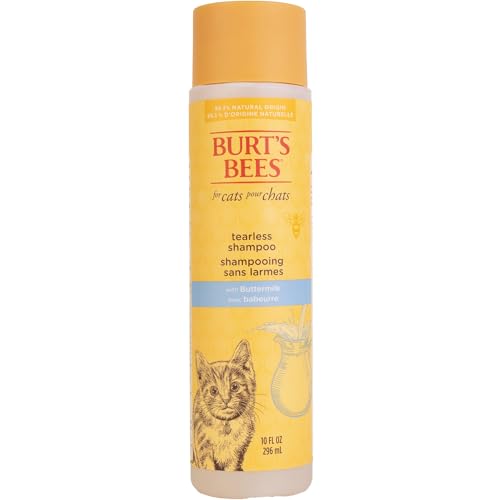
6. Burts Bees Pets Tearless Kitten Shampoo
A tearless shampoo is one formulated at a pH and surfactant level low enough that accidental eye contact causes minimal stinging. That matters enormously with kittens, who squirm at exactly the wrong moment. Burt's Bees pairs the tearless base with buttermilk in a 10 fl oz bottle aimed squarely at cats under 6 months.
Tearless
10 Fl Oz
Buttermilk
Kitten-Safe
Why I picked it
There aren't many genuinely kitten-appropriate shampoos, and most adult formulas are too aggressive for skin that thin. The tearless base plus buttermilk gives you a mild wash for the first bath a kitten ever gets, which shapes whether future baths go smoothly.
Verified buyer reports from foster homes back this up, describing calm reactions even on 8-week-old kittens.
Key specs
- Volume: 10 fl oz (296 mL)
- Formula: tearless, buttermilk-based
- Age range: kittens, per manufacturer guidance
- Free from: sulfates, colorants, harsh chemicals
- Scent: very light, not perfume-heavy
- Brand: Burt's Bees for Pets, same line as our top pick
Real-world experience
The classic use case in buyer feedback is a bottle-fed orphan kitten who has gotten formula matted into the chest fur, or a litter pulled from a barn with dirt ground into the coat. Reviewers describe filling a shallow basin with water at roughly 100°F, working in a dime-sized amount, and having the whole bath done inside 90 seconds. Several note it also works for the "kitten sat in the litter box" situation where a full bath would be overkill and a damp cloth with a drop of shampoo does the job.
The recurring complaint is that it's too mild for a genuinely filthy adult cat, which is fair since that isn't the product's job.
- Tearless base means eye contact won’t sting a squirming kitten
- Buttermilk keeps thin kitten skin from drying out after washing
- Mild enough for a first-ever bath at around 8 weeks old
- Same clean ingredient philosophy as the adult Burt’s Bees formula
- Too gentle to cut through heavy grease or ground-in dirt on adults
- Kittens outgrow it, so the 10 fl oz bottle may expire before it empties
- No deodorizing or medicated benefit at all
- ✔ You’re fostering or raising kittens under 6 months
- ✔ You want a shampoo that won’t sting the eyes
- ✔ You need something safe for frequent small clean-ups
- ✖ Your only cat is a full-grown adult
- ✖ You’re dealing with grease, tar, or heavy outdoor grime
Buy this instead of the adult Burt’s Bees only while your cat is genuinely a kitten, since the tearless formula trades cleaning power for eye safety. Once your cat passes 6 months, switching to the hypoallergenic version gives you better results on a fuller coat.
7. Veterinary Formula Clinical Care Antiseptic &
This is the medicated option, and it plays by different rules than everything above. Veterinary Formula Clinical Care Antiseptic & Antifungal Shampoo combines ketoconazole, an antifungal, with chlorhexidine gluconate, an antiseptic, in a 16 oz bottle. It's what you reach for when a vet has identified an actual skin infection rather than general dirt.
16 Oz
Ketoconazole
Chlorhexidine
Paraben-Free
Why I picked it
No gentle shampoo on this list will touch ringworm, hot spots, or a yeast overgrowth, and pretending otherwise wastes weeks of a cat's comfort. This formula includes real actives with published antifungal and antibacterial activity, which is why it's stocked in so many veterinary practices.
Buyer feedback shows the strongest results when it's used on a defined schedule rather than as a general-purpose wash.
Key specs
- Volume: 16 oz (473 mL)
- Actives: ketoconazole plus chlorhexidine gluconate
- Free from: parabens, soap, and dyes
- Typical protocol: leave on 5 to 10 minutes before rinsing
- Species: dogs, cats, and horses
- Use case: fungal infection, bacterial dermatitis, hot spots, seborrhea
Real-world experience
Verified buyers most often mention ringworm in newly adopted shelter cats, where the fungus spreads to human household members if it isn't handled fast. The protocol they describe is consistent: apply to a wet coat, set a timer for 10 minutes, rinse thoroughly, and repeat twice weekly until the vet clears it. Owners also flag that the medicinal smell is noticeable and the formula can dry the coat with repeated use, so several alternate it with a moisturizing shampoo on off-weeks.
The one thing worth stressing is that you should confirm the diagnosis first, since using antifungals on non-fungal irritation just strips the skin. The U.S. Food and Drug Administration maintains guidance on veterinary topical products that's worth a look if you want the regulatory background.
- Ketoconazole and chlorhexidine are genuine actives, not marketing terms
- Works across cats, dogs, and horses from one 16 oz bottle
- Paraben-free, soap-free and dye-free despite being medicated
- Widely used in veterinary practice, so protocols are well documented
- Can dry the coat with repeated weekly use
- Noticeable medicinal odor during the 10-minute contact time
- Not a general-purpose shampoo, and shouldn’t be used without a diagnosis
- ✔ Your vet diagnosed ringworm or a yeast overgrowth
- ✔ You adopted a shelter cat with suspicious bald patches
- ✔ You also have a dog or horse needing the same treatment
- ✖ You just want a routine maintenance shampoo
- ✖ Nobody has actually confirmed what the skin issue is
This is the only pick here that treats a diagnosed condition, which makes it irreplaceable in that narrow lane. Used as an everyday shampoo it will out-dry your cat’s coat within a month, so keep Burt’s Bees or earthbath on the shelf for the weeks in between.
8. earthbath Hypoallergenic Cat Shampoo
earthbath has been making plant-based grooming products in the United States since the mid-1990s, and this hypoallergenic cat formula is the volume-friendly middle ground on our list. You get 16 oz of soap-free, fragrance-free cleanser in a bottle that costs less per wash than the 10 oz options. It's the workhorse choice for owners who bathe more than once a season.
16 Oz
Made in USA
Soap-Free
Fragrance-Free
Why I picked it
The value math is what puts it here. At 16 oz you're getting roughly 60% more product than the Burt's Bees bottle in a formula that's similarly free of soap, fragrance, and dyes.
Long-term buyer feedback also reports very few reactions, which is the whole point of a hypoallergenic label. It's manufactured in the USA, which some owners specifically look for.
Key specs
- Volume: 16 oz (473 mL)
- Formula: soap-free, fragrance-free, dye-free
- Base: plant-derived cleansers with aloe vera
- Origin: manufactured in the United States
- Safe for: cats and kittens over 6 weeks, per the manufacturer
- Compatibility: will not strip topical flea treatments when used as directed
Real-world experience
The detail that keeps coming up in verified reviews is topical flea and tick compatibility. Owners on monthly spot-on treatments worry that a harsh shampoo will wash the product off the skin, and earthbath's soap-free base is designed to avoid that. A second pattern comes from Bengal and Savannah owners who bathe more often than average because those cats tolerate water well, and they appreciate the larger bottle.
On the downside, the fragrance-free version has a faint plant-material smell straight from the bottle that a few buyers describe as slightly earthy, and it doesn't lather as thickly as a soap-based shampoo.
- 16 oz bottle stretches much further than the 10 oz alternatives
- Soap-free base won’t strip monthly topical flea treatments
- No fragrance, dyes, or synthetic additives on the label
- Aloe vera helps calm mild irritation without heavy conditioning
- Faint earthy base smell that a few buyers find odd
- Lather is thin, so coverage is harder to judge on dark coats
- Less conditioning payoff than the ceramide-based options
- ✔ Your cat is on a monthly topical flea preventative
- ✔ You bathe every 4 to 8 weeks and need volume
- ✔ You prefer plant-based, US-manufactured formulas
- ✖ You want serious moisture repair for a flaky coat
- ✖ You judge cleaning by how thick the foam gets
earthbath is the better buy than Burt’s Bees purely on volume if you bathe a water-tolerant cat regularly. Where it gives ground is conditioning: for a cat with real dryness, the PetO’Cera ceramide formula does more for the skin barrier per bath.
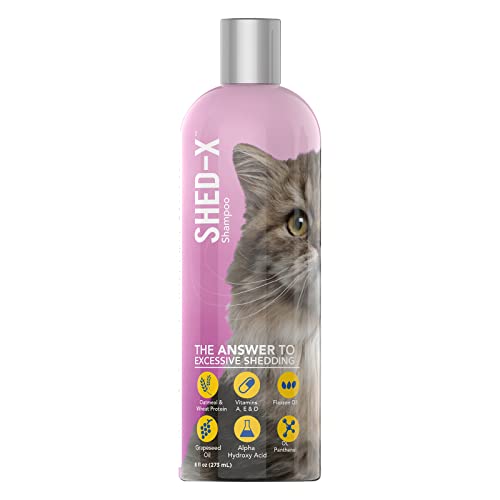
9. Shed-X Shed Control Shampoo Cats
Shedding control shampoo works by loosening dead undercoat hair during the bath so it goes down the drain instead of onto your couch. Shed-X packs vitamins and antioxidants into an 8 oz bottle aimed at exactly that job. It's the most specialized non-medicated pick here, and it earns its place if hair on furniture is your daily frustration.
8 Oz
Shed Control
Vitamins
Antioxidants
Why I picked it
Shedding is the single most common cat-ownership complaint, and it's also linked to hairball frequency, since everything your cat swallows while grooming has to come back up. A shampoo that pulls loose undercoat during the bath reduces both problems at once.
Buyer feedback is clear that results depend on brushing afterward, and reviewers who skip that step report far less benefit.
Key specs
- Volume: 8 oz (237 mL), the smallest bottle here
- Function: shed control and coat conditioning
- Additives: vitamins and antioxidants
- Species: formulated specifically for cats
- Best paired with: a deshedding comb or slicker brush
- Typical use: every 2 to 4 weeks during shedding season
Real-world experience
Spring and autumn are when this shows up most in verified feedback, because that's when cats blow their coat as daylight hours change. The pattern owners describe is bathing, towel-drying, then combing with a deshedding tool while the coat is still slightly damp, which is when loose hair releases most easily. Several report visibly less hair on black clothing within two weeks of a single bath.
The honest limitations are the small 8 oz volume, which does not go far on a long-haired cat, and the fact that no shampoo stops shedding entirely. Cats with an underlying nutritional or thyroid issue will keep shedding regardless of what you wash them with.
- Loosens dead undercoat during the bath, cutting hair on furniture
- Less loose fur swallowed during grooming means fewer hairballs
- Vitamins and antioxidants support coat condition between baths
- Formulated for cats specifically, not a rebadged dog product
- 8 oz is the smallest bottle here and empties fast on long coats
- Results depend heavily on brushing afterward
- Won’t help if shedding stems from diet or a medical issue
- ✔ Your cat blows coat every spring and autumn
- ✔ Hairballs are a recurring problem in your house
- ✔ You already own a deshedding comb or slicker brush
- ✖ Your cat has short fur and barely sheds
- ✖ You want one bottle to cover multiple long-haired cats
Shed-X is the only pick here built around hair volume rather than skin health, so it beats the others during seasonal coat blow. Outside those two windows a year, a general hypoallergenic shampoo plus consistent brushing delivers most of the same benefit for less money.
10. Pet Honesty Chlorhexidine Cat & Dog
Chlorhexidine gluconate is a broad-spectrum antiseptic that disrupts bacterial cell membranes, and Pet Honesty builds a gentler, more everyday-friendly wash around it than the clinical option above. This 16 oz bottle targets seasonal allergy itch, hot spots, and shedding in one product. Think of it as the bridge between a maintenance shampoo and a medicated one.
16 Oz
Chlorhexidine
Itch Relief
Cat & Dog
Why I picked it
Seasonal allergies in cats show up as skin irritation far more often than as sneezing, and a chlorhexidine wash rinses away the pollen and dander sitting on the coat. This one includes deodorizing and coat-supplement claims alongside the antiseptic, which makes it more usable week to week than a purely clinical shampoo.
Aggregate feedback rates it well for hot spots caught early, before they need a vet visit.
Key specs
- Volume: 16 oz (473 mL)
- Active: chlorhexidine gluconate antiseptic
- Targets: seasonal itch, allergies, hot spots, shedding
- Extras: deodorizing action and skin and coat support
- Species: safe for both cats and dogs
- Application: lather, leave 5 minutes, rinse thoroughly
Real-world experience
The households that get the most out of this tend to have a cat with indoor/outdoor access during pollen season, when the coat picks up allergens on every trip through the garden. Owners describe a wash every 1 to 2 weeks during peak season and note that the scratching around the neck and shoulders drops off noticeably. Because it's approved for both species, multi-pet homes use the same bottle on the dog, which stretches the 16 oz further.
The recurring complaint is the same one that follows all chlorhexidine products: some cats find the smell off-putting, and over-frequent use can leave the coat feeling slightly stripped, so alternating with a moisturizing shampoo is the sensible play.
- Chlorhexidine handles early hot spots before they need a vet visit
- Rinses seasonal pollen and dander off the coat during allergy months
- Safe for cats and dogs, so one 16 oz bottle covers the whole house
- Adds deodorizing and shedding support alongside the antiseptic action
- Antiseptic smell bothers some cats during the 5-minute contact time
- Frequent use can leave the coat feeling stripped
- Marketed heavily toward dogs, so cat-specific guidance is thin
- ✔ Your cat scratches more during pollen season
- ✔ You’ve spotted an early hot spot forming
- ✔ You want one antiseptic bottle for the cat and the dog
- ✖ Your cat’s skin is already dry and flaking
- ✖ You need a confirmed antifungal for diagnosed ringworm
Pet Honesty sits between everyday and clinical, which makes it the right call for recurring seasonal itch that never quite becomes an infection. If a vet has actually named a fungal problem, Veterinary Formula’s ketoconazole blend is the stronger tool for the job.
How I picked
I built this list from label analysis, manufacturer documentation, and pattern-reading across thousands of verified buyer reviews, not from personal bathing sessions. Cat shampoo is one of the few product categories where the wrong ingredient can genuinely harm the animal, so screening came before ranking.
Every product was measured against four benchmarks:
- Ingredient safety for felines. Anything containing tea tree oil, permethrin, pennyroyal, or high-concentration essential oils was cut immediately. Cats lack the glucuronyl transferase enzymes needed to process many plant compounds that are perfectly safe for dogs.
- pH appropriateness. Feline skin is thinner than human skin and sits at a different pH, which is why human shampoo causes irritation. Formulas explicitly balanced for pets scored higher.
- Rinse behavior. Residue matters more with cats than any other pet, because they ingest whatever stays on the coat. Buyer reports mentioning "hard to rinse" or "left a film" pulled a product down.
- Consistency across the review base. A single glowing review means nothing. I looked for repeated, specific patterns across hundreds of reports, especially complaints, since those cluster around real flaws.
I also weighted bottle size against realistic use. A 10 fl oz bottle is fine for a shorthair bathed three times a year. It's the wrong buy for a Maine Coon owner washing monthly, and the price-per-wash gap between a 10 oz and a 20 oz bottle is large enough to change the recommendation.
What I deliberately did not evaluate: long-term coat outcomes past six months, since that requires controlled conditions nobody in a home has. I also didn't attempt to compare medicated efficacy head to head, because that's a clinical question that belongs with your veterinarian, not a product roundup. Where a product treats a diagnosed condition, I've said so plainly and pointed you toward a professional diagnosis first.
Finally, I excluded flea shampoos entirely from this list. Insecticidal washes for cats carry real toxicity risks when dosed wrong, and modern spot-on or oral preventatives outperform them anyway. If fleas are your issue, that's a conversation with your vet rather than a shopping decision.
Buying guide — what actually matters for best cat shampoo
Most cat shampoo marketing is noise. Four or five factors actually determine whether a bottle works for your specific cat, and the rest is packaging.
Is cat shampoo really different from dog shampoo?
Yes, and the difference can matter medically. Cats groom by licking, so they ingest a measurable amount of whatever you leave on the coat, and their livers lack certain enzymes that dogs use to detoxify plant compounds. Tea tree oil, d-limonene, and permethrin all appear in dog products and all pose a documented risk to cats.
Always check the label says it's safe for cats, not just "for pets."
What ingredients should you avoid completely?
Skip anything listing tea tree (melaleuca) oil, pennyroyal oil, permethrin, or artificial dyes. Also be cautious with heavy essential oil blends even when they're marketed as natural, since concentration is what determines toxicity. The American Veterinary Medical Association publishes general guidance on household products and pet safety that's worth bookmarking.
Sulfates aren't toxic, but they strip the coat's natural oils faster than a cat can replace them.
How often should you actually bathe a cat?
Most healthy indoor cats need a bath only a few times a year, if ever, because self-grooming handles routine maintenance. Hairless breeds like the Sphynx are the exception and typically need weekly washing to manage skin oil. Long-haired cats, seniors with mobility limits, and cats with skin conditions fall somewhere in between.
Over-bathing causes more skin problems than under-bathing. If you're bathing more than monthly without a medical reason, that's usually too much.
Scented or unscented: which should you pick?
Go unscented unless you have a specific reason not to. Cats have vastly more olfactory receptors than humans, and a fragrance you find pleasant can read as an assault to them. The most common post-bath behavior problem, frantic over-grooming, traces directly to a cat trying to remove an unwanted smell.
Deodorizing formulas like the Arm & Hammer option are the reasonable exception, since baking soda neutralizes odor rather than covering it.
Does bottle size change the recommendation?
More than people expect. A 20 fl oz bottle in a three-cat household costs meaningfully less per wash than a 10 oz premium formula, and shampoo doesn't spoil quickly if stored away from heat. But buying volume you'll never use is false economy, since most formulas carry a 24 to 36 month shelf life from manufacture.
Match the bottle to your realistic bath frequency, not your aspirational one.
Do you need a separate conditioner?
For short-haired cats, no. For long-haired breeds prone to matting, a conditioning step genuinely helps the comb glide afterward, which reduces the tugging that makes cats hate grooming. All-in-one formulas like PetO'Cera solve this by combining both steps, which also cuts the time your cat spends restrained.
Frequently Asked Questions (FAQ)
Can I use human shampoo on my cat in an emergency?
No, and this is one of the few absolute rules in pet grooming. Human skin sits at a pH of roughly 5.5 while cat skin is closer to neutral, so human shampoo disrupts the acid mantle and leaves the skin vulnerable to irritation and infection. Human products also commonly contain sulfates and fragrances cats will ingest while grooming.
If you have no cat shampoo on hand, plain lukewarm water and a washcloth is safer than reaching for your own bottle.
Which cat shampoo is best for dandruff and flaky skin?
Ceramide-based formulas address dandruff at the source, which is why the Breezytail PetO'Cera unscented version is the strongest choice here. Ceramides restore the lipid barrier that keeps moisture in, rather than just washing flakes away. Expect improvement over two to three baths, not one.
If flaking persists past a month or comes with hair loss or scabbing, that's a veterinary question, since it can signal allergies, parasites, or an endocrine issue rather than simple dryness.
Is a medicated shampoo safe to use without a vet's advice?
Use it only when you know what you're treating. Ketoconazole and chlorhexidine products such as the Veterinary Formula and Pet Honesty options are effective against fungal and bacterial skin problems, but applying them to non-infected irritation strips the skin and can make things worse. A vet can confirm ringworm with a Wood's lamp exam or fungal culture in a single visit.
Once you have the diagnosis, these shampoos are a legitimate and affordable part of the treatment plan.
How do I bathe a cat that hates water?
Preparation does most of the work. Trim the claws a day ahead, set the water to roughly 100°F, use a shallow basin with a rubber mat instead of a full tub, and have everything within reach before the cat is in the room. A washcloth application works better than pouring for cats that panic at running water.
Keep the whole thing under three minutes if you can, and finish with a towel rather than a dryer, since the noise undoes any calm you built.
Will cat shampoo wash off my flea treatment?
Soap-free formulas like earthbath are specifically designed not to, and most spot-on treatments bind to the skin's oils within 24 to 48 hours of application. The safe approach is to wait at least 48 hours after applying a topical before bathing, and to avoid harsh sulfate shampoos entirely if your cat is on a monthly preventative. Check your specific flea product's instructions, since manufacturers give different waiting windows.
As of 2026, what should I look for on a cat shampoo label?
Look for four things in order: an explicit "safe for cats" statement, no essential oils in the top half of the ingredient list, a pH-balanced or soap-free claim, and a rinse-out description rather than a leave-in one. Brands like Burt's Bees, earthbath, and Veterinary Formula all print full ingredient panels, which is itself a good sign. Vague labels that say "natural blend" without specifics are the ones worth skipping.
Final verdict
Burt's Bees for Pets Hypoallergenic Cat Shampoo takes the top spot because it's the safest default for the widest range of cats: unscented, 99.7% natural, and consistently free of the irritation complaints that follow scented formulas. If dry or itchy skin is your actual problem, the Breezytail PetO'Cera unscented version is the smarter buy for its ceramide barrier support.
Affiliate disclosure: This post contains affiliate links. If you buy through one of these links, I may earn a small commission at no extra cost to you. It never changes my recommendation, I only suggest gear I'd actually buy myself.