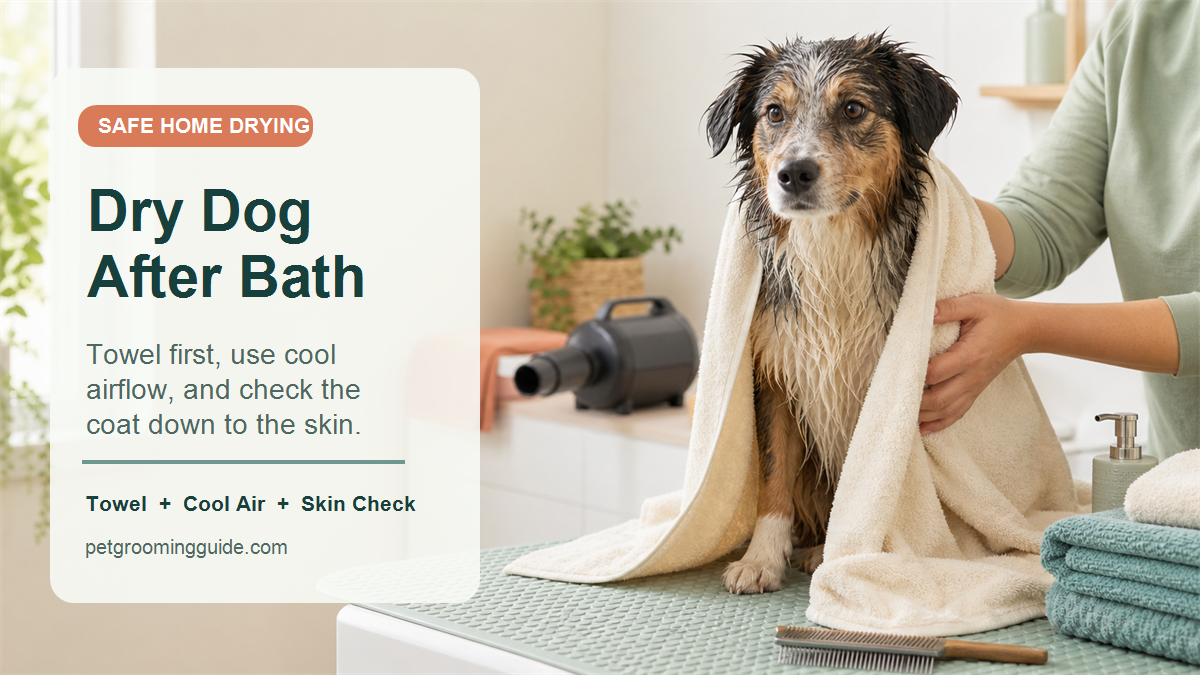

To dry a dog after a bath, towel first, choose air drying or low-stress airflow based on the coat and the dog, then check dense areas down to the skin. Short smooth coats may dry with towels and supervised air drying in a comfortable room. Dense, double, curly, long, or mat-prone coats often need more careful section-by-section drying so dampness does not sit near the skin. If the bath itself was difficult, start with these dog bathing mistakes before the next wash.
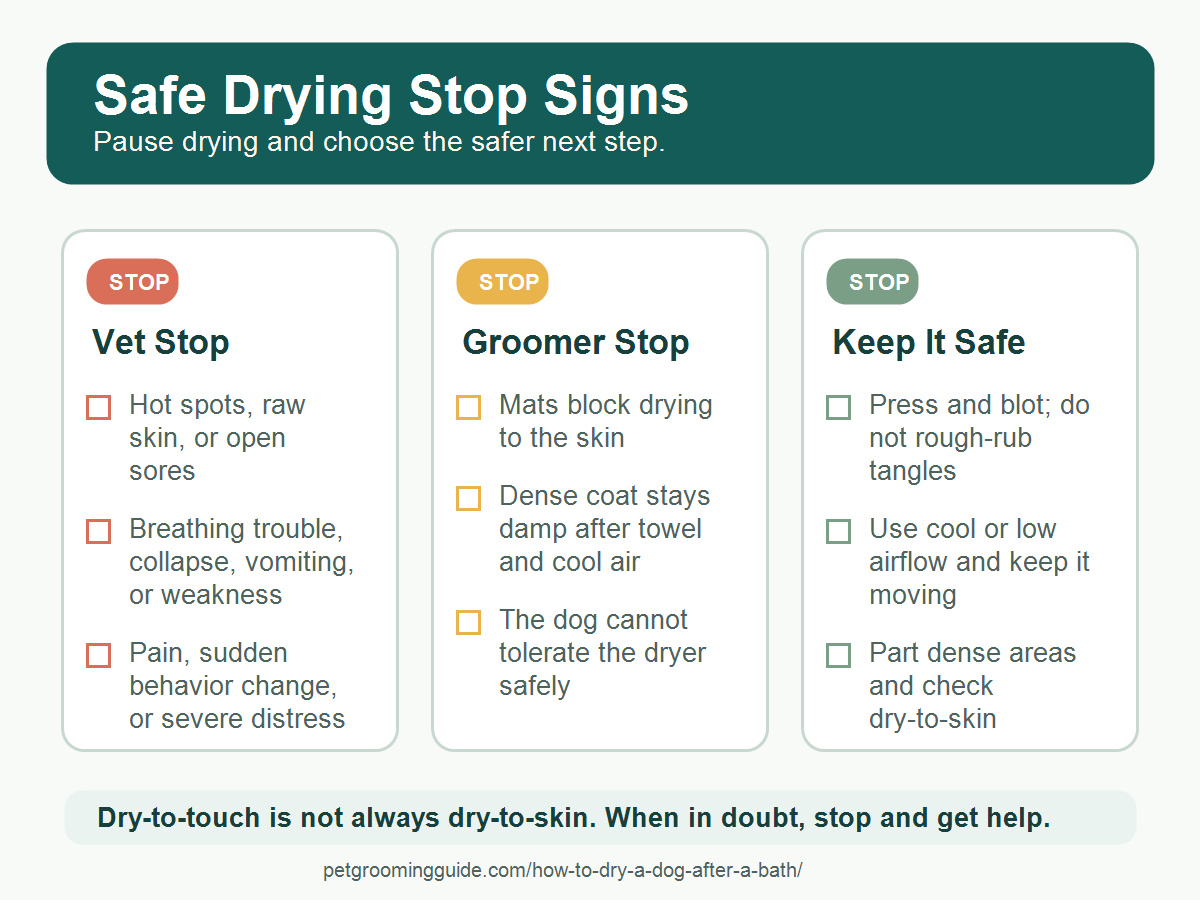
Stop before you try to finish the job if your dog is overheating, struggling to breathe, panicking, painful, too hard to handle safely, or showing skin, ear, or eye trouble. Use a professional groomer for mats, thick coats you cannot dry to the skin, or dogs who cannot tolerate drying. Call a veterinarian for raw skin, hot spots, open sores, breathing trouble, collapse, vomiting, weakness, eye irritation, ear pain, or a medically fragile dog.
| Dog or coat situation | Safer drying plan | Stop and get help if |
|---|---|---|
| Short smooth coat | Towel well, then allow supervised air drying in a warm, comfortable room | The dog is cold, shivering, panting hard, or skin looks irritated |
| Dense or double coat | Towel, dry in sections, and check near the skin in thick areas | The coat stays damp near the skin or the dog cannot tolerate more drying |
| Long, curly, or tangle-prone coat | Blot gently, use controlled airflow if tolerated, and avoid rubbing tangles tighter | You find mats, pulling, skin-close tangles, or painful spots |
| Noise-sensitive or fearful dog | Use towels first, add distance and breaks, or skip the dryer if fear rises | The dog trembles, freezes, hides, snaps, growls, or tries to escape frantically |
| Puppy, senior dog, flat-faced dog, or medical concern | Keep the session short, gentle, and closely supervised | Breathing, balance, fatigue, overheating, pain, or distress appears |
Start With Towels, Not Heat
Start by letting the dog shake in a safe spot, then use absorbent towels to remove as much water as you can. Press, blot, and squeeze lightly through the towel instead of rubbing hard circles into the coat.
Rough rubbing can worsen tangles, especially behind the ears, under the collar line, in the armpits, along the belly, on the legs, and near the tail base. Use another dry towel before you use more force.
Choose Air Drying or Dryer Drying
Air drying is not automatically good or bad. It depends on coat density, room temperature, humidity, skin condition, and how well the dog stays comfortable while drying.
Air drying may be enough for some short smooth coats when the room is comfortable and the dog is supervised. Dense, double, long, curly, or mat-prone coats need a closer check because the surface can feel dry while the coat near the skin is still damp. For routine planning by coat type, use the dog grooming schedule by coat type.
If you use airflow, keep it comfortable, moving, and away from the eyes, ears, nose, and mouth. A dog-safe dryer or forced-air dryer may be useful for some coats, but this guide is not a dryer buying guide. Do not use high heat close to the skin, and do not confine a wet dog in a hot room, crate, car, or small space to speed drying.
Check Dry-to-Skin, Not Just Dry-to-Touch
A coat can feel dry on top while moisture remains underneath. Part the coat gently with your fingers and feel near the skin in the areas most likely to hold dampness.
Check behind the ears, the collar line, chest, armpits, belly, thighs, tail base, and between the toes. If the coat feels cool, damp, clumped, or heavy near the skin, that area is not fully dry.
Cornell’s canine health guidance notes that thick coats that do not dry fully and matted areas that hold moisture can increase hot-spot risk. That is a reason to dry carefully, not a reason to force a scared or painful dog through a dryer session.
Use Dryer Air Safely
Dryer safety is about heat, noise, airflow, restraint, and session length. Keep the airflow moving, check the skin often with your hand, and give breaks before the dog is overwhelmed.
Human hair dryers can focus heat in a small area. If one is used at all, use only a cool or low setting, keep distance from the coat, keep the dryer moving, and stop if the dog shows distress. Do not aim airflow into the face, ears, eyes, nose, or mouth.
Stop the dryer for heavy panting, frantic escape attempts, trembling, freezing, growling, snapping, repeated hiding, coughing, breathing trouble, weakness, or collapse. Those are not training moments. They are stop signs.
Handle Mats and Tangles Before They Become a Drying Problem
Do not try to blast a matted coat dry at home. Mats can trap moisture and pull on skin, and water can make some tangles feel tighter. If the dryer cannot move air through the coat or you cannot part the coat without pulling, stop.
Use a professional groomer for mats, pelted coat, skin-close tangles, or a coat that stays damp because air cannot reach the base. Use a veterinarian if the skin under or near the mat looks red, raw, swollen, bleeding, painful, smelly, or irritated.
Protect the Face, Ears, Eyes, and Paws
Use a towel for the face instead of blowing air toward it. Dry around the muzzle, beard, cheeks, and folds with gentle blotting. Do not push towel corners, cotton swabs, or liquid into the ear canal.
Dry the outside of ear flaps, then stop and call a veterinarian if there is ear odor, discharge, redness, swelling, head shaking, pain, or repeated scratching. Stop for eye redness, squinting, pawing at the eye, discharge, or any sign that shampoo, water, or airflow irritated the eye.
Dry paws enough that the dog can walk safely. Check between toes and pads, but do not dig at sore skin or force a paw hold if the dog panics or pulls hard.
When to Call a Groomer or Veterinarian
Call a professional groomer when the coat is too dense to dry to the skin, mats block airflow, the dog cannot tolerate dryer noise, or the dog is too large, strong, slippery, fearful, or painful to handle safely at home.
Call a veterinarian for hot spots, raw skin, open sores, skin irritation, swelling, discharge, ear pain, eye irritation, breathing trouble, overheating, collapse, vomiting, weakness, severe distress, pain, or any puppy, senior dog, flat-faced dog, or medically fragile dog who does not seem right after the bath.
Cornell’s hot-spot guidance explains why thick coats and moisture matter. ASPCA dog grooming tips reinforce gentle grooming and protecting sensitive areas. A peer-reviewed heat-stroke article supports treating overheating signs as serious, which is why this guide routes heat stress, breathing trouble, weakness, collapse, or vomiting to a veterinarian instead of giving home treatment steps.
FAQ
Can I let my dog air dry after a bath?
Sometimes. Air drying may be fine for some short smooth coats in comfortable conditions, but dense, double, curly, long, or mat-prone coats usually need a dry-to-skin check and may need controlled airflow.
How do I know if my dog’s coat is dry to the skin?
Part the coat in thick areas and feel near the skin. If the base feels cool, damp, clumped, or heavy, that area is not fully dry.
Can a damp coat cause hot spots?
Damp, thick, or matted coat can contribute to skin trouble when moisture stays near the skin. Hot spots, raw skin, or painful areas need veterinary guidance.
Is it safe to use a human hair dryer on a dog?
Use extreme caution. Human hair dryers can get too hot and too focused, so use only cool or low air, keep distance, keep it moving, check the skin often, and stop if the dog is distressed.
Should I brush while drying?
Only if the coat is safe to handle and the dog is calm. Do not brush through mats, painful tangles, damp irritated skin, or areas where the dog flinches, growls, snaps, or panics.
When should a groomer dry my dog instead?
Use a groomer when the coat is dense, matted, slow to dry, dryer-sensitive, or too hard for you to dry safely to the skin at home.
Bottom Line
Drying a dog safely means removing surface water, choosing the lowest-stress drying method, checking thick coat down to the skin, and stopping early for mats, skin irritation, overheating, breathing trouble, fear, pain, or unsafe handling. The goal is a dry, comfortable dog, not finishing a drying session at any cost.