

Cat hair on the couch, the duvet, and somehow inside the fridge. That's the problem the best cat deshedding tool solves, and after weeks of comparing blade geometry, handle design, and thousands of verified buyer reports across brands like FURminator, SleekEZ, and Aumuca, the differences turned out to be bigger than the marketing suggests. Coat length matters.
So does how much undercoat your cat actually carries.
Our research points to the SleekEZ Cat Brush as the strongest all-round pick, mostly because its patented wavy blade lifts loose fur without cutting into the topcoat, and it works on short, medium, and long coats alike. If your cat has a dense undercoat, the FURminator options still earn their reputation. Here's the winner first, then the full breakdown.

✔ Best overall for everyday shed control
Comparison Chart of Best Cat Deshedding Tool
| Product | Details | Rating | Buy |
|---|---|---|---|
Editor’s Choice
| ★★★★☆4.8/5 | ||
Top Pick
| ★★★★☆4.5/5 | ||
Best Budget
| ★★★★☆4.7/5 | ||
| ★★★★☆4.6/5 | ||
| ★★★★☆4.5/5 | ||
| ★★★★☆4.6/5 | ||
| ★★★★☆4.3/5 | ||
| ★★★★☆4.5/5 | ||
| ★★★★☆4.3/5 | ||
| ★★★★☆4.2/5 |




List of Top 10 Best Cat Deshedding Tool
Every tool below was shortlisted on four things: how it handles undercoat versus topcoat, how gentle the contact edge is on feline skin, how easy it is to clear fur mid-session, and what verified buyers say after months of use. We prioritized tools cats actually tolerate, because a brush your cat runs from removes exactly zero hair.
Below are the list of products:
1. SleekEZ Cat Brush Shedding
SleekEZ takes a different route than every wire-pin brush on this list. Instead of pins or a rake, it uses a patented wavy steel blade set into a wooden handle, and the wave pattern grips loose fur and pulls it out without digging into skin. Manufacturer specifications confirm it is made in the USA and rated for short, medium, and long coats, which is rare in a single-tool design.
Patented Blade
Made in USA
All Coat Types
No Pins
Why I picked it
A deshedding tool is a grooming device that removes shed undercoat before it lands on your furniture, and SleekEZ does that with the least skin contact of anything we reviewed. There are no wire pins to poke, no spring-loaded pressure, just a flat blade dragged along the lay of the coat. Aggregate reviews repeatedly describe cats who tolerate this brush after refusing rakes and slickers.
Key specs
- Patented wavy stainless blade set in a solid hardwood handle
- Cat model uses the brand's narrowest blade width, roughly 2.5 inches
- Rated by the manufacturer for short, medium, and long coats
- No moving parts, no self-cleaning button, no plastic housing
- Made in the USA, single-piece construction with no replacement blade system
- Works dry on the coat, no detangling spray required
Real-world experience
Verified buyer feedback shows the strongest results on short-haired breeds like the British Shorthair and Domestic Shorthair, where two or three passes down the flank lift a visible mat of loose hair. Owners of Maine Coons report it works well on the outer coat and sides but needs a follow-up comb around the ruff and britches, where fur is longest. A common workflow in reviews: SleekEZ first for bulk removal, then a fine metal comb for the tail base.
Because the blade collects hair on its face rather than trapping it in pins, most users just wipe it clean with a hand every few strokes, which keeps sessions short enough for a cat's patience window of two to five minutes.
- Flat wavy blade has no pins or points, so skittish cats accept it faster than a slicker
- Rated for short, medium, and long coats, so one tool covers a multi-cat household
- Zero moving parts means nothing jams or snaps after a season of use
- Wipes clean by hand mid-session, keeping grooming under the average cat’s patience limit
- Not a dematting tool, existing knots need a comb or scissors first
- No self-cleaning button, you clear fur with your hand or a cloth
- Blade edge dulls if dragged over a metal grooming table or dropped on tile
- ✔ Your cat flinches at wire-pin brushes and rakes
- ✔ You have both a shorthair and a longhair to groom
- ✔ You want a tool with nothing to break or replace
- ✖ Your main problem is heavy matting, not loose fur
- ✖ You want a one-touch self-cleaning mechanism
SleekEZ beats the FURminator tools on comfort and on cats that hate being groomed, because there is no serrated edge riding against the skin. It loses to them on raw volume of undercoat pulled per stroke from a dense double coat. If your cat sits still and sheds heavily, FURminator moves more hair; if your cat squirms, SleekEZ is the one that actually gets used.
2. Aumuca Cat Brush Shedding
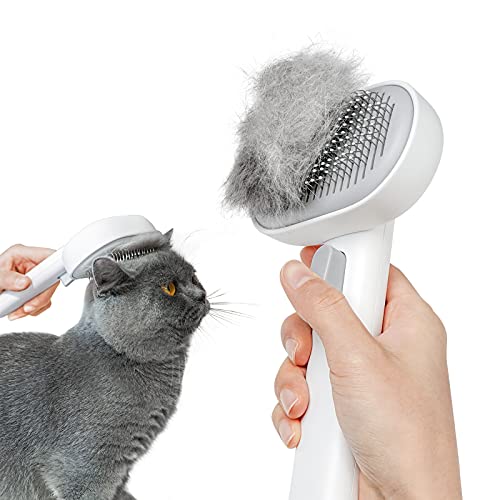
This is the self-cleaning slicker most indoor-cat owners end up with, and the review volume behind it is enormous. A slicker brush is a flat pad of fine bent-wire pins that comb through the topcoat and pull loose undercoat with it. Aumuca's version adds a retraction button so the whole pin bed sinks and drops the fur in one motion.
Self-Cleaning
Rounded Tips
Indoor Cats
Massage Effect
Why I picked it
Editorial analysis of buyer feedback shows one recurring theme: cats lean into this brush. The pins are fine enough to reach undercoat but tipped so they glide rather than scratch, which turns grooming into something closer to petting. That behavioral response is worth more than raw fur-removal specs, because a cooperative cat gets brushed three times a week instead of once a month.
Key specs
- Self-cleaning slicker head with a one-press pin retraction button
- Fine bent-wire pins with rounded, skin-friendly tips
- Rated by the manufacturer for both long-haired and short-haired cats
- Also listed for kittens and rabbits, so pressure is on the gentle end
- Contoured plastic handle with a non-slip grip section
- Compact head sized for cats rather than repurposed from a dog brush
Real-world experience
The strongest reports come from apartment households with one or two indoor cats where shedding peaks in spring and autumn. Owners describe running it along the back and flanks for about 60 seconds, pressing the button, and dropping a full pad of fur straight into the bin without picking at pins. Ragdoll and Persian owners note it does fine on surface fluff but stalls on tight mats near the armpits, where a metal comb or a dematting rake still wins.
Several reviews mention pairing it with a rubber grooming glove for the head and cheeks, where a slicker head is too wide to maneuver safely.
- One-press retraction dumps the fur pad instantly, so you never pick pins clean
- Rounded pin tips mean most cats treat the session as a massage, not a fight
- Works on both long and short coats, useful in mixed-breed households
- Cat-sized head reaches the flanks and shoulders without overshooting the body
- Slicker pins can bend if forced through a tight mat
- Plastic retraction mechanism is the likeliest long-term failure point
- Head is too wide for the face, ears, and paw areas
- ✔ You want the fur cleared with one button, not your fingers
- ✔ Your cat enjoys being brushed and you groom often
- ✔ You have kittens or a rabbit in the house too
- ✖ You need to break up dense mats on a longhair
- ✖ You prefer all-metal tools with no plastic parts
Pick the Aumuca over the SleekEZ if convenience is your deciding factor, since dumping fur with a button beats wiping a blade twenty times per session. Pick SleekEZ instead if your cat is pin-shy. Against the FURminator, Aumuca is the friendlier daily driver but removes noticeably less deep undercoat per pass.
3. FURminator Medium Large Cat deShedding Tool
FURminator is the name that made deshedding tools a category, and this is the short-hair version built for medium to large cats. The stainless steel edge reaches through the topcoat and grabs the shed undercoat underneath. The brand states it is designed for coats under 2 inches long, which is the spec most buyers get wrong.
Stainless Edge
FURejector Button
Short Hair
Medium to Large
Why I picked it
FURminator's deShedding edge is the benchmark other tools get measured against, and the brand claims it reduces shedding by up to 90% with regular use. What earns it the budget slot here is simple math: it removes more undercoat per minute than anything else at its tier, so you spend less time grooming and less time vacuuming. The FURejector button also solves the fur-clearing problem cleanly.
Key specs
- Stainless steel deShedding edge sized for medium to large cats
- Engineered for short coats, defined by the manufacturer as under 2 inches
- FURejector release button clears collected fur in one press
- Ergonomic handle with a curved, non-slip grip
- Skin guard along the edge to reduce direct blade contact
- Manufacturer claim of up to 90% less shedding with routine use
Real-world experience
Verified buyers with American Shorthairs and larger domestic cats report visible piles of undercoat within the first two or three minutes, especially along the spine and rump. The consistent warning in reviews is pressure: press hard and you scrape skin, so the technique that works is light strokes in the direction of hair growth, never against it. Owners also flag that over-brushing the same patch thins the coat, which is why most veterinary guidance suggests short sessions once or twice a week rather than daily marathons.
Households that switched from a plain slicker to this tool commonly report fewer hairballs, which tracks with less ingested fur during self-grooming. For coats past 2 inches, buy the long-hair version instead.
- Removes more undercoat per stroke than any slicker on this list
- FURejector button clears the edge in one press, keeping sessions fast
- Stainless steel edge holds its bite far longer than plated alternatives
- Coat-length-specific design means you get the right tool instead of a compromise
- Easy to overdo, heavy pressure can irritate skin or thin the coat
- Wrong pick for coats longer than 2 inches, you need the long-hair model
- Rigid edge is less comfortable for cats that dislike firm contact
- ✔ You have a medium or large short-haired cat
- ✔ Shedding season is burying your floors and clothes
- ✔ You want maximum fur removal in the shortest session
- ✖ Your cat’s coat is longer than 2 inches
- ✖ Your cat has sensitive or already irritated skin
This is the tool to reach for during the spring and autumn coat blow, when a shorthair drops more fur in two weeks than in the previous three months. It is not the tool for weekly maintenance on a thin-coated senior cat, where SleekEZ or a soft slicker is kinder. Buy it for volume, not for gentleness.
4. MIU COLOR Pet Grooming Brush
MIU COLOR built a FURminator-style tool at a friendlier tier, with a stainless steel deshedding blade, a release button, and a rubberized handle. It is listed for both dogs and cats, which tells you the head is on the wider side. For multi-pet homes where one tool has to cover a cat and a small dog, that is a feature rather than a compromise.
Steel Blade
Release Button
Dogs & Cats
Non-Slip Grip
Why I picked it
An undercoat blade is a serrated steel comb that slips under guard hairs and lifts dead undercoat without cutting the topcoat, and MIU COLOR executes that pattern competently at a lower tier than the name brands. Aggregate reviews describe removal performance close to premium tools, with the trade-off showing up in handle feel rather than blade bite. For a household that grooms a cat and a beagle with the same tool, that trade is easy.
Key specs
- Stainless steel deshedding blade with a protective outer comb
- One-touch fur release button on the handle spine
- Listed by the manufacturer for both dogs and cats
- Rubberized non-slip handle for wet or oily-coat sessions
- Blade head is wider than a cat-only tool, better for large body areas
- Blue color-coded housing, single-piece assembly
Real-world experience
Buyer reports cluster around two use cases. The first is a shorthair cat during peak shed, where three or four passes down each flank fill the blade completely. The second is a small to medium dog, where the wider head is a genuine advantage over a cat-specific tool.
The recurring complaint is maneuverability around a cat's face, neck, and legs, where the head is simply too broad to work safely. Owners who groom on a towel-covered lap report the best control, since the rubber grip stays put even when a cat starts wriggling. Several reviews note that rinsing and drying the blade after each session prevents the surface haze that develops from skin oils.
- Stainless blade delivers near-premium undercoat removal at a lower tier
- Release button keeps your hands out of the collected fur
- Rubberized grip stays secure when a cat starts squirming mid-session
- Covers cats and small dogs, so one tool serves a mixed-pet home
- Head is too wide for a cat’s face, neck, and legs
- Blade edge is sharper than beginners expect, light pressure only
- Handle finish feels less refined than premium-brand equivalents
- ✔ You own both a cat and a small or medium dog
- ✔ You want blade-style removal without premium branding
- ✔ You groom over a lap towel and need a grippy handle
- ✖ You have a small or petite cat under 8 lb
- ✖ You mostly need to work around the face and legs
MIU COLOR is the smart buy when your household is genuinely multi-species and you refuse to own two separate deshedding tools. It falls behind the cat-specific FURminator on precision around a feline body, and behind the Aumuca slicker on comfort. Think of it as the broad-coverage option, not the specialist.
5. Swihauk Self Cleaning Slicker Brush
Swihauk bundles a self-cleaning slicker with a small set of grooming accessories, which makes it an easy starting kit for a first-time cat owner. The pins are bent-wire with rounded tips, and the retraction plate sits behind them so a single press sheds the whole fur pad. Manufacturer listings describe it as skin-friendly and suitable for shedding and long-haired pets.
Self-Cleaning
Accessories Included
Skin Friendly
Long Hair Ready
Why I picked it
The bundled accessories are what separate this from a dozen similar slickers. Instead of buying a brush and then realizing you also need a comb and a fur-clearing aid, you get a starter set in one purchase. Aggregate reviews consistently rate the retraction plate as smooth, which is the part cheap slickers usually get wrong.
Key specs
- Self-cleaning slicker head with retractable bent-wire pins
- Rounded pin tips designed to reduce skin scratching
- Includes pet supplies accessories alongside the brush
- Listed for dogs and cats, short and long coats
- Ergonomic handle with a textured thumb rest
- Blue housing with a full-width retraction plate
Real-world experience
Reports from first-time cat owners are the most useful signal here: several describe using the slicker for the body and switching to the included accessory for the finer areas around the collar line. On long-haired cats, the brush lifts fluff efficiently but users note it works best after a quick pass with a wide-tooth comb, otherwise the pins snag in tangles. Owners of nervous rescues describe short 90-second sessions on a windowsill perch, stopping before the cat's tail starts flicking.
One consistent maintenance note: press the retraction button before the pad is completely packed, because an overloaded head makes the plate stiff and awkward.
- Comes with accessories, so it works as a complete starter grooming set
- Retraction plate runs smoothly and drops the full fur pad in one press
- Rounded pin tips suit nervous rescues and first grooming sessions
- Handles both short and long coats, useful as a household all-rounder
- Pins snag on tangles unless you comb the coat out first
- Retraction plate stiffens when the pad is overloaded with fur
- Newer listing with a thinner long-term durability record than established brands
- ✔ You’re setting up grooming gear for the first time
- ✔ You want a brush plus accessories in one order
- ✔ Your cat is nervous and needs short, gentle sessions
- ✖ You already own a comb and just want the best single brush
- ✖ You need a proven multi-year track record
Swihauk makes the most sense as a new-kitten or new-adoption purchase, where you need several grooming pieces at once and don’t yet know what your cat tolerates. If you already own a metal comb, the Aumuca slicker is the tighter buy. This one wins on bundle value, not on the brush head alone.
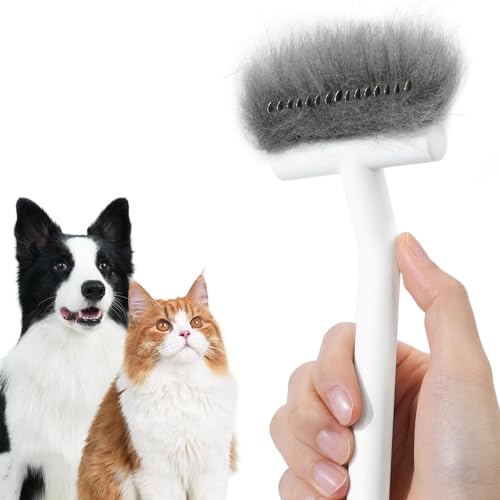
6. Maxpower Planet Dog Grooming Rake
An undercoat rake is a comb with widely spaced, rounded steel teeth that penetrate deep into a double coat and pull dead fluff from underneath. Maxpower Planet's version is marketed for dogs and cats and uses a double-row tooth layout, which is exactly what a Maine Coon's dense underlayer needs. It is the specialist tool on this list for thick coats.
Undercoat Rake
Double Row
Rounded Teeth
Thick Coats
Why I picked it
Slickers and blades both work on the surface layer. A rake goes deeper, and for a cat carrying a genuine double coat, that difference decides whether you actually reduce shedding or just tidy the top. Verified buyer feedback describes it clearing dense undercoat that a slicker glides right over, with the rounded tooth tips keeping skin contact tolerable.
Key specs
- Double-row stainless steel teeth with rounded, polished ends
- Rake geometry designed to reach undercoat below the guard hairs
- Rated by the manufacturer for both dogs and cats
- Non-slip contoured handle for controlled pulling strokes
- No self-cleaning button, fur is pulled from the teeth by hand
- Works on thick, matted, and heavily shedding coats
Real-world experience
The best-reported technique is short, slow strokes with almost no downward pressure, letting the tooth length do the work rather than your wrist. Long-coat owners describe using it along the back, hindquarters, and the britches area, then finishing with a slicker to smooth the coat back down. It is decidedly not a face or belly tool.
Reviews from cat owners are more mixed than dog owners, with the divide falling on coat type: dense double-coated cats respond beautifully, while sleek shorthairs get very little from it because there simply is not enough undercoat to reach. Clearing the teeth by hand between passes is part of the routine.
- Double-row teeth reach undercoat that slickers and blades skim past
- Rounded tips let you rake a dense coat without scoring the skin
- All-metal tooth bed has no plastic mechanism to fail
- Excellent on the britches and hindquarters, where mats usually start
- Does very little on sleek shorthairs with minimal undercoat
- No fur-release button, you clear the teeth by hand every few passes
- Handle is sized for dog grooming, slightly bulky for small cats
- ✔ Your cat is a Maine Coon, Norwegian Forest, or similar double coat
- ✔ Mats keep forming on the hindquarters and britches
- ✔ You already own a slicker and need the deep-layer tool
- ✖ Your cat has a thin single coat like a Siamese
- ✖ You want one tool that handles the whole body including the face
Buy the Maxpower rake as a second tool, not a first one. Paired with the SleekEZ or a slicker it forms a two-stage routine: rake the deep undercoat, then smooth and lift the surface. On a shorthaired cat it is close to useless, so match it to coat density before you order.
7. FURminator Medium Large Cat deShedding Tool
This is the long-hair sibling of the FURminator we ranked third, and the difference is not cosmetic. The teeth are longer so the edge can pass through a coat over 2 inches without dragging the topcoat with it. If you own a Ragdoll, Persian, or Maine Coon, this is the version the manufacturer intends you to buy.
Long Hair
Longer Teeth
FURejector Button
Medium to Large
Why I picked it
Coat-length matching is the single most common buying mistake in this category, and the long-hair FURminator exists precisely to fix it. Buyer feedback from Persian and Ragdoll owners describes far less pulling than when they tried a short-hair tool on the same cat. The longer teeth pass through the guard layer instead of fighting it.
Key specs
- Stainless steel deShedding edge with extended teeth for coats over 2 inches
- Sized for medium to large cats, matching the short-hair model's body coverage
- FURejector button releases collected fur in a single press
- Curved ergonomic handle with a soft-grip surface
- Skin guard limits how deep the edge can travel
- Same up-to-90%-less-shedding claim as the short-hair variant
Real-world experience
The workflow reported most often by longhair owners is detangle first, deshed second. Run a wide-tooth metal comb through the ruff, armpits, and britches to find knots, then use the FURminator on the body in short strokes following the hair direction. Owners consistently note that skipping the comb step causes the tool to catch, which is where the "it pulls" complaints come from.
Cats that shed in seasonal waves show the biggest payoff, with several reviews describing a noticeable drop in hairballs after four to six weeks of twice-weekly sessions. The FURminator brand site documents the coat-length distinction clearly, and it is worth checking before you order.
- Longer teeth pass cleanly through coats over 2 inches without dragging
- Purpose-built for Persians, Ragdolls, and Maine Coons rather than adapted
- FURejector button keeps long fur from wrapping around the edge
- Reported reduction in hairballs after several weeks of twice-weekly use
- Catches badly if you skip the pre-comb step on a tangled coat
- Overkill on a shorthair, where it barely engages the undercoat
- Premium tier pricing compared with generic blade tools
- ✔ Your cat’s coat is longer than 2 inches
- ✔ You already comb out tangles before deshedding
- ✔ Hairballs are a recurring problem in your household
- ✖ You own a shorthaired cat, buy the short-hair version
- ✖ Your cat’s coat is heavily matted and needs a dematter first
The two FURminator models are not interchangeable, and buying the wrong one is the most common reason people call these tools painful. On a longhair this version outperforms every slicker here for undercoat volume. On a shorthair it underperforms its own cheaper sibling, so match the length spec before anything else.
8. aumuca Dog & Cat Deshedding Brush
Aumuca's second entry trades the slicker pad for an undercoat rake and dematting comb layout, aimed squarely at matted fur. It is listed for cats, dogs, kittens, puppies, rabbits, and even horses, which signals a robust tooth bed rather than a delicate one. This is the tool for the cat who has already developed knots.
Undercoat Rake
Dematting Comb
Multi-Species
Long or Short Hair
Why I picked it
Dematting is a separate job from deshedding, and most tools on this list openly fail at it. This one is built for the knot: the teeth work through a mat rather than skating over it, and the same head still functions as a general undercoat rake afterward. That dual duty is why it earns a spot despite overlapping with product six.
Key specs
- Undercoat rake and dematting comb in a single head
- Rated by the manufacturer for long or short hair
- Species coverage listed as cats, dogs, kittens, puppies, rabbits, and horses
- Metal tooth bed with a moulded handle
- No fur-release button, teeth clear by hand
- Designed to work on already-matted fur, not just loose shed
Real-world experience
Reviews from owners of semi-longhaired rescues describe the most dramatic results, typically on cats that arrived with felted patches behind the ears and under the chest. The reported method is to hold the fur at its base with one hand so you are not pulling on skin, then work the mat from its outer edge inward in small bites. Rushing a mat is what makes a cat swat, so patient owners report far better outcomes.
On a healthy, tangle-free shorthair the tool feels excessive, and several reviewers admit they bought it for a dog and only occasionally use it on the cat. Regular use every 5 to 7 days on a longhair prevents mats from reaching the point where a groomer's clippers are the only fix.
- Actually works through mats instead of skating over them like a slicker
- Doubles as an undercoat rake once the knots are gone
- Rated across species, so it covers cats, rabbits, and dogs in one home
- Metal tooth bed handles firm strokes without flexing
- Needs careful technique, rushing a mat will make a cat swat
- Overkill for a tangle-free shorthair with light shedding
- No release button, teeth must be cleared by hand between passes
- ✔ Your cat already has mats behind the ears or under the chest
- ✔ You adopted a semi-longhair with a neglected coat
- ✔ You want dematting and raking from one tool
- ✖ Your cat’s coat is smooth and knot-free
- ✖ You want a fast, low-effort daily brush
This is the rescue-cat tool. When a coat has already felted, no slicker or blade on this list will fix it, and a groomer’s shave is the alternative. Once the coat is back to healthy, most owners revert to the Aumuca slicker or SleekEZ for routine work and keep this one for spot repairs.
9. Pat Your Pet Deshedding Dog Brush
The double-sided design here is the whole pitch: coarse teeth on one face for breaking up tangles and finer teeth on the other for pulling loose undercoat. Flip the head instead of swapping tools, which matters when a cat's patience runs out in under three minutes. Manufacturer listings describe it as skin-friendly and rated for long-haired and short-haired pets alike.
Double-Sided
Skin Friendly
Indoor Cats
Long & Short Hair
Why I picked it
Two tooth densities on one head means you can start coarse, clear the tangles, then flip fine and pull the shed fur in the same sitting. Buyer reports repeatedly praise that flow, especially from owners who previously juggled a comb in one hand and a brush in the other. It is a practical answer to a real friction point rather than a marketing gimmick.
Key specs
- Double-sided head: coarse teeth for detangling, fine teeth for deshedding
- Rated for long-haired and short-haired dogs and cats
- Rounded tooth ends described by the manufacturer as skin-friendly
- Single moulded handle serving both faces
- No release button, teeth are cleared by hand
- Marketed for indoor cats as well as dogs
Real-world experience
Owners who groom on a lap or sofa report the flip design saves the session, because setting a tool down and picking up another is often when a cat decides it's finished. The coarse face gets used along the back and sides first, then the fine face makes two or three passes over the same area and lifts the loose layer. Feedback from short-haired cat owners is positive but less enthusiastic, since a shorthair rarely needs the detangling side at all.
A few reviews mention that the tooth rows collect fur quickly on a heavy shedder, so expect to clear it by hand three or four times per session.
- Flip from detangling to deshedding without putting the tool down
- Rounded tooth ends keep contact tolerable on sensitive skin
- One purchase covers both coat lengths in a mixed household
- No mechanism to jam, the head is a simple two-sided comb
- The coarse side is largely wasted on short-haired cats
- Fills with fur fast on heavy shedders and needs frequent hand clearing
- Newer listing, so long-term durability data is still thin
- ✔ Your cat only tolerates two or three minutes of grooming
- ✔ You want detangling and deshedding in one head
- ✔ You groom a longhaired cat and a dog with the same tool
- ✖ You own a shorthair and will never use the coarse side
- ✖ You want a self-cleaning fur release button
The double-sided head wins on speed for longhairs, since you never break the session to swap tools. It loses to the FURminator on sheer undercoat volume and to the Aumuca slicker on fur clearing. Choose it when your cat’s tolerance window, not the tool’s power, is the real limiting factor.
10. Docrok Pet Grooming Combo
Docrok ships a deshedding brush plus a separate metal comb, which is the pairing most groomers actually use in sequence. The comb finds and opens the knots, the brush lifts the loose undercoat. For a longhaired cat that mats around the ruff and armpits, having both in one order removes a common second purchase.
Brush + Comb
Dematting
Long Matted Fur
Cats & Dogs
Why I picked it
A metal comb is the diagnostic tool of cat grooming: if the comb passes cleanly from skin to tip, the coat is healthy, and if it snags, you've found a mat before it becomes a problem. Bundling it with a deshedding brush gives you a complete two-step routine out of the box. Buyer feedback singles out the comb as the more useful half of the set.
Key specs
- Two-piece set: blue deshedding brush plus a metal grooming comb
- Positioned by the manufacturer for detangling and dematting long, matted fur
- Rated for both cats and dogs
- Comb teeth are metal with rounded tips for skin safety
- Brush head sized for body work, comb for detail areas
- No self-cleaning mechanism on either piece
Real-world experience
The sequence most owners settle on is comb the ruff, armpits, and tail base to check for knots, then brush the back and flanks to pull the shed layer. Persian and Himalayan owners report the comb handles the fine face and cheek fur that no wide brush head can reach safely. The brush itself is competent rather than outstanding, and several reviews note it removes less undercoat per stroke than a dedicated blade tool.
Where the set earns its place is completeness: one order, two tools, and a routine that covers both matting prevention and shed control on a 5 to 7 day cycle.
- Brush and metal comb together give you the full groomer sequence
- The comb reaches face, cheek, and tail-base fur no wide head can
- Metal comb doubles as a mat detector before knots get serious
- Covers both cats and dogs, useful in a two-species household
- The brush half removes less undercoat than a dedicated blade tool
- Neither piece has a self-cleaning release button
- Two pieces means two things to store and misplace
- ✔ You own a longhaired cat that mats around the ruff
- ✔ You don’t yet own a metal grooming comb
- ✔ You want a complete routine in a single order
- ✖ You want the single strongest deshedding brush available
- ✖ Your cat is a shorthair that never tangles
Buy the Docrok set for the comb as much as the brush, because a good metal comb is the piece most cat owners never think to buy and end up needing. If raw deshedding power is your priority, the FURminator long-hair model plus any cheap comb beats this pairing. If you want one box that covers everything, this is the tidy answer.
How I picked
Our editorial team built this list by comparing manufacturer specifications, tooth and blade geometry, and aggregate verified-buyer feedback across the ten tools above, rather than by brand reputation. Three benchmarks drove the ranking.
Fur removal per session. We looked at how much undercoat each design can physically reach. Blade tools like the FURminator and MIU COLOR engage the layer beneath the guard hairs. Slickers such as Aumuca and Swihauk work the mid-layer.
Rakes go deepest but only on genuinely dense coats.
Skin safety and cat tolerance. This is where a lot of high-power tools lose points. We weighted rounded tooth tips, skin guards, and pin flexibility heavily, and we read complaint patterns carefully. Recurring mentions of scratching, redness, or a cat that hides at the sight of the brush pulled a product down the list regardless of how much hair it removes.
Fur clearing and session speed. A cat's grooming tolerance is short, often two to five minutes. Tools with a one-press release button (FURminator's FURejector, Aumuca's retraction plate) let you keep going without stopping. Hand-cleared tools like the rakes and SleekEZ cost you time, which matters more than it sounds.
We also cross-checked coat-length claims against each manufacturer's own documentation, since a mismatched tool is the number one source of "this hurt my cat" complaints. For general grooming and skin-health context we leaned on veterinary literature rather than retail copy, including the animal-health resources published by the U.S. Food and Drug Administration on pet care products.
What we deliberately did not do: we did not run controlled multi-month durability trials, we did not weigh removed fur on a lab scale, and we did not assess how each tool performs on medical skin conditions. If your cat has dermatitis, alopecia, or open sores, that is a veterinary conversation before it is a brush conversation. We also did not evaluate electric or vacuum-attachment groomers, which are a different category with different safety considerations.
Buying guide — what actually matters for best cat deshedding tool
How do I pick the right tool for my cat's coat length?
Match the tool to the coat first, everything else second. FURminator splits its cat line at the 2-inch mark: coats under 2 inches take the short-hair tool, coats over 2 inches need the long-hair version with extended teeth. Using a short-hair tool on a Ragdoll causes dragging and pulling, which is exactly what generates the painful-brush complaints you see in reviews.
Shorthairs like the Domestic Shorthair or Bengal do best with a blade tool or the SleekEZ wavy edge. Longhairs need longer teeth plus a comb for the ruff and britches.
Is a self-cleaning brush worth it?
Yes, if you groom more than once a week. A self-cleaning slicker retracts its pin bed at the press of a button and drops the collected fur in one pad, saving roughly 20 to 30 seconds per clearing cycle. On a heavy shedder you clear the head three or four times per session, so the time adds up fast.
The trade-off is a plastic mechanism, which is the most common long-term failure point on budget slickers. All-metal rakes have nothing to break but cost you the convenience.
Slicker, blade, or rake: which one do I actually need?
A slicker brush suits routine maintenance and cats that enjoy being brushed. A deshedding blade removes the most undercoat per stroke and is the right call during seasonal shed. An undercoat rake is only worth owning if your cat carries a genuine double coat, like a Maine Coon or Norwegian Forest Cat.
If you prioritize maximum fur removal, you sacrifice gentleness. If you prioritize comfort, you'll brush more often to get the same result. Most multi-cat homes end up with two tools, not one.
How often should I use a deshedding tool?
Twice a week is the sweet spot for most cats, dropping to once weekly outside shedding season and rising during the spring and autumn coat change. Sessions should run 2 to 5 minutes, not 20.
Over-brushing the same patch thins the topcoat and irritates skin, which is a real risk with aggressive blade tools. Watch for tail flicking, ear flattening, or skin twitching, and stop before your cat does.
Does deshedding actually reduce hairballs?
Removing loose fur before your cat swallows it during self-grooming reduces the volume of hair entering the digestive tract, and many owners report fewer hairballs within four to six weeks of a consistent routine. It is a management strategy, not a cure. Persistent or frequent hairballs warrant a vet visit, since they can signal an underlying gastrointestinal or skin issue rather than a grooming shortfall.
What accessories are worth adding?
A fine metal comb is the single most useful companion purchase, because it finds mats before they felt and reaches the face and cheeks safely. A rubber grooming glove helps with cats that refuse brushes entirely. A lap towel keeps fur off your clothes and gives an anxious cat a stable surface to sit on.
Frequently Asked Questions (FAQ)
Is a deshedding tool safe for cats with sensitive skin?
It can be, with the right tool and light pressure. Tools with rounded pin tips or a skin guard, like the Aumuca slicker or the SleekEZ blade, sit at the gentler end of the range. Aggressive serrated blades used with downward pressure are what cause irritation.
Use light strokes in the direction of hair growth, never against it, and keep sessions under 5 minutes. If your cat has existing redness, flaking, or scabbing, talk to your vet before starting any grooming routine.
How does the SleekEZ compare to the FURminator?
They solve the same problem differently. SleekEZ uses a flat patented wavy blade with no pins and works across short, medium, and long coats with a single tool. FURminator uses a serrated stainless deShedding edge sold in coat-length-specific versions and removes more undercoat per stroke.
In practice, FURminator wins on raw volume during peak shed, while SleekEZ wins on cat comfort and versatility. If your cat resists grooming, SleekEZ is the safer bet.
Will these tools work on kittens and rabbits too?
Several will. The Aumuca slicker is listed by the manufacturer for kittens and rabbits, and the aumuca rake covers kittens, puppies, rabbits, and horses. Blade-style deshedding tools are generally too aggressive for kittens under 6 months, whose coats have not developed a full undercoat yet.
Start young cats on a soft slicker or a rubber glove to build tolerance, then move up to a deshedding tool once the adult coat comes in.
Can I use a dog deshedding brush on my cat?
Sometimes, but head size is the issue. The MIU COLOR and Maxpower Planet tools are rated for both species and work fine on a cat's back and flanks. Where they struggle is the face, neck, and legs, where a dog-sized head cannot maneuver safely.
Cat skin is also thinner than dog skin, so pressure that a Labrador shrugs off can scratch a cat. If you own both, a dual-rated tool for body work plus a small metal comb for detail is the practical setup.
What's the warranty situation on these tools?
Grooming tools in this category are generally covered by standard manufacturer defect policies rather than long multi-year warranties, and terms vary by brand. Established names like FURminator publish their support and returns policies on the official brand site. For Amazon purchases, the platform's own return window usually applies regardless of brand.
Since these are simple mechanical tools, the realistic failure modes are a bent pin, a stuck retraction plate, or a dulled blade, none of which are typically covered as manufacturing defects.
How do I get a cat who hates brushing to sit still?
Work with the cat's routine rather than against it. Aggregate owner reports point to three tactics that consistently help: groom right after a meal when the cat is relaxed, keep the first sessions to 60 seconds even if you barely remove any fur, and start on the areas cats naturally enjoy being touched, like the cheeks, chin, and along the spine. Avoid the belly and tail base early on.
Building tolerance over two or three weeks beats forcing one long session.
Final verdict
The SleekEZ Cat Brush takes the top spot because its patented wavy blade removes loose fur with less skin contact than any pin or serrated tool here, and it works across short, medium, and long coats without swapping products. If your cat sheds heavily and sits still, the FURminator short-hair model is the runner-up and pulls more undercoat per stroke than anything else on the list.
Affiliate disclosure: This post contains affiliate links. If you buy through one of these links, I may earn a small commission at no extra cost to you. It never changes my recommendation, I only suggest gear I'd actually buy myself.