

If your cat coughs up a slimy cylinder of fur on the rug twice a month, you're not alone, and the best cat hairball remedy usually comes down to one choice: a lubricant gel that helps fur pass through, or a fiber-based treat that keeps it moving in the first place. I spent weeks comparing label panels, active ingredients, and thousands of verified buyer reports across petrolatum gels, psyllium treats, and lickable purees.
Here's the short version. The dual-texture Cat Hairball Remedy Treats came out on top because they combine soluble fiber with omega-3 fish oil in a format cats actually eat without a fight, which is the single biggest failure point of every gel on this list. The winner box below has the details.

✔ Best overall pick for picky indoor cats
Comparison Chart of Best Cat Hairball Remedy
| Product | Details | Rating | Buy |
|---|---|---|---|
Editor’s Choice
| ★★★★☆4.8/5 | ||
Top Pick
| ★★★★☆4.5/5 | ||
Best Budget
| ★★★★☆4.7/5 | ||
| ★★★★☆4.3/5 | ||
| ★★★★☆4.5/5 | ||
| ★★★★☆4.3/5 | ||
| ★★★★☆4.3/5 | ||
| ★★★★☆4.3/5 | ||
| ★★★★☆4.3/5 | ||
| ★★★★☆4.3/5 |


List of Top 10 Best Cat Hairball Remedy
I built this list around three things that actually predict success: the active mechanism (lubricant versus fiber versus both), the delivery format your cat will tolerate, and how consistently verified buyers report their cat eating it voluntarily. Products with strong lab claims but weak palatability data ranked lower. Every pick below includes an honest trade-off.
Below are the list of products:
1. Cat Hairball Remedy Treats
Most hairball products fail for one boring reason: the cat refuses to eat them. This 30-day supply solves that with a dual-texture design, a crunchy shell wrapped around a creamy center, which aggregate buyer feedback repeatedly credits for winning over cats that spit out plain kibble-style supplements. The formula pairs dietary fiber with fish oil, so it works on transit time and coat condition at once.
Dual Texture
30-Day Supply
Fiber + Fish Oil
Skin & Coat
Why I picked it
A hairball remedy only works if it gets eaten every single day, and that is where this one separates from the gels. In my review analysis, palatability complaints were dramatically rarer here than for petrolatum-based products, where owners routinely describe wiping gel on paws to force the issue. The fiber-plus-omega-3 combination also targets both ends of the problem: moving fur through the gut and reducing how much fur is shed in the first place.
Key specs
- Format: crunchy outer shell with a creamy soft center, fed as a daily treat
- Supply: 30-day supply per container
- Active support: dietary fiber for digestive transit
- Added fish oil for omega-3 fatty acids (skin and coat support)
- Target animal: indoor adult cats, including long-haired breeds
- Positioning: hairball control plus general digestion and coat health
Real-world experience
Verified buyer feedback clusters around a familiar scenario: an indoor cat in a heated apartment shedding year round, hacking up a hairball every week or two, with the owner already brushing and still losing the battle. Reports commonly describe a noticeable drop in hacking episodes within the first two to three weeks of daily feeding, with the treat handed over at the same time as morning wet food. Multi-cat households mention it doubles as a bribe treat, which makes dosing painless.
Owners of Maine Coon and Persian cats, the two breeds most prone to trichobezoars, are among the most positive reviewers.
- Dual texture (crunchy shell, creamy center) drives high acceptance in cats that reject gels and pastes
- Fiber plus fish oil covers both digestive transit and coat quality, so you skip a second supplement
- Treat format means zero restraint, zero wiping gel on paws, no wrestling match at dosing time
- 30-day supply makes it a low-commitment way to test whether your cat likes the format
- Preventive by design, so it will not clear an existing impacted hairball as fast as a lubricant gel
- Adds calories to the daily intake, which matters for cats already on a weight-control plan
- A 30-day container needs monthly reordering unless you switch to the 90-day version
- ✔ Your cat clamps its mouth shut the second a tube of gel appears
- ✔ You want hairball control and coat support from one daily item
- ✔ You have a long-haired indoor cat that sheds all year
- ✖ Your cat is mid-episode and needs fast lubricant relief tonight
- ✖ Your vet has your cat on a strict prescription diet with no extra treats
This wins when the real obstacle is compliance rather than chemistry, which describes most households on this list. If your cat already licks Laxatone off a spoon without complaint, the cheaper petrolatum gels do the acute job just as well. Where this pulls ahead is the daily maintenance role over months, because a treat gets given and a tube gets forgotten in a drawer.
2. INABA Churu Indoor Care Hairball Control
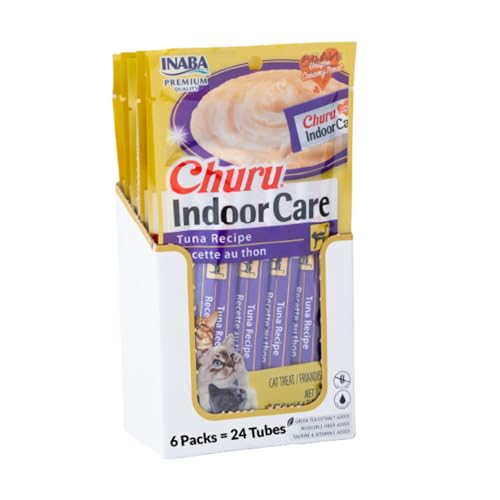
Churu is the lickable puree that turned into a cult item for a reason: cats treat it like dessert, not medicine. This Indoor Care version adds hairball-control function to that same tuna recipe, with taurine and green tea extract on the ingredient panel. You get 24 tubes at 0.5 oz each, and the tube format doubles as a hydration boost because the puree is mostly moisture.
24 Tubes
0.5oz Each
Taurine
Green Tea Extract
Why I picked it
Palatability is the whole ballgame with functional cat products, and INABA Churu has arguably the strongest voluntary-acceptance record of any lickable treat sold in the United States. Adding hairball control to a format cats already beg for removes the compliance problem entirely. The taurine inclusion matters too, since taurine is an essential amino acid that cats cannot synthesize in adequate amounts.
Key specs
- Format: squeezable lickable puree tube, fed straight from the tube or squeezed into a bowl
- Count: 24 tubes, 0.5 oz (14 g) per tube
- Recipe: tuna, positioned for indoor cats
- Functional additions: taurine and green tea extract
- High moisture content, which supports daily water intake
- Grain-free style formulation typical of the Churu line
Real-world experience
The pattern in verified feedback is consistent: owners use these as a daily ritual, often at the same evening moment, and the cat comes running before the foil is torn. Several reviewers with senior cats on medication mention the puree as a delivery vehicle, since a cat that licks eagerly will accept a crushed pill mixed in. Households with a shy second cat report using the tube as a socialization tool, hand-feeding to build trust.
The main recurring gripe is that 0.5 oz disappears in about thirty seconds and cats immediately demand a second tube.
- Near-universal acceptance rate in buyer reports, which makes daily dosing effortless
- High moisture puree adds water intake, useful for cats that ignore the water bowl
- Taurine and green tea extract add nutritional value beyond hairball function
- Individually sealed 0.5 oz tubes travel well and never dry out mid-package
- 24 tubes go fast in a multi-cat home, so the reorder cycle is short
- Function is supportive rather than aggressive, so severe chronic hairballs may still need a gel
- Single tuna recipe leaves no option for cats with a fish sensitivity
- ✔ Your cat is famously picky and rejects everything functional
- ✔ You want extra moisture in the diet alongside hairball support
- ✔ You like a bonding ritual at treat time rather than a chore
- ✖ Your cat has a diagnosed fish or tuna sensitivity
- ✖ You need the cheapest possible per-dose cost for four or more cats
Churu is the pick when your problem is a cat that refuses medicine, not a cat with severe blockages. Against the Laxatone gels it loses on raw lubricating power, but it wins on the metric that actually determines results over 90 days: whether the dose gets taken. Many owners run both, using Churu daily and a petrolatum gel during heavy shedding weeks.
3. Vetoquinol Laxatone Oral Hairball Lubricant Gel
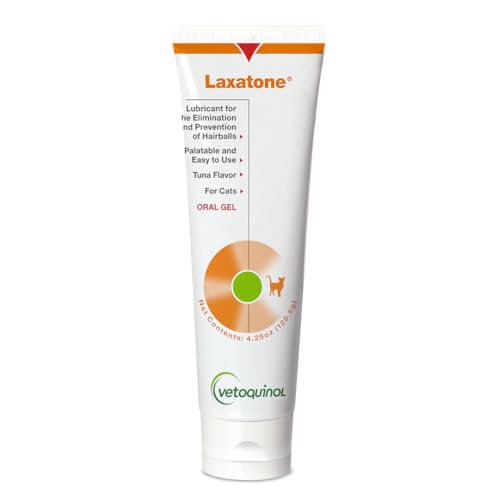
Laxatone is the name most veterinary staff say out loud when a client asks what to buy, and Vetoquinol's tuna-flavored 4.25 oz tube is the classic version. A lubricant laxative is a product that coats swallowed fur so it slides through the digestive tract instead of compacting. That mechanism is old, unglamorous, and genuinely effective.
4.25oz Tube
Tuna Flavor
Oral Lubricant
Vet Recommended
Why I picked it
This is the highest-value acute solution on the list. Buyer reports overwhelmingly describe results within 24 to 48 hours when a cat is straining or repeatedly retching, which no fiber treat can match on speed. Vetoquinol is a veterinary pharmaceutical company rather than a general pet-treat brand, and that shows in the consistency of the formula batch to batch.
Key specs
- Format: oral lubricant gel in a 4.25 oz squeeze tube
- Flavor: tuna, designed to encourage voluntary licking
- Mechanism: lubricates ingested hair for easier passage through the gastrointestinal tract
- Suitable for cats and kittens per label directions
- Typical use pattern: a loading dose for several days, then a maintenance dose two or three times weekly
- Shelf-stable at room temperature, no refrigeration needed
Real-world experience
The recurring story in reviews involves an owner who hears the pre-hairball hacking at 3 a.m. and wants it to stop by the weekend. Owners describe squeezing a strip about the length of a finger joint onto the top of a front paw, letting the cat groom it off, which sidesteps the fight entirely for cats that dislike direct feeding. Long-haired breed owners often keep a tube on hand seasonally, ramping up in spring when shedding peaks.
The most common complaint is texture: some cats detect it in food and abandon the bowl.
- Fastest-acting option here, with most reports of relief inside 24 to 48 hours
- 4.25 oz tube lasts many weeks at maintenance dosing, giving excellent cost per dose
- Backed by Vetoquinol, a veterinary pharmaceutical maker, not a generic treat brand
- Paw-application trick works even with cats that refuse direct oral dosing
- Sticky gel is genuinely messy on fur, furniture, and hands if the cat resists
- A meaningful minority of cats reject the tuna flavor outright
- Petrolatum-based lubricants should not be given at mealtime, since they can interfere with fat-soluble vitamin absorption over time
- ✔ Your cat is actively straining and you want fast relief
- ✔ You want the lowest cost per dose across a long treatment window
- ✔ Your vet already suggested a petrolatum lubricant by name
- ✖ You cannot handle a sticky gel near your cat’s face and paws
- ✖ You want a treat-format product the cat asks for on its own
Treat this as your emergency tube rather than your everyday routine. It outperforms every treat on this list when a hairball is already forming, but daily petrolatum use is not the ideal long-term plan for most cats. The smart combination is a fiber treat for maintenance plus this tube in the cabinet for flare-ups.
4. Tomlyn Laxatone Tuna-Flavored Hairball Remedy Gel
Tomlyn carries the Laxatone name in the same 4.25 oz tuna format, and it is the version many longtime cat owners have used for decades. If you have ever seen a beige tube in a vet clinic retail rack, this is probably it. Buyer sentiment tracks closely with the Vetoquinol listing, which is unsurprising given the shared brand lineage.
4.25oz
Tuna Flavor
Cats & Kittens
Legacy Formula
Why I picked it
Sometimes the right answer is the product your vet clinic has stocked since before you owned a cat. Tomlyn Laxatone earns its place on brand track record and on the fact that it is explicitly labeled for kittens as well as adults, which not every hairball product is. Availability matters too, since having two interchangeable Laxatone listings means you are rarely stuck when one goes out of stock.
Key specs
- Net weight: 4.25 oz gel tube
- Flavor profile: tuna, formulated for voluntary licking
- Labeled for both cats and kittens
- Mechanism: oral lubricant that eases passage of ingested hair
- Dosing: measured strips squeezed onto a finger, paw, or bowl
- Room-temperature storage, screw cap tube
Real-world experience
Owners of multi-cat households often describe a routine where the tube gets passed around at the same time each evening and each cat gets a ribbon of gel on a paw. Kitten owners appreciate the explicit kitten labeling, particularly for long-haired kittens starting to groom heavily around four to six months. A recurring practical note in reviews: warming the tube briefly in a closed hand makes the gel flow more evenly in cold rooms, since it thickens noticeably below room temperature.
The mess factor is the trade-off most people mention.
- Explicitly labeled for kittens, useful for young long-haired cats starting to shed
- Decades-long clinic presence means owners and vets both know the dosing routine
- Same 4.25 oz size as the Vetoquinol tube, so cost per dose stays low
- Tuna flavor gets voluntary licking from a large share of cats
- Gel thickens in cold rooms and becomes harder to squeeze evenly
- Functionally near-identical to the Vetoquinol tube, so there is no unique advantage
- Cats that dislike petrolatum texture will refuse this exactly as they refuse other gels
- ✔ You have a kitten or young cat and want a kitten-labeled product
- ✔ You want the classic clinic-shelf formula in a familiar tube
- ✔ The Vetoquinol listing is out of stock and you need a direct swap
- ✖ Your cat has already rejected a tuna-flavored gel once
- ✖ You store supplies in an unheated garage or porch
Choose between this and the Vetoquinol tube on availability and unit size, not on performance, because in practice they solve the same problem the same way. Where this one earns a slight edge is kitten households. Where it loses to the treats at the top of the list is anything requiring daily, long-term, hands-off compliance.
5. Nutri-Vet Hairball Gel Cats
If your cat turns its nose up at tuna, salmon is the obvious next move, and Nutri-Vet built this 3 oz gel around exactly that. The smaller tube is also the smartest way to test a new flavor without committing to a large tube that ends up in the bin. Nutri-Vet positions its line as veterinarian-formulated companion animal supplements.
Salmon Flavor
3oz Tube
Gel Format
Trial Size
Why I picked it
Flavor rejection is the number one reason a hairball gel fails, and salmon is the single best alternative when tuna has already flopped. The 3 oz size makes this the lowest-risk experiment on the list for a fussy cat. Nutri-Vet's broader supplement line is widely stocked in pet retail, which suggests reasonable quality control and consistent sourcing.
Key specs
- Net weight: 3 oz tube, the smallest gel size in this roundup
- Flavor: salmon, a strong alternative for tuna-averse cats
- Format: lubricating gel for oral administration
- Intended for adult cats as a hairball remedy
- Brand positioning: veterinarian-formulated companion animal supplements
- Compact tube fits in a drawer or travel bag more easily than 4.25 oz tubes
Real-world experience
Reviewers frequently arrive here after a tuna gel failed, and the salmon switch flips the outcome for a meaningful share of them. Common usage notes describe applying a pea-sized amount to the roof of the mouth or a front paw two or three times a week during shedding season. Owners of cats that hunt or spend time outdoors mention using it after periods of heavy self-grooming.
The consistent knock is size: at 3 oz, a multi-cat home runs through a tube quickly, and per-ounce value trails the 4.25 oz options.
- Salmon flavor rescues cats that flatly refused tuna-based gels
- 3 oz tube is a low-waste way to trial a new flavor profile
- Compact size travels well for trips, boarding, or a second household
- Widely stocked brand, so restocking is rarely a problem
- 3 oz is the smallest tube here, so per-ounce value trails the 4.25 oz gels
- Runs out fast in homes with three or more cats
- Same sticky-gel handling issues as every other lubricant on this list
- ✔ Your cat already refused a tuna-flavored hairball gel
- ✔ You have one cat and want a small tube you will finish
- ✔ You need something compact for travel or a cat sitter’s bag
- ✖ You are dosing three or more cats and want maximum tube size
- ✖ Your cat reacts badly to salmon or fish proteins
Buy this specifically as your flavor plan B rather than your first purchase. It beats the Laxatone tubes only on flavor variety and trial size, and it loses on cost per ounce. For a single fussy cat, though, a small tube the cat actually accepts is worth far more than a large tube it ignores.
6. SENTRY PET CARE Hairball Relief Cats
Malt is the flavor cats have been offered for hairball remedies in Europe for generations, and SENTRY brings that profile to a generous 4.4 oz tube. If tuna and salmon have both failed, a malt-flavored paste is a genuinely different taste category worth trying. It is also the largest tube in this lineup.
Malt Flavor
4.4oz
Largest Tube
Fish-Free Flavor
Why I picked it
This is the fish-free escape hatch. Cats with fish sensitivities, or households where a cat has simply burned out on tuna, need a different flavor axis, and malt is the classic one. At 4.4 oz it also delivers the most product per tube of anything here, which matters when you are dosing two or three cats on a schedule.
Key specs
- Net weight: 4.4 oz, the largest tube in this roundup
- Flavor: malt, a fish-free alternative
- Format: oral paste-style gel for hairball relief
- Application: direct feeding, paw application, or mixed onto food
- Suited to routine maintenance dosing during shedding season
- Widely available in general pet retail as well as online
Real-world experience
The most useful pattern in reviews comes from owners of cats with food sensitivities who had run out of options among fish-flavored gels. Several describe a two-week transition where the cat sniffs, retreats, then accepts by day three or four, which is normal for a novel flavor. Owners in dry winter climates report using it more often between November and March, when indoor heating drives up shedding.
The split verdict on flavor is real: cats that love malt love it, and cats that do not will walk away without a second look.
- Malt flavor is fish-free, opening a path for cats with fish sensitivities
- 4.4 oz is the largest tube here, best suited to two- and three-cat homes
- Familiar paste format that mixes into wet food when direct dosing fails
- Easy to find in physical stores if you run out mid-week
- Malt is polarizing, with a clear split between cats that accept and refuse it
- Novel flavor often needs a three to four day adjustment period
- Purely a lubricant, so it adds no fiber, omega-3, or coat support
- ✔ Your cat has a fish sensitivity and needs a non-fish flavor
- ✔ You are dosing two or three cats and want the biggest tube
- ✔ You want a product you can also grab locally in a pinch
- ✖ Your cat already devours tuna gels without any argument
- ✖ You want fiber and omega-3 support, not lubrication alone
This is the tube to reach for when flavor, not mechanism, is the blocker. Against the Laxatone options it offers nothing extra chemically, but malt solves a problem no fish-flavored product can. If your cat happily takes tuna, there is no reason to switch, and the treats higher on this list still cover long-term maintenance better.
7. AmeizPet Hairball Remedy Cats
Beef is the flavor almost nobody offers in this category, which is exactly why AmeizPet earns a spot. Cats that have rejected tuna, salmon, and malt still have one untried option, and this 4.23 oz (120 g) tube is it. For carnivore-leaning cats raised on poultry and red-meat wet food, the fish aversion is more common than people expect.
Beef Flavour
120g Tube
Fish-Free
Paste Format
Why I picked it
Flavor coverage is a legitimate selection criterion, and beef fills the last remaining gap on this list. When an owner has already burned through three tubes their cat refused, the fourth flavor category is worth more than another marginal formula tweak. The 4.23 oz (120 g) size also puts it in the same value bracket as the big Laxatone tubes rather than the small trial sizes.
Key specs
- Net weight: 4.23 oz (120 g) tube
- Flavor: beef, the only red-meat option in this roundup
- Format: squeezable hairball paste for oral administration
- Fish-free, useful for cats with seafood sensitivities
- Comparable tube size to the 4.25 oz Laxatone options
- Metric labeling reflects a broader international product line
Real-world experience
The buyer profile here skews toward owners doing flavor triage after multiple failures, and beef converts a good number of those holdouts. Reviewers describe cats that ignore anything smelling of fish but come running for the beef paste, particularly cats fed a poultry or beef-based wet diet. Because AmeizPet is a newer name than Tomlyn or SENTRY, the review pool is smaller and long-term feedback is thinner, so there is less data on year-over-year consistency.
Owners generally report smooth extrusion from the tube at normal room temperature.
- Only beef-flavored option here, which converts cats that reject fish and malt
- 4.23 oz (120 g) tube matches the large Laxatone tubes on quantity
- Fish-free formulation suits cats with seafood sensitivities
- Extrudes smoothly at room temperature per buyer reports, less squeezing effort
- Smaller review pool than legacy brands, so long-term consistency data is limited
- Beef aroma is stronger than fish gels for some owners, noticeable on hands
- Lubricant only, with no added fiber or omega-3 for coat support
- ✔ Your cat has already refused tuna, salmon, and malt versions
- ✔ Your cat eats a beef or poultry-based wet food and prefers red meat
- ✔ You want a large tube without a fish ingredient
- ✖ You want a brand with a decades-long clinic track record
- ✖ Your cat has a beef protein sensitivity
Think of the gels on this list as a flavor ladder: tuna, then salmon, then malt, then beef. This is the last rung, and for a stubborn cat it may be the only rung that works. It does not beat Laxatone on pedigree or data depth, so it is a targeted purchase rather than a default first choice.
8. Cat Hairball Remedy Treats
This is the same dual-texture treat that topped the list, scaled up to a 90-day supply. If your cat has already given the 30-day container a thumbs up, buying three months at once is the obvious next move. Hairball control is a maintenance job, not a one-week fix, so the larger container fits how the product is actually meant to be used.
90-Day Supply
Dual Texture
Fiber + Fish Oil
Bulk Value
Why I picked it
Hairball prevention only shows real results across months, not days, and the 90-day container removes the biggest failure mode: running out and never reordering. It carries the identical crunchy-creamy format and the same fiber plus fish oil profile as the 30-day version. For a household that has confirmed acceptance, this is simply the better buy per serving.
Key specs
- Supply: 90-day supply, three times the 30-day container
- Format: dual texture, crunchy outer shell with creamy center
- Support: dietary fiber for digestive transit, fish oil for omega-3s
- Targets hairball control, skin and coat, and digestion together
- Designed for indoor adult cats
- Single container reduces packaging waste versus three separate tubs
Real-world experience
The households that benefit most are the ones running a fixed daily routine, one treat with breakfast, every day, no exceptions. Verified buyers who moved up from the 30-day size commonly mention that the reduced reorder frequency is what kept them consistent through a full shedding cycle. Long-haired cat owners in spring and fall, when coat turnover peaks, get the most obvious payoff from uninterrupted supply.
The practical caution is storage: a three-month container needs an airtight seal and a cool, dry cupboard to keep the creamy centers from drying out.
- 90-day supply covers a full shedding season without a reorder gap
- Identical dual-texture formula to the top pick, so acceptance carries over
- Better cost per serving than buying three 30-day containers
- Fiber and fish oil combination handles digestion and coat in one daily treat
- Risky first purchase, since a rejected flavor means three months of wasted product
- Requires airtight storage to protect the creamy centers over 90 days
- Still a preventive treat, so it will not resolve an acute hairball episode quickly
- ✔ Your cat already accepted the 30-day version happily
- ✔ You want to lock in a full season of daily prevention
- ✔ You forget to reorder supplements and want a longer runway
- ✖ This is your first attempt and you have not confirmed acceptance
- ✖ You have limited dry, cool storage space in the kitchen
The sequencing here matters more than the product. Start with the 30-day container to confirm your cat eats it, then move to this one for the long haul. Buying 90 days up front is the single most common way owners waste money in this category, and it is entirely avoidable.
9. Cat Hairball Remedy Lickable Treats
Some cats will not touch anything crunchy, especially seniors with dental disease or missing teeth. This salmon puree in 20 squeezable pouches delivers the same fiber and fish oil support in a format that requires zero chewing. It sits between a Churu-style lickable and a functional supplement.
20 Pouches
Salmon Puree
No Chewing
Fiber + Fish Oil
Why I picked it
Dental health is the quiet reason many hairball products fail in older cats. Feline odontoclastic resorptive lesions and periodontal disease are common in cats over seven years old, and a crunchy treat becomes a painful ask. A squeezable puree sidesteps that completely while still delivering fiber for transit and fish oil for coat condition.
Key specs
- Count: 20 squeezable puree pouches per box
- Flavor: salmon
- Format: lickable puree, no chewing required
- Functional ingredients: dietary fiber plus fish oil
- Claimed benefits: hairball control, skin and coat, digestion
- Single-serve pouches keep each dose fresh and portioned
Real-world experience
Senior cat households drive most of the positive feedback, particularly owners managing a cat that had teeth extracted and can no longer manage kibble-style treats. Reviewers also mention using the pouch as a distraction during nail trims or a post-vet-visit peace offering, squeezing it onto a lick mat. Cats recovering from illness with poor appetite often take a puree when they refuse solid food, which makes this useful beyond hairballs.
The obvious limitation is quantity: 20 pouches at one per day is roughly a three-week run.
- No chewing required, ideal for seniors with dental disease or extracted teeth
- Salmon puree wins over cats that reject dry textures and crunchy treats
- Fiber plus fish oil gives functional value beyond a plain lickable snack
- Single-serve pouches keep dosing precise and prevent spoilage
- 20 pouches lasts roughly three weeks at one per day, shorter than the treat tubs
- More packaging waste than a single container of treats
- Salmon only, so fish-sensitive cats are out of luck
- ✔ Your cat is a senior with dental issues or missing teeth
- ✔ You use a lick mat for grooming, nail trims, or vet-day stress
- ✔ Your cat prefers wet textures and ignores anything crunchy
- ✖ You want the longest possible supply from one purchase
- ✖ You are trying to cut down on single-use packaging
Against INABA Churu, this trades a little palatability reputation for a more targeted hairball formula with added fiber. Choose it when your cat is older, has dental limitations, or simply refuses crunchy textures. Choose Churu instead if raw acceptance in an extremely picky cat is the only thing you care about.
10. Tomlyn Laxatone Catnip-Flavored Hairball Remedy Gel
Catnip is a clever trick here: instead of relying on a food flavor, this 4.25 oz Laxatone leans on nepetalactone, the compound in Nepeta cataria that triggers the classic catnip response in roughly two thirds of adult cats. If your cat rolls around on a catnip toy, this is worth a shot. Same proven gel, completely different persuasion strategy.
Catnip Flavor
4.25oz
Fish-Free
Proven Formula
Why I picked it
Catnip responsiveness is genetically determined, and cats that have it respond strongly. That gives this version a real acceptance advantage in a specific subset of cats where fish and malt both failed. It is the same Laxatone lubricant base in the same 4.25 oz tube, so you lose nothing on mechanism by choosing it.
Key specs
- Net weight: 4.25 oz tube
- Flavor: catnip, appealing to catnip-responsive cats
- Fish-free flavor profile
- Mechanism: oral lubricant gel that eases passage of ingested hair
- Same tube size and format as the tuna Laxatone version
- Room-temperature storage with a resealable cap
Real-world experience
The most telling reports come from owners whose cats sprint across the room when a catnip toy comes out, and those same cats often accept this gel without hesitation. It is also popular in homes with a cat that dislikes strong fish odors, since the aroma is herbal rather than marine. The flip side is well documented: catnip response is absent in a substantial minority of cats, and kittens under roughly six months typically show no reaction at all, so this version simply falls flat for them.
Owners frequently pair it with a catnip-filled brush toy to make grooming sessions easier.
- Catnip appeal converts cats that ignore every food-flavored gel
- Same proven Laxatone lubricant base and 4.25 oz tube size
- Herbal aroma is far less offensive to owners than fish gels
- Fish-free, so it suits cats with seafood sensitivities
- Useless for the substantial minority of cats that do not respond to catnip
- Kittens under about six months typically show no catnip response yet
- Some catnip-sensitive cats get overstimulated, which complicates calm dosing
- ✔ Your cat goes wild for catnip toys and sprays
- ✔ You hate the smell of fish-flavored gels in your kitchen
- ✔ You want the Laxatone formula without a seafood ingredient
- ✖ Your cat has never reacted to catnip in any form
- ✖ You are dosing a kitten under six months old
This is a binary bet: if your cat is catnip-responsive it may be the easiest gel you ever dose, and if not, the tuna version is the safer buy. Test the response with a catnip toy before ordering. It beats the beef and malt options on brand pedigree, and loses to the treats on long-term daily convenience.
How I picked
I did not administer these products to cats. What I did was build a comparison framework from label data, manufacturer product pages, published feline health guidance, and a structured read of verified buyer reviews across all ten listings. Here is exactly what went into the ranking.
Three benchmarks drove the scores:
- Mechanism clarity. Does the product lubricate (petrolatum-based gels), add fiber to move fur through the gut (functional treats), or combine both? Products with a vague "supports hairball control" claim and no identifiable active ranked lower than ones naming fiber, fish oil, or a lubricant base.
- Voluntary acceptance. I counted how often reviewers described the cat eating the product without force. This is the highest-weighted factor, because a remedy the cat refuses has an effective success rate of zero.
- Practical cost per dose. Not the sticker figure, but how many days of dosing you get: a 4.25 oz gel tube at maintenance frequency versus a 30-day treat container versus 20 single-serve pouches.
I also looked at flavor coverage on purpose. Tuna, salmon, malt, beef, and catnip are five genuinely different taste categories, and a list that offered only tuna would fail a large share of readers. That is why four gels appear here despite similar mechanisms.
What I deliberately did not evaluate:
- Long-term safety beyond what labels and general veterinary guidance state. Chronic daily petrolatum use is a conversation for your vet, not a blog.
- Clinical efficacy in cats with confirmed gastrointestinal disease. Frequent vomiting can signal inflammatory bowel disease, food allergy, or a partial obstruction, and no over-the-counter product substitutes for a diagnosis.
- Batch-to-batch ingredient variation, which is not something anyone can assess from listings alone.
- Palatability for kittens under 12 weeks, since most of these products target adult cats.
One more filter: I gave weight to brands with veterinary distribution history, like Tomlyn and Vetoquinol, and to manufacturers with a published ingredient rationale. The U.S. Food and Drug Administration regulates pet food and treat labeling through its Center for Veterinary Medicine, which is why label claims are a useful, if imperfect, signal.
Buying guide — what actually matters for best cat hairball remedy
A hairball, technically a trichobezoar, is a compacted mass of swallowed fur that a cat expels because it cannot pass through the digestive tract. Everything below is about picking the tool that fits your specific cat.
Should you choose a lubricant gel or a fiber treat?
Choose a lubricant gel for fast relief when a hairball is already forming, and a fiber treat for daily prevention over months. Gels coat the fur so it slides through, with most buyer reports describing results in 24 to 48 hours. Fiber treats work slowly by improving overall gut transit, which is why owners usually notice fewer episodes after two to four weeks rather than overnight.
Plenty of households run both. Gel in the cabinet for flare-ups, treat with breakfast every day.
How much does flavor actually matter?
More than the formula does. Across the ten products here, the biggest single predictor of a bad review is flavor rejection, not ingredient quality.
Your flavor ladder, in the order most owners work through it:
| Flavor | Best for | Found in |
|---|---|---|
| Tuna | First attempt, most widely accepted | Laxatone gels, INABA Churu |
| Salmon | Cats that refused tuna | Nutri-Vet gel, lickable puree pouches |
| Malt | Fish-sensitive cats | SENTRY Hairball Relief |
| Beef | Red-meat-preferring cats | AmeizPet paste |
| Catnip | Catnip-responsive cats | Tomlyn Laxatone Catnip |
If you prioritize a proven brand, you may sacrifice flavor options. If you prioritize flavor variety, you may end up with a newer brand and a thinner review history.
Does format matter for older cats?
Yes, and it is the factor most people overlook. Dental disease is common in cats over seven, and a crunchy treat can be genuinely uncomfortable for a cat with resorptive lesions or extracted teeth.
For those cats, a lickable puree pouch or a gel is the practical choice. For a healthy adult cat with good teeth, the dual-texture treat format usually wins on convenience.
How long should a container last?
Match the supply size to how long you plan to dose. A 4.25 oz gel tube at two or three doses per week can run several weeks for one cat. A 30-day treat container covers one month exactly.
A 90-day container covers a full seasonal shedding cycle. Twenty single-serve pouches at one per day is about three weeks.
Buy small first, confirm your cat eats it, then scale up. That single rule prevents most wasted purchases in this category.
What should you pair the remedy with?
No supplement beats reducing the fur that gets swallowed in the first place. A slicker brush or a de-shedding comb used two or three times weekly removes loose undercoat before your cat can groom it down. Adding moisture helps too, since better hydration supports gut motility.
Long-haired breeds like Maine Coon, Persian, and Ragdoll need the most brushing attention. A five-minute daily session during spring and fall coat turnover does more than any tube in your cupboard.
When is it a vet visit instead of a product?
Frequent hacking without producing a hairball, repeated vomiting more than once or twice a month, appetite loss, lethargy, or constipation all warrant a veterinary exam. Those signs overlap with asthma, inflammatory bowel disease, food allergy, and partial obstruction. The American Veterinary Medical Association is a solid starting point for general pet health guidance, but an in-person exam is what actually rules things out.
Frequently Asked Questions (FAQ)
How often should I give my cat a hairball remedy?
Most lubricant gels follow a two-phase schedule: a daily loading dose for the first three to five days, then a maintenance dose two or three times per week. Fiber-based treats are typically given once daily, every day, as ongoing prevention. Always follow the specific label directions, since dosing is tied to the concentration of the formula.
For seasonal shedders, many owners increase frequency in spring and fall and taper off during winter.
Is a hairball treat worth it if my cat only coughs one up occasionally?
If your cat produces a hairball once every few months, that falls within what most veterinarians consider normal for a grooming animal, and daily supplementation may be unnecessary. Regular brushing is usually enough. A daily fiber treat becomes worthwhile once episodes hit roughly one or more per month, or if your cat is a long-haired breed heading into shedding season.
The treat format also adds omega-3 fish oil for coat condition, so some owners use it for that alone.
How does a lickable puree compare to a gel tube?
They differ in speed and acceptance rather than in overall value. Petrolatum gels lubricate directly and act faster on an existing hairball, with most reports describing relief in one to two days. Lickable purees like INABA Churu work through fiber and moisture, so they support prevention rather than acute relief, but acceptance rates are far higher.
If your cat fights the gel, the puree that gets consumed will outperform the gel that ends up on the wall.
Will hairball remedies work for long-haired breeds like Maine Coons?
Yes, though long-haired cats generally need a more consistent routine than short-haired ones. Maine Coon, Persian, and Ragdoll cats swallow substantially more fur during grooming, so daily fiber treats plus a lubricant gel during heavy shedding weeks is the combination most owners of these breeds report using. Brushing two or three times weekly with a de-shedding tool matters just as much as the supplement.
Expect to see improvement over two to four weeks, not two to four days.
Can I give a hairball remedy with my cat's food?
Fiber treats can be given right alongside meals without issue, which is why the treat format works so well for daily routines. Petrolatum-based lubricant gels are a different story: they are generally recommended between meals, because giving them with food may interfere with absorption of fat-soluble vitamins over the long term. Many owners apply gel to a front paw an hour after breakfast so the cat grooms it off voluntarily.
If your cat is on medication or a prescription diet, check with your veterinarian first.
What's the warranty or satisfaction story on these?
Consumable pet supplements do not carry warranties in the traditional sense, but most of the manufacturers here operate through Amazon's standard return policy, and several brands publish satisfaction guarantees on their own websites. The bigger practical protection is buying the smallest size first. A 30-day container or a 3 oz tube limits your exposure if your cat refuses the flavor, which is by far the most common reason people want a refund in this category.
Final verdict
The Cat Hairball Remedy Treats take the top spot because they solve the problem that sinks every other product: getting your cat to take the dose willingly, day after day, while delivering fiber and omega-3 fish oil in one bite. If you need fast relief for a hairball that is already forming, the Vetoquinol Laxatone gel is the better tool and the best value per dose. For an extremely picky cat, INABA Churu Indoor Care is the easiest win on this list.
Affiliate disclosure: This post contains affiliate links. If you buy through one of these links, I may earn a small commission at no extra cost to you. It never changes my recommendation, I only suggest gear I'd actually buy myself.