A dog snout wipe routine after outdoor play is for loose dirt, grass, sand, pollen, damp mud, or sticky surface debris on the outside of a dog's snout. It is not for cleaning inside the nostrils, mouth, eyes, ears, or wounds, and it is not a way to treat allergy signs, nasal discharge, injury, or unknown chemical exposure.
Debris-Type Flowchart
What you see Routine action Stop boundary
Dry dust or sand on outside fur Brush off with a dry towel, then wipe if needed Stop if eyes, nostrils, mouth, or wounds are involved
Damp mud on outside snout Use a barely damp cloth on outside fur, then dry Stop for pain, swelling, bleeding, or distress
Grass bits Lift loose pieces from surface fur only Stop for embedded-object concern
Sticky food-like debris Soften surface hair with a damp cloth and wipe gently Stop if it will not release without pulling
Unknown substance Do not groom it as routine debris Contact a vet/pro or poison-control resource as appropriate
How To Read The Flowchart In Real Life
In practice, the hardest call is not "mud versus sand" — it is deciding whether something is ordinary outdoor dirt or an unknown substance. A useful field test is to ask three questions before the cloth touches the dog: Do I know where it came from? Does it smell like anything (fuel, solvent, chemical sweetness, rot)? Is it stuck to the hair rather than sitting on it? If the answer to the first question is no, or the answer to either of the others is yes, the debris leaves the routine category immediately and becomes a call-someone situation. The American Veterinary Medical Association and the ASPCA Animal Poison Control Center both maintain owner-facing guidance for suspected toxin exposure, and the AVMA's public resources are a sensible first stop when you are unsure whether something warrants a phone call.
A second real-life nuance: debris often changes category while you are working on it. Dry sand that seemed harmless can reveal a small scrape underneath once brushed away; a "grass bit" can turn out to be a grass awn with a barbed tip. The routine is not a commitment — the moment the picture changes, you stop, step back, and reassess rather than finishing what you started.
Outside-Only Wipe Map
Wipe the bridge and sides of the snout from the outside, moving away from the eyes and nostrils. Keep the cloth flat and visible. Do not poke into nostrils, swipe across the eye, open the mouth, or chase debris that has moved into an opening.
Zone-By-Zone Detail
Thinking of the snout as four outside zones makes the map easier to follow without ever drifting toward an opening:
- Bridge (top of the muzzle): the safest zone. Wipe front-to-back, from just below the eyes toward the forehead, so the stroke direction always moves away from the eye.
- Sides (cheeks and whisker beds): wipe downward and backward. Support the jaw lightly with your other hand so the dog is not pushed off balance.
- Lip fold and chin (outside surface only): short, blotting dabs rather than long drags. Never lift or open the lip to clean under it as part of a routine wipe.
- Nose leather rim (outside edge only): the very outer edge of the nose pad may be blotted if mud is sitting on it, but the cloth stays flat and never enters or presses into a nostril.
A common mistake is working too fast on the side zones because they look forgiving. Whisker beds are richly innervated, and a hard scrub there is one of the quickest ways to teach a dog that face handling is unpleasant. Slow, light passes with a flat cloth do more in three strokes than scrubbing does in ten.
What You Need For The Routine
You do not need specialty products for this — you need a few clean, dedicated items kept where you actually stop after walks:
- Two soft cloths: one dry, one barely damp. Microfibre and plain cotton flannel both work; avoid anything with a scrubby or textured side.
- Plain lukewarm water. Water alone handles the overwhelming majority of routine outdoor dirt. If you use a commercial pet wipe, choose an unscented, alcohol-free, fragrance-free product and still keep it away from the eyes, nostrils, and mouth.
- A dry towel for the final blot, because leaving moisture in facial folds is a bigger problem than the original dirt.
- A treat pouch or a few high-value pieces of food for dogs who are still learning that face handling ends well.
Keeping these in one place matters more than the brand you buy. If you already maintain an everyday supply caddy, add a labelled "face cloths only" pouch to it so snout cloths never get mixed with paw cloths. Many households find the whole after-play sequence smoother when the wipe-down happens next to a dedicated cleanup spot by the door, where towels, water, and treats are already within reach.
Set your kit up once this week — a single hook, two cloths, and a treat jar by the door removes the main excuse for skipping the routine on cold, muddy evenings.
Wipe Material Comparison
| Option | Best for | Watch out for | Notes |
|---|---|---|---|
| Dry soft cloth or towel | Dust, dry sand, dried pollen film | Rubbing hard on gritty debris can abrade skin | Always the first attempt; adds no moisture to manage |
| Barely damp cotton or microfibre cloth | Damp mud, dried-on dirt, sap-free sticky residue | Over-wetting; leaving folds damp | Wring until no drips; follow with a dry blot |
| Unscented, alcohol-free pet wipe | Travel and car use | Fragrance, alcohol, and "antibacterial" additives near the face | Convenient, not superior; still outside surfaces only |
| Baby wipe | Not recommended as a default | Fragrance and preservatives formulated for human skin | Use only if a vet has specifically approved a product |
| Warm water compress (held, not scrubbed) | Softening dried debris before wiping | Holding too long on an anxious dog | 10–20 seconds is usually enough to loosen crust |
| Human shampoo, dish soap, disinfectant wipes | Never for the face | Irritation, ingestion risk, eye contact | Not part of any routine snout wipe |
Two honest trade-offs worth naming. First, wipes are convenient but produce more waste and cost more per use than a rinsed cloth, and their solutions are the most common cause of face-wipe irritation reports owners describe. Second, damp cloths clean better but create a drying obligation — if you are not going to blot afterwards, stay dry.
Quick Routine
Look first, before wiping.
Identify whether the debris is ordinary outdoor dirt or an unknown substance.
Use a dry or lightly damp cloth on outside fur only.
Wipe away from the eyes, nostrils, and mouth.
Dry the area if you used moisture, especially near folds.
Stop if the dog pulls away repeatedly or shows pain.
The Sixty-Second Version, Step By Step
For a dog who already tolerates face handling, the whole thing should take under a minute:
- Position (5 seconds). Kneel or sit beside the dog rather than looming over the head. Approach from the side, not straight down the muzzle.
- Inspect (10 seconds). Look at the bridge, both sides, the lip line, and the outer nose rim in good light. Note anything stuck, any redness, and any asymmetry.
- Dry pass (15 seconds). Lift loose material with a dry cloth first. Most dust, sand, and dried pollen leaves at this stage.
- Damp pass, only if needed (15 seconds). Two or three flat strokes per zone, always angled away from openings.
- Blot dry (10 seconds). Press, do not rub. Pay particular attention to any fold under or beside the nose.
- Release and reward (5 seconds). End on a treat and a clear "all done" cue so the dog learns the routine has a predictable finish.
If the dog is still learning, split those steps across several short sessions instead of pushing through one long one. The same principle that makes short pauses during nail work effective applies here: end while the dog is still comfortable, not after the point where they resist.
Building Tolerance For Face Handling
The snout is the most sensitive area most owners will ever ask to touch, and a dog who dislikes it will remember. A simple desensitisation ladder, done in one-minute sessions over a couple of weeks, works better than any technique change:
- Stage 1: Show the folded cloth, feed a treat, put it away. Repeat until the cloth predicts food.
- Stage 2: Touch the cloth to the cheek for one second, treat, stop.
- Stage 3: One slow stroke on the bridge, treat, stop.
- Stage 4: Two zones per session, then the full map.
Consent signals matter. If your dog turns the head away, stiffens, licks the lips repeatedly, or steps back, that is a request to pause — honour it and drop back a stage. Dogs who are broadly worried about grooming equipment often improve faster when the whole home routine is calmer, which is why owners of sound-sensitive dogs tend to see face handling improve once the noisier parts of grooming stop being a battle.
Coat And Muzzle Type Matters
The same routine gets adjusted depending on what is in front of you:
- Flat-faced (brachycephalic) breeds — Pugs, Bulldogs, Boston Terriers, Frenchies. The nose rope and facial folds trap moisture and debris and need a careful dry blot every single time you use a damp cloth. Never dig into a fold to clean it as part of a routine; persistent redness, odour, or discharge in a fold is a veterinary matter, not a grooming one.
- Long-muzzled, short-coated breeds — Greyhounds, Dobermans, Pointers. Easiest to wipe, but thin coat over the bridge means light pressure only; grit under a dry cloth can graze the skin.
- Bearded and wire-coated breeds — Schnauzers, Terriers, Doodle crosses. Muzzle hair holds mud, food, and burrs. Comb the beard hair downward with fingers before wiping, and dry thoroughly; a damp beard is where odour starts.
- Heavy double coats — Huskies, Shepherds, Retrievers. Debris tends to sit on the topcoat and shakes free easily, but snow and ice balls can stick to muzzle guard hairs in winter.
If you are not sure how often the rest of the face and body need attention, matching your habits to what your dog's coat actually demands is more useful than following a fixed weekly calendar.
Seasonal Adjustments
Spring and early summer (pollen and awns). Pollen forms a fine film on muzzle hair and is often carried straight to the eyes when a dog rubs its face on furniture. A dry-cloth pass after every outing is genuinely worth it in high-count weeks, and the broader habits used for managing coats through high-pollen weeks apply to the face as well. This is also foxtail and grass-awn season in much of the country — anything spear-shaped near the nose, lip, or eye is a stop-and-call situation, never a pull-it-out situation.
Summer (sand, sap, and heat). Beach sand abrades skin under a dry cloth, so shake and brush before wiping. Tree sap is sticky debris that frequently fails the "will it release without pulling" test; if it does not lift, leave it for a groomer to trim out.
Autumn (mud and leaf litter). Peak damp-mud season. Use the damp-cloth-then-blot sequence, and pay attention to the underside of the jaw where mud splashes collect.
Winter (salt, grit, and ice). Dogs pick up de-icing residue on the muzzle by sniffing the pavement, not just on the paws. Wipe the snout first — before the dog has a chance to lick it — and treat any suspected chemical de-icer as an unknown substance rather than routine dirt. The same after-walk discipline that owners use for paws exposed to road salt belongs on the face too. Municipal and university extension services publish seasonal pet-safety guidance each winter; a general-purpose overview from a land-grant programme such as university extension outreach is a reliable, non-commercial place to check current advice.
Common Mistakes To Avoid
- Wiping toward the eyes. Every stroke should end further from an opening than it started.
- Using a scented or "antibacterial" wipe. Fragrance and alcohol near the nose are irritating and unnecessary.
- Chasing debris that has entered an opening. Once it is inside a nostril, lip, or eye, it is no longer a grooming task.
- Leaving folds damp. This is the single most common cause of a mild after-play wipe turning into a smell-and-redness problem days later.
- Scrubbing dried mud instead of softening it. A 10–20 second warm compress does the work without abrading skin.
- Reusing yesterday's cloth. A cloth that dried stiff with mud in it is a scouring pad.
- Doing it while the dog is still over-aroused. Give a few minutes of decompression after play; a panting, wriggling dog makes precise wiping impossible.
- Ignoring what the inspection told you. The look-first step is not a formality — a small scrape, a new lump, or a chipped tooth spotted at the muzzle is worth acting on.
Fitting It Into The Wider After-Play Check
The snout wipe works best as one item in a short post-outing sweep rather than a standalone ritual. A practical order after muddy play: paws first (they carry the most contamination indoors), then the snout, then a quick run of the hands over the legs and belly for burrs and ticks. Paws deserve their own attention because grit lodges between the pads, and many owners already do an evening once-over as standard. If the paws needed water rather than a dry brush, the same press-don't-rub blotting technique used after a bath keeps moisture from sitting between the toes.
Cloth hygiene is the part most routines skip. Wash face cloths separately from paw cloths, on a hot wash, without fabric softener — softener leaves a residue that reduces absorbency and can irritate skin. Rinse and air-dry any cloth you plan to reuse the same day rather than dropping it damp into a basket. Tools follow the same logic: the habits that keep combs and slicker heads genuinely clean apply just as much to the humble cloth you use on a face.
If your dog also needs regular body grooming, the wipe routine slots naturally in front of it, and the general sequencing advice for doing the whole job yourself will tell you where to put it in a longer session.
Stop and Call a Vet or Pro
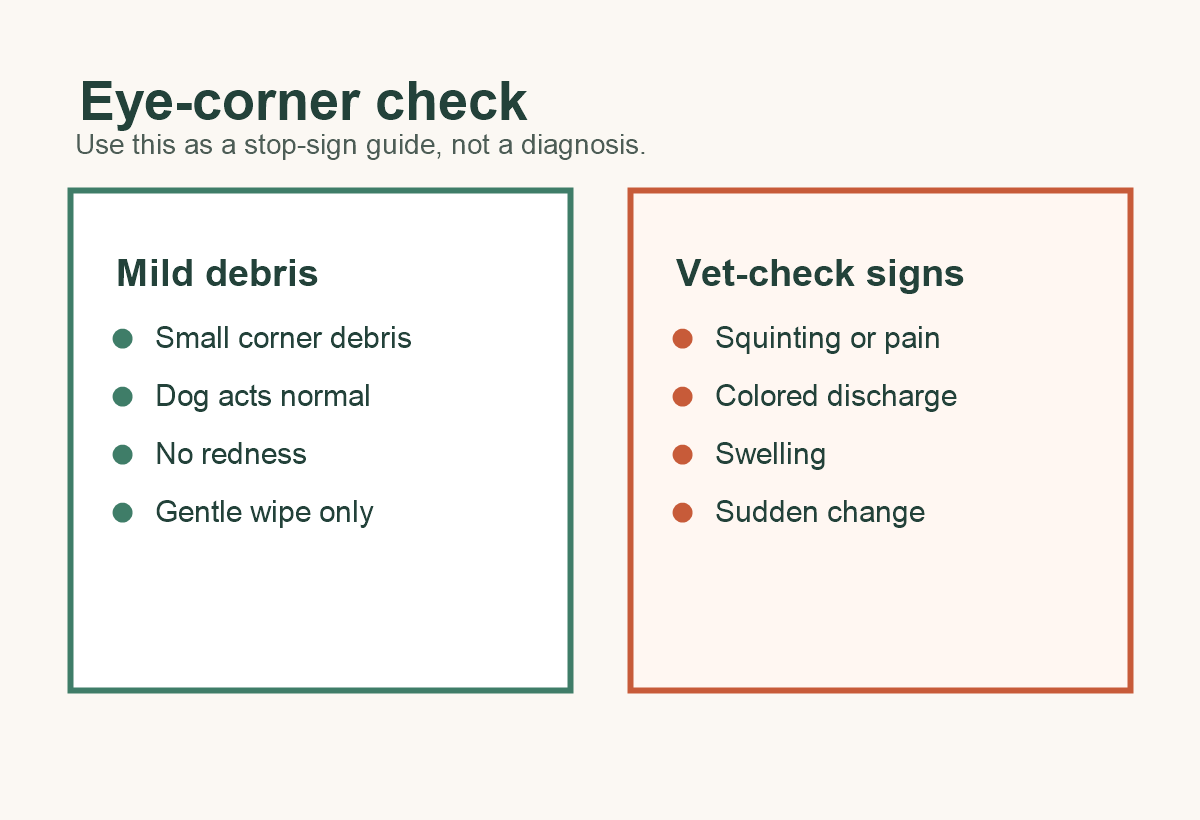
Stop for eye involvement, nose bleeding, mouth injury, unknown chemical exposure, embedded-object concern, foxtail concern, redness, swelling, pain, discharge, bad odor, breathing trouble, repeated distress, behavior change, or worsening symptoms. Do not use home remedies or attempt medical removal at home.
Urgency Guide
Not every stop signal carries the same clock. As a rough triage, without replacing veterinary judgement:
| Situation | Typical urgency |
|---|---|
| Suspected toxin, chemical, or plant ingestion or contact | Call immediately — poison control or an emergency clinic |
| Breathing difficulty, collapse, facial swelling that is spreading | Emergency, same hour |
| Bleeding from the nose, eye injury, suspected grass awn near the eye or nostril | Same-day veterinary appointment |
| Persistent pawing or rubbing at the face, repeated violent sneezing | Same-day if it does not settle within an hour |
| Fold redness, mild odour, small scab, dry cracked nose | Routine appointment; note when it started |
| Debris a groomer would need to trim out | Book a grooming appointment; do not cut near the face at home |
Before you call, it helps to have three things ready: what the dog was doing and where, what you saw and when, and what you already did (dry cloth, damp cloth, any product used). Photographing the area in good light before you touch anything gives the vet a useful baseline, especially for swelling that changes over hours.
FAQ
Can I wipe inside my dog's nose?
No. This routine is outside snout fur and skin only.
What if the debris is near the eye?
Do not wipe the eye surface or remove embedded debris. Stop and contact a veterinarian if the eye is red, painful, watery, injured, or involved.
Can I use this after the dog park?
Yes, for routine outside snout dirt. For whole-body cleanup, pair it with a broader after-dog-park routine.
How often should I do a snout wipe?
After any outing that leaves visible debris on the muzzle. For most dogs that means after muddy, sandy, or dusty walks, daily during peak pollen weeks, and after every winter walk on treated pavement. There is no benefit to wiping a clean, dry snout "just because" — unnecessary handling of a sensitive area costs tolerance you may want later.
Are baby wipes safe for a dog's face?
They are not a good default. Baby wipes are formulated for human skin and commonly contain fragrance and preservatives you would not choose to put next to a dog's nostrils and mouth. Plain water on a soft cloth is the safer everyday option; if you want a wipe for convenience, choose an unscented, alcohol-free pet-specific product and keep it off the eyes, nostrils, and mouth.
Can I use dog shampoo on the snout?
Not as part of this routine. Shampoo near the face creates a real risk of eye contact and ingestion, and rinsing it thoroughly on a muzzle without getting water into the nose is difficult. Face shampooing is a bath-time task with careful technique, and it is one of the areas where the errors owners most often make at bath time show up.
My dog's nose looks dry and crusty after outdoor play — is that a wipe issue?
No. A persistently dry, cracked, thickened, or crusting nose is a skin and health question, not a debris question. Wipe away any surface dirt gently, then have it looked at rather than applying balms, oils, or home remedies to something you have not had diagnosed.
What if my dog hates having its face touched?
Stop trying to complete the wipe and start building tolerance instead. Work the desensitisation ladder above in one-minute sessions, keep every session shorter than the dog's patience, and pair the cloth with food. Forcing a face wipe reliably makes the next one harder. If a dog is genuinely fearful rather than just fidgety, a vet or a qualified behaviour professional is the right next call.
Should I wipe the snout before or after the paws?
Paws first in most cases, because they track the most contamination through the house and because dogs are usually more settled about paw handling than face handling. Ending on the snout also lets you finish with the calmest, shortest step and a reward.
Do puppies need a different approach?
The technique is identical, but the goals differ: for a puppy, the point of the routine is as much about building a lifetime of easy face handling as it is about the dirt. Keep sessions very short, very rewarding, and stop early. Puppies who learn that cloths, hands near the muzzle, and the end-of-walk pause are all predictable and pleasant become dramatically easier adults.
Can grooming wipes replace bathing?
No. A snout wipe manages surface debris in a small area between baths and grooms. It does not clean the coat, does not address skin conditions, and does not substitute for proper drying after a full wash — for that, the standard post-bath drying method still applies.
Bottom Line
Wipe outside snout dirt away from the eyes and nostrils, and treat anything involving the eyes, nose, mouth, or an unknown substance as a reason to stop and call a professional.
Next step: keep two clean cloths and a treat jar by the door this week, run the sixty-second version after every muddy or dusty outing, and note anything you spot during the look-first step — that habit catches small problems while they are still small.