
A dog grooming monthly review checklist helps you look back at baths, brushing, nails, paws, face care, coat changes, missed sessions, photos, and professional questions. It helps you adjust the next month without treating notes as a diagnosis.
Quick Answer
Once a month, review what grooming tasks actually happened, look for repeated skipped areas, compare any photos in similar light, and plan one or two small changes for next month.
Review the Main Tasks
Look at what was actually done, not what you meant to do. Mark baths, brushing, nail checks, paw cleaning, face care, drying, and any skipped areas.
In practice, the fastest way to do this honestly is to work from evidence rather than memory: the date on a photo, a note on the fridge calendar, a receipt from the groomer, or the fact that the nail clippers are still where you left them. A common mistake is scoring the month on intention — “I brush most days” — when the actual pattern was three heavy sessions and eleven quiet days. Both can be fine; you just want to know which one you are actually running before you change anything. If you track pressure or comfort during brushing, this is also the moment to notice whether how hard you press the brush has crept up on thicker areas without you noticing.
Find Repeated Skips
If the same area was skipped more than once, ask why. Common reasons include stress, tangles, poor lighting, time pressure, or uncertainty. The answer may be a shorter session, a safer room, or help from a groomer.
Repeated skips usually fall into one of four honest categories, and naming the right one changes the fix:
- Access — the spot is awkward to reach (rear pants, armpits, under the tail, between the toes). Fix the position or surface, not the dog.
- Tolerance — your dog moves, freezes, or leaves. Shorten the session before you shorten the standard.
- Equipment — the comb is too coarse, the clippers are dull, the towel is already damp. Fix the tool.
- Timing — the task keeps landing at the busiest hour of the day. Move it, don’t drop it.
Face and paw areas dominate this list for most owners. If chin or muzzle care keeps sliding, a small, repeatable habit tends to stick better than a big weekly effort — for example, a quick pass at drying the chin after drinks rather than one long face session on Sunday. Paws behave the same way: a short evening once-over on the porch catches grit before it becomes a matted, sore spot you then have to skip because it hurts.
Check Photos and Notes
Compare photos only when they show the same area in similar light. Write down questions instead of deciding a medical cause from a photo.
Same-light comparison is more demanding than it sounds. Phone cameras adjust exposure, white balance, and skin tones automatically, so the same patch of coat can look pink at breakfast and grey under a lamp. To make photos genuinely comparable month to month, standardise three things: the spot (same window or same lamp), the distance (same arm’s length, no zoom), and the framing (include a fixed landmark such as a collar edge or a paw). Turn the flash off — flash flattens texture and exaggerates redness. It also helps to write one line of context under each photo: after a bath, after a walk, before brushing.
Photo logs are useful precisely because they are boring and consistent, and they are risky when they become a substitute for an exam. Keeping clear limits on what a photo record is for is part of the review, not an afterthought. If eye-area staining is one of the things you follow, a dedicated record of eye-area staining over time is far more useful to a veterinarian than a single dramatic close-up taken on a bad day.
Monthly Review Worksheet
Section What to review
Tasks done Baths, brushing, nails, paws, face care, drying
Repeated skips Same area skipped more than once, and why
Photos/notes Same-light comparison, questions raised
Next month plan One or two changes to try
Pro/vet question Anything to ask a groomer or veterinarian
A Formatted Version You Can Copy
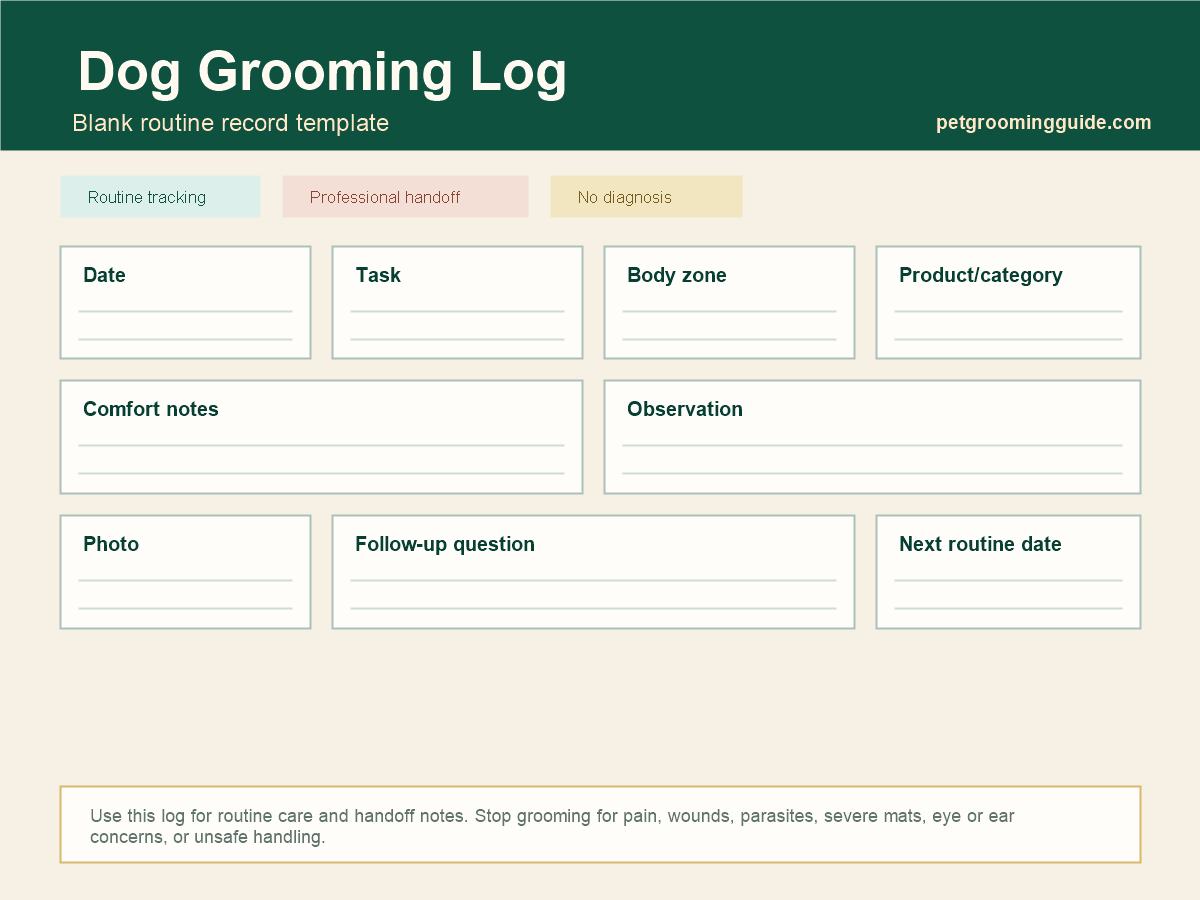
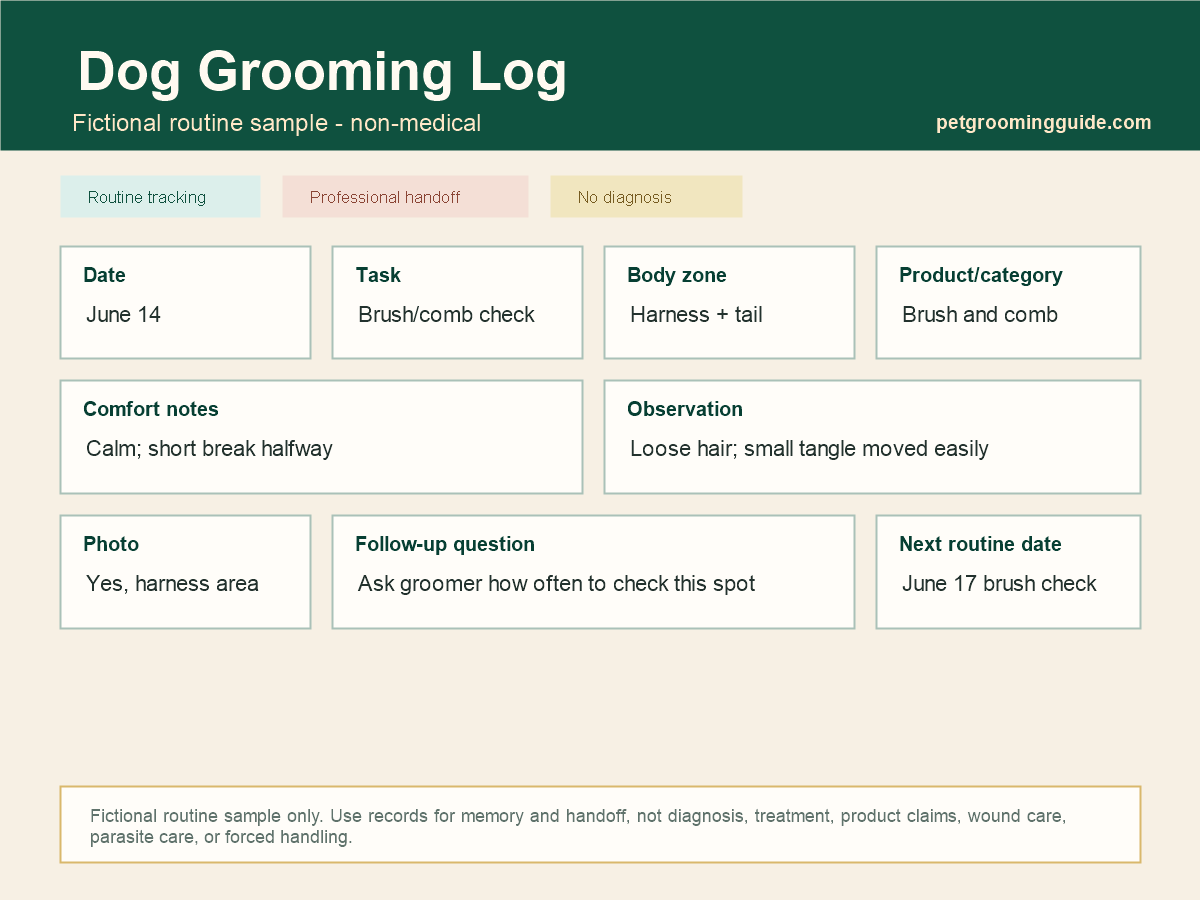
If you prefer a table you can rewrite into a notebook or notes app, use this expanded layout. Keep it to one page — a review that takes longer than fifteen minutes tends not to happen twice.
| Section | What to review | Quick scoring |
|---|---|---|
| Baths | How many, what shampoo, drying method, any residue or itch afterwards | Done / Partial / Skipped |
| Brushing & combing | Sessions per week, problem zones, tangles found, pressure and comfort | Done / Partial / Skipped |
| Nails | Trim or grind dates, quick length, any snags or splits | Done / Partial / Skipped |
| Paws & pads | Grit, debris between toes, pad dryness, hair between pads | Done / Partial / Skipped |
| Face, beard & muzzle | Wiping after meals and water, staining, odour, crusting | Done / Partial / Skipped |
| Ears (external flap only) | Drying after baths, rain, or water play; visible dirt on the flap | Done / Partial / Skipped |
| Drying | Towels used, drying time, damp spots left behind | Done / Partial / Skipped |
| Repeated skips | Which area, how many times, most likely reason | Access / Tolerance / Equipment / Timing |
| Photos & notes | Same-light pairs, what changed, what did not | Compare / Recheck / Ask |
| Next month | One or two changes only | Written down? Y/N |
| Pro or vet questions | Exact wording of the question you want answered | Booked? Y/N |
Plan Next Month
Choose one or two changes: a shorter nail session, a weekly coat check, a groomer appointment for mats, or a vet question about skin or pain.
Two is the ceiling for a reason. Change three or four things at once and you lose the ability to tell which one helped — the same problem researchers have with uncontrolled variables, just at kitchen-table scale. Make each change specific enough to be pass/fail at the next review: “trim two nails per evening on weekdays” is testable, “be better about nails” is not. Write the change where you will actually see it, and attach it to something you already do (after the evening meal, before the last walk) rather than to a time of day.
It also helps to name the trade-off out loud. Shorter sessions mean more of them. A professional groom for mats costs money but protects skin and your dog’s tolerance for handling. Bathing more often may reduce odour but can dry the coat if you do not adjust the product or the rinse. Honest trade-offs make the plan survive contact with a busy month.
Seasonal and Coat-Change Notes
Monthly reviews are where seasonal shifts become visible, because they are too gradual to notice day to day. Heading into spring and autumn, double-coated dogs shed undercoat in volume and brushing time can double for six to eight weeks. In winter, indoor heating dries skin and coat, and salt or grit from treated pavements makes paw checks non-negotiable. In summer, water play, sprinklers, and swimming leave ear flaps and beards damp far more often than owners expect.
Add a single line to each review noting the season’s dominant issue — “shedding heavy, brushing 4x/week”, “salt on pavements, rinsing paws nightly”, “sprinkler season, ear flaps damp”. Over a year, those lines become the most useful part of the log, because they let you anticipate next year’s workload instead of reacting to it. If your dog swims or plays in water, drying routines such as towel work on the ear flaps should move up the checklist for those months and back down again when the weather changes.
Coat Type Changes What You Review
The checklist stays the same; the weighting does not. Use this as a starting point and adjust to your own dog rather than the breed label.
| Coat type | Typical examples | Review priority | Watch for |
|---|---|---|---|
| Short, smooth | Beagle, Boxer, Staffordshire | Bathing frequency, skin, nails | Dry skin from over-bathing, long nails hidden by dark coat |
| Double coat | Husky, German Shepherd, Corgi | Undercoat removal, seasonal shedding | Packed undercoat, hot spots, over-clipping |
| Long silky | Yorkshire Terrier, Maltese, Shih Tzu | Daily combing, face and eye area | Mats behind ears and armpits, staining |
| Curly / wool | Poodle, Bichon, many doodle crosses | Line brushing to the skin, professional trims | Surface-only brushing hiding mats underneath |
| Wire | Schnauzer, many terriers | Beard and furnishings, hand-stripping schedule | Food and water build-up in beard, texture loss from clipping |
| Hairless / sparse | Chinese Crested, Xolo | Skin cleaning, sun and cold protection | Blackheads, dryness, sunburn |
Bearded and moustached breeds deserve their own line in the review because the muzzle is wet or soiled several times a day. If odour keeps appearing in your notes, working through a structured check for muzzle odour usually identifies whether the cause is food residue, trapped moisture, or something that belongs in a veterinary conversation.
Review Your Tools, Not Just Your Dog
Half the “skipped” entries in a typical log are equipment problems in disguise. Once a month, spend five minutes on the kit itself:
- Brushes and combs — pull out trapped hair, check for bent or missing pins, and replace slicker brushes whose pins have splayed or lost their protective tips.
- Nail clippers and grinders — dull blades crush rather than cut, which is the single most common reason a dog starts objecting to nail work. Test on a thick offcut or replace if the cut feels crushing.
- Towels and cloths — a damp towel does not dry anything. Owners who use a colour-coded cloth system for face, paws, and body tend to have far fewer cross-use problems and cleaner face routines.
- Shampoo and conditioner — check expiry dates, separation, and whether the product still suits the current season and coat condition.
- Clipper blades — blades that get hot quickly are usually dull or need oiling; heat is a burn risk on thin-skinned areas.
- Lighting — a cheap clip-on lamp solves more “I couldn’t see it” skips than any grooming product.
Restocking one worn item a month is cheaper and far less disruptive than replacing everything at once. If a single tool keeps showing up as the reason a task got skipped, replace that one item this week — it will do more for next month’s checklist than any new routine.
How Long the Review Should Take
Fifteen minutes, once a month, on a fixed date — the first Sunday, payday, or the day you refill flea and tick prevention. Longer reviews get postponed, and postponed reviews become annual ones. A workable sequence:
- Minutes 1–4: fill in what actually happened, using photos and calendar entries rather than memory.
- Minutes 5–7: circle repeated skips and label the reason (access, tolerance, equipment, timing).
- Minutes 8–11: compare same-light photo pairs and write questions, not conclusions.
- Minutes 12–13: choose one or two changes for next month and write them where you will see them.
- Minutes 14–15: book anything that needs booking — groomer, vet, or nail appointment — before you close the notebook.
The last step matters most. A question written down and never asked is just a worry with a date on it.
Turning Notes Into Better Professional Conversations
Groomers and veterinarians work from patterns, and a monthly log gives them one. Instead of “his skin has been bad”, you can offer “itching on the flank started about three weeks ago, worse after baths, no change to food, photos from the 4th and the 25th in the same window light”. That is a far better starting point for an exam, and it saves appointment time.
Bring three things: a short timeline, two or three comparable photos, and your specific question. Professional bodies such as the American Veterinary Medical Association publish general owner guidance on routine care and on when signs warrant an exam, and many university veterinary extension programmes offer plain-language pet care resources — both are better reference points than a search-engine self-diagnosis. Use them to frame questions, not to replace the visit.
For groomers specifically, note what your dog tolerated and what it did not. Telling a groomer that back-paw handling triggers withdrawal lets them plan the session differently, which is safer for everyone and usually produces a better finish. If nails have been snagging on rugs or carpet, mentioning that pattern of nails catching on carpet helps them judge length and shape rather than guessing.
Common Mistakes in Monthly Reviews
- Reviewing the plan instead of the month. Score what happened, not what you intended.
- Diagnosing from photos. A log identifies change; only an exam identifies cause.
- Changing everything at once. Two changes maximum, or you learn nothing.
- Only logging problems. Record what went well — it tells you which habits to protect when the month gets busy.
- Letting the log get long. If the worksheet grows past one page, it will be abandoned by month four.
- Skipping the areas you dislike. Whatever you avoid most is usually the entry that matters most. Between-the-toes checks are the classic example; a quick look at the gaps between toes after grass walks stops small debris becoming a painful, brushing-averse dog.
- Not dating photos or notes. Undated evidence is nearly useless in a veterinary conversation.
Safe Limits For This Page
Monthly review may identify patterns, not causes. Do not use it for medical interpretation, treatment planning, allergy conclusions, parasite treatment, or behavior therapy. Call a veterinarian for worsening skin, wounds, pain, sudden hair loss, limping, or repeated distress. Call a groomer for severe mats or coat work you cannot manage safely. Call a qualified trainer or behavior professional for repeated handling fear or bite risk.
To be explicit about escalation timing: anything that is worsening week over week, anything that is clearly painful, and anything involving broken skin, discharge, foul odour, or a dog that will no longer let you touch a body part it previously accepted, belongs in a professional’s hands now rather than at the next monthly review. A review is a scheduling tool, not a waiting period.
FAQ
What if I did not keep notes all month?
Review what you remember and start tracking more consistently going forward. Even a partial review can reveal a pattern.
Should I change my routine every month?
Not necessarily. Some months the review may confirm the current routine is working fine.
Can this review replace a vet visit?
No. It is a way to organize your own observations and prepare better questions for a professional.
Frequently Asked Questions
How detailed should a monthly grooming log be?
One page, at most. The goal is a pattern you can see at a glance, not a clinical record. Date, task, done/partial/skipped, and a short note is enough for the vast majority of dogs. Detail becomes valuable only in the specific area you are currently watching — if that is the muzzle, a focused record such as a running face-hygiene photo record is worth keeping alongside the main sheet while the issue is active, then retired once things settle.
Paper notebook or an app?
Whichever one you will actually open. Paper wins on speed and on not being interrupted by notifications; apps win on photo storage and automatic date-stamping. A practical hybrid that works well: photos in a dedicated album on your phone (so they carry timestamps automatically) and the one-page worksheet on paper. Avoid systems that require more than about thirty seconds to make an entry.
What should I do if the same problem appears three months running?
Stop adjusting your own routine and get eyes on it. Three consecutive months of the same finding — persistent staining, recurring mats in the same spot, ongoing odour, repeated flinching — is a pattern, and patterns are what professionals are good at interpreting. Bring the log, bring comparable photos, and ask directly whether what you are seeing is normal for the coat type or something that needs investigating.
Does a monthly review replace daily and weekly grooming habits?
No — it depends on them. The review is only as good as the small routines feeding it: wiping the face after meals, drying after water, checking paws after walks. A monthly session cannot undo four weeks of packed undercoat. Think of daily habits as the work and the review as quality control.
How does the review change for a puppy or a senior dog?
Puppies need the review weighted toward tolerance and handling: how many body parts they accept calmly, whether sessions are getting shorter and easier, and which areas still trigger wriggling. Senior dogs need it weighted toward comfort and change: standing tolerance, nail length (older dogs walk less and wear nails down less), lumps or texture changes you already know about, and stiffness during positioning. Both groups benefit from shorter, more frequent sessions than an adult dog in its prime.
Should I review before or after a professional groom?
Before, ideally by a few days. That way the review generates the questions and the notes you take with you, and the appointment answers them. Reviewing immediately after a groom can be misleading — everything looks and smells fine on day one, which is exactly when problem areas are hardest to spot.
What if my dog resists a specific step every single month?
Treat consistent resistance as information, not defiance. Rule out pain and equipment first — a dull clipper, a sore pad, a nail cut too short once — then reduce the step to a fraction of itself and rebuild tolerance from there. If resistance escalates into freezing, growling, snapping, or a bite risk, stop and involve a qualified trainer or veterinary behaviour professional rather than pushing through.
Do I need to review baths and drying separately?
Yes, and it is one of the most useful splits in the whole checklist. Plenty of grooming problems trace back to incomplete drying rather than bathing itself — damp skin under a thick coat, damp beards, damp ear flaps after rain or water play. Logging drying as its own line item makes those gaps visible. Habits like a consistent post-drink beard dry-off are the kind of small step that quietly prevents recurring odour and irritation.
What is worth keeping year over year?
Keep the seasonal summary lines, the dates of professional grooms, any veterinary findings related to skin, coat, ears, or nails, and a small set of reference photos taken in consistent light. Discard the day-to-day ticks — they have already done their job. A single page per year, kept in the same place as vaccination records, is enough to answer “was it like this last spring?” the following year.
Bottom Line
A monthly review is a calm reset. It shows what worked, what kept getting skipped, and what should be handled by a groomer, veterinarian, or behavior professional.
Set a recurring reminder for the same date each month, print or copy the worksheet table above, and run your first fifteen-minute review this week — the sooner you have two months to compare, the sooner the pattern becomes obvious.