
A dog face hygiene photo log helps you record routine grooming patterns around the muzzle, chin, beard, mouth corners, eye-adjacent fur, and facial folds without trying to diagnose a health problem. Use the log for repeatable before-and-after photos, simple cleaning notes, and clear stop reasons when something looks outside normal grooming.
Why a Photo Log Is Worth the Two Minutes
Memory is a poor grooming tool. Faces change slowly, and a beard that has gradually gone from cream to rust-tinged over eight weeks looks “normal” every single day if you only ever see it live. Side-by-side photos taken from the same angle turn a slow drift into something obvious.
In practice, the log earns its keep in three ways:
- It shows what your routine is actually achieving. If the after photo looks identical to the before photo week after week, your wipe technique, your drying step, or your timing needs adjusting — not more scrubbing.
- It gives a professional something concrete to look at. A groomer or veterinarian can tell far more from three consistent photos across a month than from “his chin seemed a bit off last Tuesday.”
- It keeps the routine honest. A dated line in a log is harder to skip than a vague intention, which is the same reason a broader session-by-session grooming diary helps owners stay consistent with baths, brushing, and nail trims.
The log is a documentation habit, not a diagnostic instrument. That distinction matters throughout everything below.
What to Track
Keep the log focused on normal grooming details: where routine debris collects, whether a gentle wipe or dry was completed, and which photo angle shows the area clearly. The goal is consistency, not a medical record.
Zone Routine note to record Photo angle
Muzzle sides Dirt, food smudge, or light moisture on outside fur Front and side
Chin Water-bowl wetness or normal drool Low front angle
Beard Meal crumbs or damp hair Front, beard lifted only if hair moves freely
Mouth corners Outside-only food or moisture Side angle, no inside-mouth photo
Eye-adjacent fur Fur around the eye, not the eye surface Side-lit photo that avoids touching the eye
Facial folds Dried after routine wipe or bath Fold area from outside only
Two extra fields make the log far more useful without turning it into a medical chart. First, note what happened before the session — a muddy walk, a swim, a wet-food meal, a play session at daycare — because context explains most day-to-day variation. A face that looks grubby the morning after a rainy hike is telling you about the hike, not about the dog. Owners who log environmental triggers alongside grooming often spot patterns quickly, which is the same logic behind a dedicated clean-up round once the trail dust settles.
Second, note how long the area stayed damp. Moisture retention around the chin, beard, and folds is the single most common cause of routine odor and staining in long-faced and heavy-coated dogs. “Wiped, towel-dried, dry to the touch in five minutes” is a genuinely useful entry; “cleaned face” is not.
Face Types That Need Different Notes
Not every muzzle collects the same things, and a one-size log will miss the details that matter for your dog:
- Brachycephalic / wrinkled faces (Pug, French Bulldog, Bulldog, Pekingese, Shar Pei): the note that matters most is dry, yes or no, after every wipe and every bath. Log the fold as a whole from the outside; do not photograph the depth of a fold by stretching skin.
- Bearded and moustached coats (Schnauzer, Wheaten, Poodle mixes, Airedale): log meal residue, water carry-over from the bowl, and whether the beard hair still separates freely. If a comb stops moving, that is a coat-management issue rather than a hygiene one — the difference between loose knots and true felting changes what you do next.
- Long-eared, low-slung faces (Basset, Cocker Spaniel, Bloodhound): note ear leather position in the photo, since dragging ears pick up whatever the muzzle just walked through.
- Tear-stain-prone light coats (Maltese, Bichon, Havanese, Shih Tzu): photograph the fur only, in the same light each time, and record the routine wipe. Managing the surrounding hair sits closer to tidying the corners of the eyes than to any treatment of the eye itself.
- Short, smooth muzzles (Beagle, Lab, Boxer): the log is short by design — usually a quick damp-cloth note and a monthly comparison photo.
Simple Photo Log Template
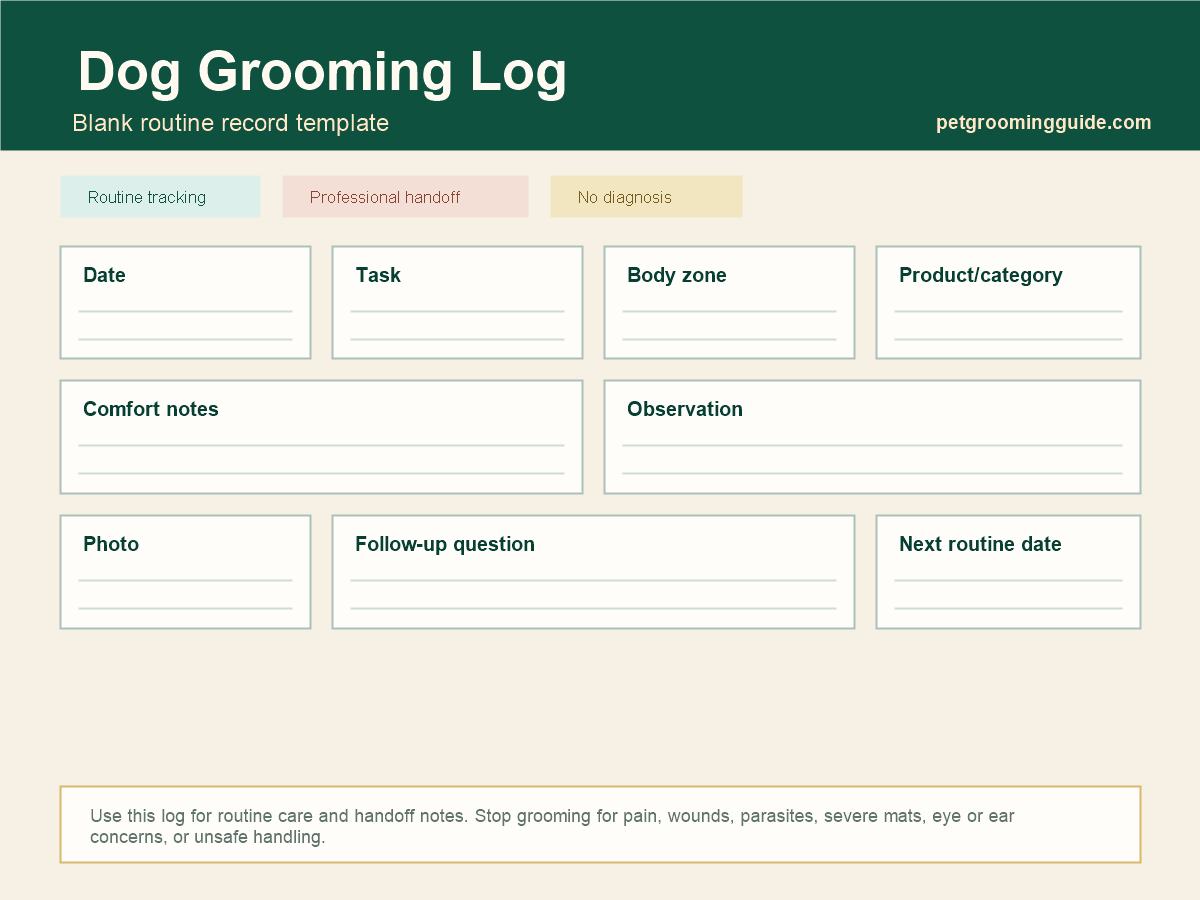
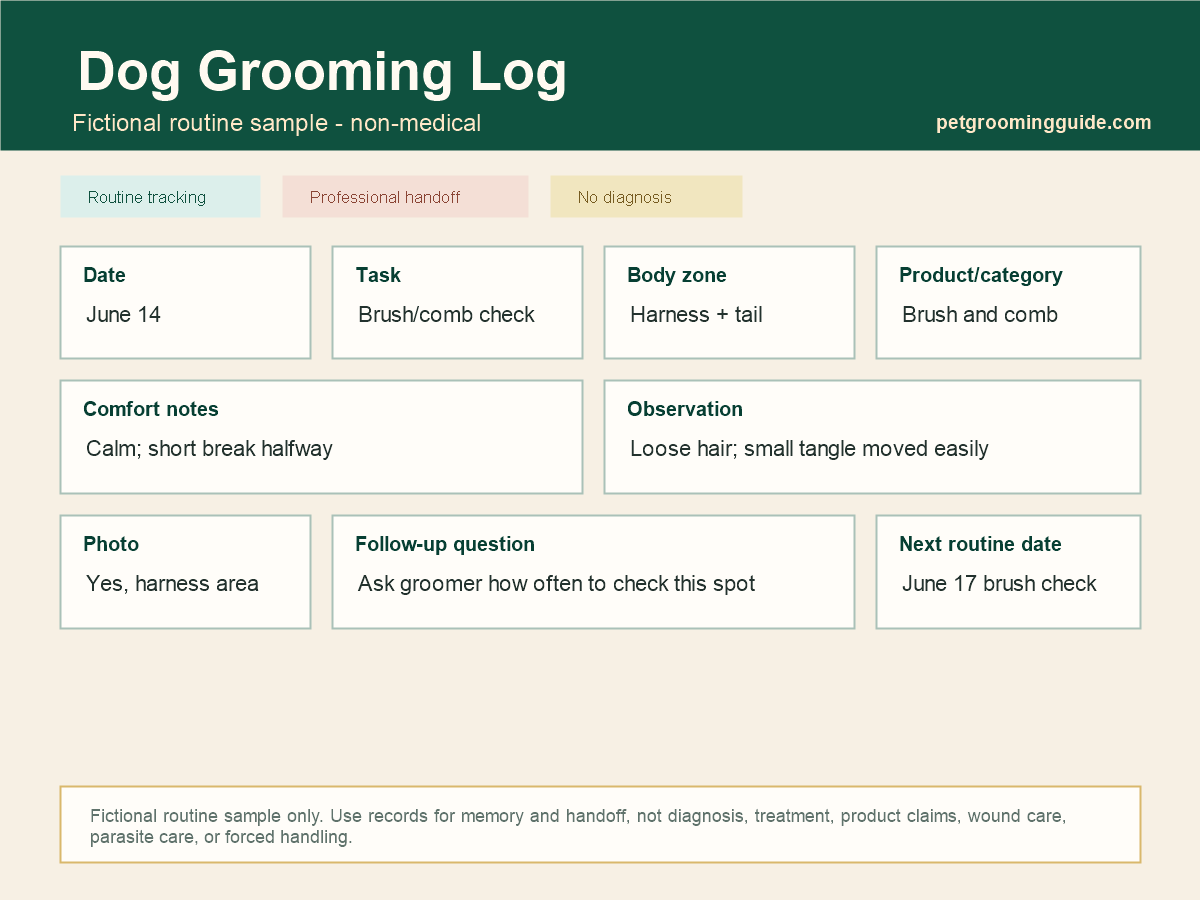
Use one line per grooming session, recording date, zone, before photo, routine action (wiped, dried, comb-checked, or left alone), after photo, and any stop reason such as redness, swelling, pain, bleeding, discharge, bad odor, skin change, behavior change, breathing trouble, or worsening.
A filled-in line should read almost boringly plain. That is the point:
2026-03-14 | Beard | before_0314.jpg | damp cloth, towel-dried, combed through | after_0314.jpg | no stop reason | context: wet-food dinner
2026-03-21 | Chin + folds | before_0321.jpg | rinsed after muddy walk, dried fully | after_0321.jpg | no stop reason | context: rain, park
2026-03-28 | Muzzle sides | before_0328.jpg | left alone, clean | — | STOP: odor + damp fur not clearing — booked vet
Notice that the last line stops describing and starts routing. Once “STOP” appears, the log’s job is finished; the next entry is a phone call, not a close-up. Keep the columns identical every week so you can scan a month at a glance, and keep photo filenames tied to the date so a file never becomes an orphan.
Choosing Your Format: Phone Album, Spreadsheet, or Notebook
Most people abandon a log because the format fights them. Pick the one that matches how you already behave:
| Format | Best for | Strengths | Trade-offs |
|---|---|---|---|
| Phone album + notes | Almost everyone starting out | Photos and notes live where you take them; zero setup | Notes drift apart from photos unless you name files carefully |
| Spreadsheet (cloud) | Multi-dog homes, shared households | Sortable, filterable, easy to share with a groomer or vet | Requires you to upload or link photos separately |
| Pet-care or grooming app | People who like reminders | Built-in dates, prompts, and photo attachments | You are dependent on the app staying available; export your data periodically |
| Paper notebook | Owners who hate screens mid-groom | Fastest to jot on with wet hands; nothing to sync | Photos live elsewhere; no search; easy to lose |
A hybrid works best for most households: photos in a single dated phone album named after the dog, one line of text per session in a notes app or cloud sheet, and a monthly reminder to skim the last four entries. Whatever you choose, back it up — a log that lives only on one phone is one dropped device away from nothing.
Set it up once this week: create the album, add the columns, and take a baseline photo of each face zone while everything looks normal. Baselines are what make every later comparison meaningful.
How to Take Routine Before-and-After Photos
Choose bright, indirect light and take the photo before any wiping. Keep the dog relaxed, keep the camera outside the face, and do not pull skin or hair for a clearer shot. After the routine wipe or dry, take the same angle again. Do not photograph inside the eye, nose, mouth, or ear canal, and do not use photos to interpret discharge, odor, swelling, or skin changes.
A few practical habits make the photos genuinely comparable rather than merely numerous:
- Fix your light source and stick to it. A north-facing window, an open doorway, or a consistent overhead lamp beats a different room each week. Mixed lighting is the number one reason a beard “looks worse” in one photo and fine in the next.
- Turn the flash off. Direct flash blows out white fur, exaggerates pink tones on pale skin, and makes normal damp fur look glossy and alarming.
- Stand at the same distance. Mark a spot on the floor or use the same grooming table position. Zooming with your feet keeps the perspective consistent; digital zoom does not.
- Include a neutral reference. A plain towel or mat of the same colour behind the head gives you a constant background and a rough colour reference for staining comparisons.
- Take three, keep one. Dogs move. Burst mode, then delete the blurry two immediately so the album stays scannable.
- Do not edit. No filters, no brightness boosts, no cropping past the face outline. Edited photos are useless for comparison and misleading if you ever hand them to a professional.
A common mistake is photographing only when something looks off. That leaves you with a folder of “bad days” and no baseline to measure them against. Take the routine photo on ordinary weeks too — those unremarkable images are the reference that gives every later photo its meaning.
How Often to Log
Frequency should follow coat and face type, not enthusiasm. As a starting point:
- Wrinkled or heavily folded faces: a written note after every wipe (often daily), with photos weekly.
- Beards and moustaches: a note after messy meals, with photos weekly.
- Drop-eared, long-muzzled dogs: photos every two weeks.
- Short, smooth muzzles: photos monthly, plus after anything unusual.
Always add an off-schedule entry after high-mess events — a swim, a rainstorm, a boarding stay, a roll in something regrettable. Those are the sessions that generate the most useful before-and-after pairs, and they slot neatly beside your other event-driven routines such as rinsing off pond or pool water or the clean-up that follows a boarding pickup. Anchoring your face-log cadence to a broader plan built around your dog’s coat type keeps the whole routine on one calendar instead of five.
Seasons shift the workload too. Wet months mean more chin and beard moisture and more mud in muzzle fur; hot months mean more drool, more water-bowl carry-over, and more panting-related dampness at the mouth corners. Expect your notes to get longer in spring and shorter in autumn, and don’t read that seasonal swing as a change in the dog.
Keeping the Dog Comfortable While You Photograph
The face is the most sensitive area you will handle, and a dog that dreads the camera will make every future photo harder to take. Work with short sessions, treats delivered after the photo rather than waved during it, and a hand placed under the chin instead of on top of the muzzle. Let the dog see and sniff the phone once, then keep it low and steady.
Watch for the early signals — lip licking, head turns, whale eye, a suddenly still body — and stop before they escalate. Recognising the small stress signals is more valuable than getting the shot, and the same gentle, break-friendly approach that works for dogs who resist the brush applies to face handling. Two calm photos a week beat a wrestling match every day.
Never restrain a dog to force a face photo, never pry a fold open, and never chase a squirming dog with a camera. If your dog cannot tolerate the photo, that itself is worth a line in the log and a conversation with your groomer.
What You Need on Hand
The kit is deliberately small, and everything should be soft, clean, and reserved for the face:
- Plain soft cloths or unscented, dog-safe wipes — one pass per cloth surface, never a re-used dirty corner
- Lukewarm water, or a product your veterinarian has specifically recommended for your dog
- A small, dry towel and, for folds, a dry cotton pad for blotting
- A fine comb for beards, used gently and only where hair moves freely
- Your phone, charged, with the album already open
Human face products, alcohol wipes, baby shampoo, and scented cleansers do not belong near a dog’s muzzle or eyes. If you are assembling supplies from scratch, a quick pass over the essentials worth owning will stop you buying three tools that do the same job.
Stop and Call a Vet or Pro
Stop photo logging as a grooming task if you see redness, swelling, pain, bleeding, discharge, bad odor, skin changes, breathing trouble, eating change, repeated distress, behavior change, or worsening symptoms.
When you stop, hand off cleanly rather than continuing to document. What a clinic actually finds useful is short and factual: the date you first noticed the change, what you have been doing routinely, what products have touched the area, whether eating or drinking has changed, and the two or three existing photos that show the progression. Do not arrive with forty images and no dates; arrive with three dated ones and a one-paragraph summary. Veterinary organisations such as the American Veterinary Medical Association and university teaching hospitals like Cornell’s College of Veterinary Medicine publish owner-facing guidance on when routine care ends and clinical care begins — the practical rule is that anything painful, spreading, bleeding, weeping, or smelling wrong is theirs, not yours.
One more honest trade-off: a photo log can make you over-observant. Staring at the same muzzle daily invites you to invent problems. The log’s value is comparison across weeks, not scrutiny across hours. If you find yourself photographing several times a day, dial the frequency back.
Common Mistakes to Avoid
- Changing the angle each session. Inconsistent framing destroys comparability faster than anything else.
- Photographing only after cleaning. The before shot is the informative one.
- Using the log to self-diagnose. Colour in a photo is not a finding; a phone camera shifts hue with light, white balance, and screen calibration.
- Pulling folds or lifting lips for a “better” view. This causes discomfort and can worsen irritated skin.
- Cleaning a wet face and calling it done. Damp fur is a routine problem in its own right — the drying step deserves as much attention as the wiping step, which is why proper moisture removal after washing matters more than most owners expect.
- Letting the log replace the routine. Documentation is not hygiene. If a week’s entries all say “left alone,” the routine itself has lapsed.
- Over-cleaning. Wiping a healthy face several times daily with harsh products strips oils and irritates skin. Many face problems owners create for themselves start here, in the same way that over-frequent or over-hot washing causes more coat trouble than it solves.
How the Face Log Fits the Rest of Your Routine
Face hygiene is one small block inside a larger session. Most owners get the best results by handling the face first, while the dog is dry, calm, and least fidgety, then moving on to brushing, bathing, and drying. Whether you comb before or after water changes the outcome, and the sequencing question of brushing first or washing first is worth settling before you build a log around it.
Pair the face log with the other quick post-outing checks you already do — a wipe-down of the feet and a fast run-through with the comb — and the whole thing takes under five minutes. If you are still assembling a home routine from scratch, a broader walkthrough of handling grooming yourself will show you where the face step naturally lands. Even a small setup works: apartment dwellers and owners without a usable tub can run a full face log with nothing more than a towel, a cloth, and a window.
FAQ
Is this log for diagnosing face problems?
No. It is only for routine grooming documentation. It should not be used to diagnose infection, eye problems, dental disease, skin-fold disease, wounds, or discharge.
Should I include close-up photos of irritated skin?
No. Record “stop” in the log and route the concern to a veterinarian or professional.
Can I clean around the eye for the photo?
Only routine fur around the eye belongs in this log. Do not touch, flush, wipe inside, or medicate the eye.
How long should I keep the photos?
Twelve months is a sensible rolling window. It covers a full seasonal cycle, which is long enough to see whether a change is weather-driven or genuinely new. Archive or delete anything older unless a professional has asked you to keep it.
What if my dog will not sit still for photos?
Shorten the session rather than restraining the dog. One zone per day, taken while the dog is already relaxed — after a walk, before a meal — beats a full-face session that ends badly. If refusal is new or the dog reacts when you approach a specific area, treat that as a stop reason and ask a professional.
Should I photograph in the same room every time?
Yes, if you can. Consistent light and background are what make two photos comparable. If you must move, note the location in the log so you know why the tone looks different.
Does the log replace professional grooming appointments?
No. It supplements them. Bringing a groomer three dated photos of how the beard or folds look between visits helps them adjust technique, trim length, or scheduling — but hands-on work, close clipping around the face, and anything clinical still belongs to a professional.
Can I use the same log for more than one dog?
Use one album and one set of rows per dog, even in the same file. Mixing dogs in a single stream makes comparison impossible and is the fastest way to attribute one dog’s change to another.
Is it normal for the beard or muzzle fur to change colour?
Fur around the mouth and eyes commonly picks up staining from saliva, food, and moisture, and it is one of the most-photographed things in these logs. Record it, do not treat it. Persistent colour change, especially with odor, dampness that will not clear, or any skin involvement, is a stop-and-call situation rather than a grooming project.
What should I do after a really messy outing?
Log it as an extra entry with context noted. Rinse or wipe only the outside fur, dry thoroughly, and photograph afterwards. Dried-on grime deserves patience rather than force — the soak-and-lift approach used for caked-on dirt works far better on a muzzle than scrubbing does.
Bottom Line
Use the log to notice routine grooming patterns over time, and treat anything that looks medical as a reason to stop and call a professional, not as something to document further.